













On this page

Supplier shortages hurt twice. I lose product first. Then I lose time, proof, and trust when I find the problem too late.
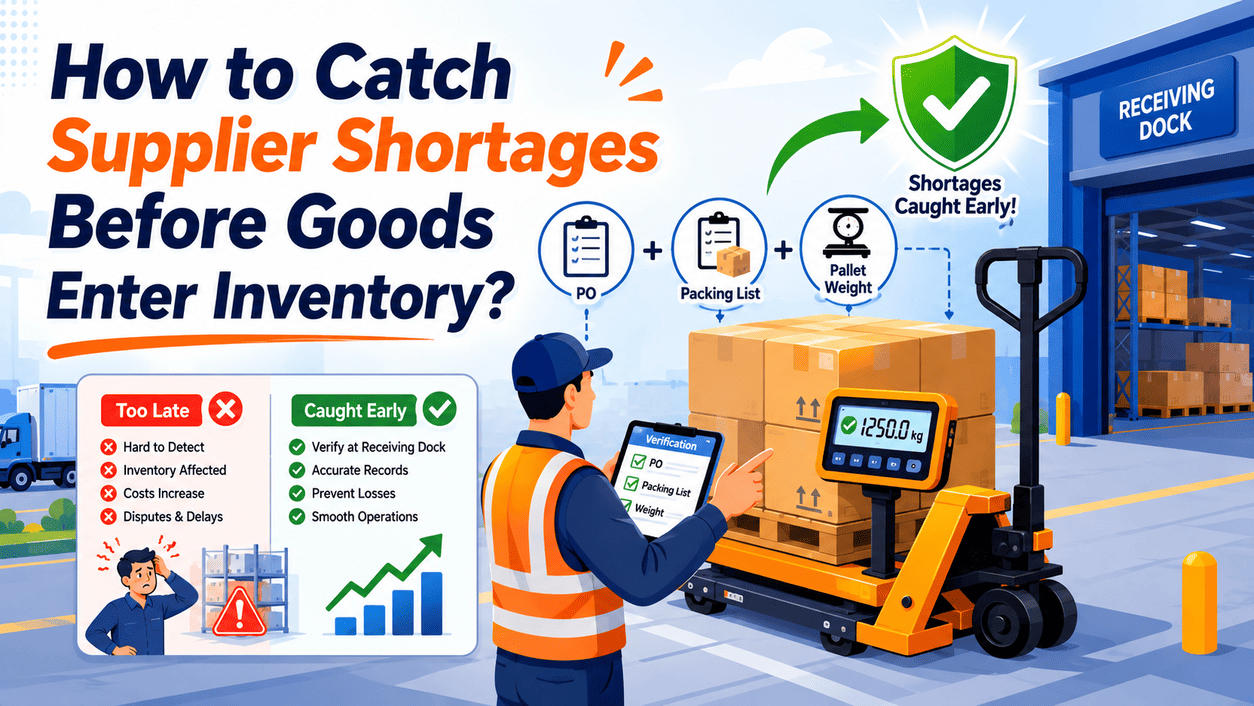
A pallet jack scale helps receiving teams catch supplier shortages at the dock by weighing pallets before inventory entry. It lets me compare actual pallet weight with purchase orders, packing lists, and supplier documents, so I can stop errors before goods are stored, split, or shipped again.

I have seen many warehouse problems start with one simple sentence: “We will check it later.” In receiving work, later is often too late. Once goods move past the dock, the original condition of the shipment starts to disappear. Pallets are broken down. Cartons are moved. Bags are stacked in different zones. Labels are replaced. Workers start picking from the stock. At that point, a shortage is no longer a clean receiving issue. It becomes a warehouse dispute.
That is why I like to move weight verification to the first physical touch point. A pallet jack scale does not ask the team to build a separate weighing station. It works where the goods already move. The operator unloads, moves, weighs, checks, and records in one flow. For many warehouses, this simple change makes supplier shortage control faster and easier.
Why Supplier Shortages Are Hard to Detect After Goods Enter the Warehouse?
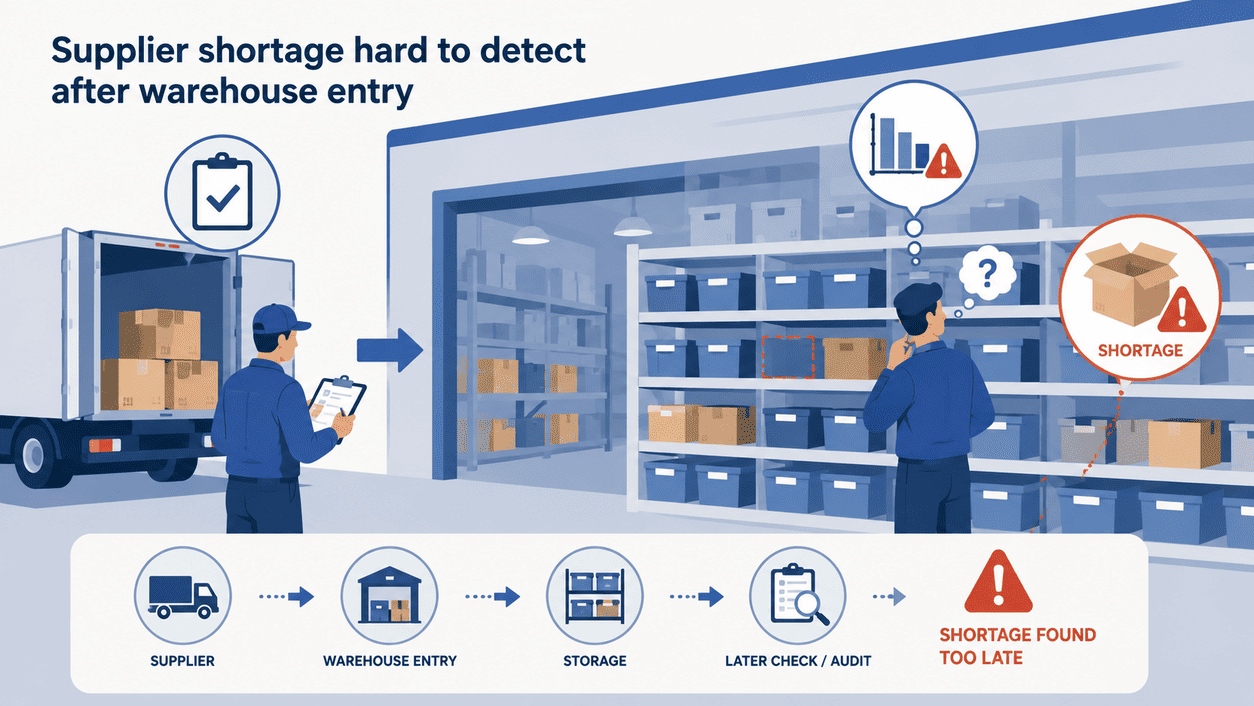
Supplier shortages are hard to detect after storage because the shipment loses its original form. Once pallets are opened, moved, mixed, or picked, I cannot easily prove what arrived from the supplier.
Supplier shortage claims need timing, records, and clear proof. I may know that the stock is short. But I also need to show when the shortage happened. Did the supplier ship less? Did the carrier damage or lose part of the load? Did my team miscount during receiving? Did stock disappear after it entered storage? Each question adds more work.
The real problem is not only missing weight
In my experience, the hardest part of supplier shortages is not the missing quantity itself. The hardest part is finding the shortage after the goods have already entered the warehouse. A full pallet may look normal from the outside. A few missing bags, cartons, or components may not be obvious. This is very common with bulk materials, food packaging, hardware parts, spare parts, and mixed cartons.
When the load is still at the dock, it has a clear identity. It is linked to one truck, one delivery note, one supplier, and one receiving time. After it enters storage, that identity becomes weaker. The team may split one pallet across different rack locations. They may combine similar items from different suppliers. They may remove stretch film and outer packaging. Then any later shortage check needs more people, more time, and more judgment.
| Stage | What I can prove | What becomes difficult |
|---|---|---|
| At receiving dock | Shipment condition, pallet count, gross weight | Very little, because the load is still intact |
| After put-away | Storage location and system entry | Original pallet weight and original package condition |
| After picking starts | Remaining stock quantity | Whether the shortage came from supplier, receiving, or warehouse operation |
| After mixed storage | Item location | Which supplier shipment caused the shortage |
I always tell customers that inventory accuracy starts before the goods enter inventory. If the first record is wrong, the whole system carries that error forward. A pallet jack scale gives me a practical way to test the shipment before that first record becomes official.
How Mobile Weighing Speeds Up Receiving Dock Verification?
Mobile weighing speeds up receiving because the operator can move and weigh the pallet with one tool. I do not need to send every pallet to a fixed floor scale.
A receiving dock is a busy place. Trucks wait. Drivers want signatures. Forklifts cross the area. Warehouse staff need to unload, check, label, and move goods quickly. If the weighing process creates another stop, workers may skip it when the dock becomes crowded.

I can verify weight during the natural movement of goods
A pallet jack scale fits the normal receiving motion. I place the forks under the pallet. I lift the load. I move it away from the truck. I read the weight. I compare the result with the receiving document. Then I decide whether the pallet should enter inventory or move to a hold area. The weighing action does not feel like a separate job. It becomes part of unloading.
This matters because receiving teams are judged by speed and accuracy at the same time. Manual counting may work for small cartons. But it becomes slow when goods are stacked, wrapped, or shipped in full pallets. Many warehouses handle bagged raw materials, paper cartons, food ingredients, hardware items, and export packages. Counting each unit may take too long. Weight checking gives the team a fast first screen. It does not replace every detailed inspection. It tells me where to look.
| Receiving method | Speed | Best use | Weak point |
|---|---|---|---|
| Manual counting | Slow to medium | Small orders, visible units | Labor heavy on full pallets |
| Fixed floor scale | Medium | Controlled weighing zone | Pallets must travel to the scale |
| Pallet jack scale | Fast | Dock verification and mobile checks | Needs good tare practice |
| Random inspection only | Fast | Low-risk suppliers | May miss hidden shortages |
I like mobile weighing because it reduces excuses. The scale is not across the warehouse. The operator does not need to wait for another team. The weight is captured while the load is still fresh from the truck. This gives warehouse managers and purchasing teams a better chance to solve problems while the supplier and carrier documents still match the physical shipment.
Matching Pallet Weight Records with Purchase Orders and Packing Lists?
Matching pallet weight records with purchase orders and packing lists helps me confirm whether the delivered goods match the expected shipment before I accept them into stock.
A pallet weight alone is just a number. It becomes useful when I connect it to the purchase order, packing list, supplier delivery note, item code, pallet ID, and receiving time. This is where a pallet jack scale can support a better receiving process, not only a weighing process.
I need a clear comparison before I sign off
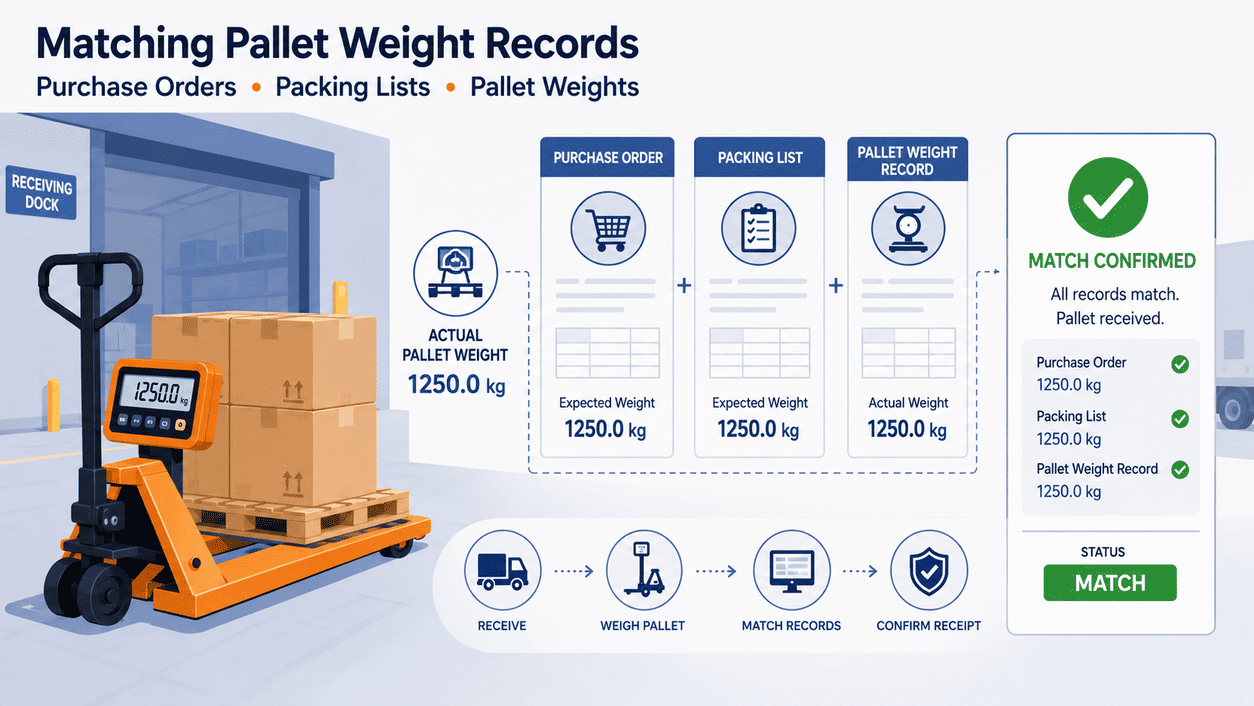
When I receive goods, I want to compare three things. First, I check what I ordered. Second, I check what the supplier says they shipped. Third, I check what actually arrived. If these three records do not agree, I need to stop and review the shipment before it enters inventory.
Weight records make this comparison more objective. For example, if one pallet of bagged material should contain 40 bags at 25 kg each, the net product weight should be close to 1,000 kg. I still need to account for pallet weight, wrapping, and packaging. But if the measured weight is far below the expected range, I have a strong signal that something is wrong. I can then inspect the pallet, count the bags, take photos, and report the issue while the shipment is still in the receiving area.
| Record | What it tells me | How weight helps |
|---|---|---|
| Purchase order | What I expected to buy | Gives the target quantity |
| Packing list | What the supplier says was packed | Gives pallet-level or carton-level detail |
| Delivery note | What arrived with the truck | Supports claim and receiving signature |
| Pallet jack scale record | What I actually measured | Gives physical proof at the dock |
| Inventory entry | What enters the warehouse system | Should only happen after checking |
I suggest that customers create a simple receiving rule. No questionable pallet should enter normal stock before the weight record is checked. The team can mark it as “hold,” “shortage review,” or “pending supplier confirmation.” This keeps uncertain goods away from normal inventory. It also makes communication with suppliers much cleaner because I can show the date, pallet ID, measured weight, and related documents.
What Features Matter: Printer, Tare Function, Fork Size and Data Output?
The most important pallet jack scale features are printer, tare function, correct fork size, and data output. These features decide whether weighing results are easy to use, record, and trust.
A pallet jack scale is not only a pallet mover with a display. It is part of the receiving control system. If the wrong features are chosen, the scale may still weigh goods, but the team may not use the data well. For commercial or legal-for-trade applications, local rules for weighing and measuring devices and legal metrology should also be checked.

Good features make the receiving record stronger
The tare function is one feature that many buyers underestimate. Different pallets, returnable boxes, and packaging materials do not weigh the same. If I ignore tare weight, I may accuse a supplier of shortage when the real issue is a heavy pallet type or extra packaging. I may also miss a real shortage when the packaging is lighter than expected. That is why I recommend a standard tare process. A warehouse can build a common pallet tare table. It can include wooden pallets, plastic pallets, export pallets, cages, bins, and common packaging sets. The operator can apply the correct tare before judging the net product weight.
A printer is also useful when the team needs fast proof. A printed weight ticket can travel with the receiving documents. It can show weight, time, date, and sometimes operator or item information. This helps purchasing, warehouse, and finance teams speak from the same record. Data output is important when the company wants digital receiving. RS232, USB, Bluetooth, Wi-Fi, or other data connections can send weight records to a computer, printer, ERP system, or warehouse management system.
| Feature | Why it matters | What I check before buying |
|---|---|---|
| Tare function | Removes pallet and container weight | Can the operator tare quickly and safely? |
| Printer | Creates on-site proof | Does the ticket show date, time, and weight? |
| Fork size | Fits real pallet dimensions | Does it match local and export pallets? |
| Capacity | Handles full pallet weight | Is there enough safety margin? |
| Accuracy | Supports fair receiving decisions | Is the division suitable for the goods? |
| Data output | Reduces manual entry | Can it connect with current systems? |
| Battery | Keeps dock work moving | Is charging simple for daily use? |
Fork size should match the actual pallets used in the warehouse. A scale that does not fit the pallet will slow down work and create safety risks. Capacity also needs careful selection. A warehouse should not choose capacity only by average pallet weight. It should consider the heaviest expected load, packaging, and safe operating margin. I prefer to choose a scale that fits the real receiving environment, not only the catalog number.
Conclusion
A pallet jack scale helps me catch shortages early, protect inventory accuracy, and turn receiving weight into clear proof before goods enter the warehouse.