













On this page

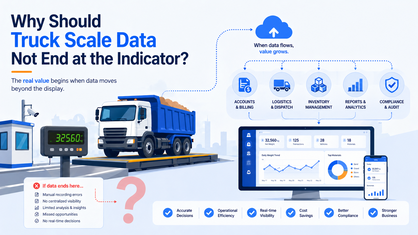
Most truck scales stop at printing a ticket. But that ticket holds only one number. Real value starts when weight data feeds your business decisions, not just your gate.
Truck scale data should not end at the indicator because a single weight number cannot improve operations. When you capture vehicle ID, tare, net weight, time, material, and driver into a structured system, you turn raw readings into insights for purchasing, dispatch, inventory, and finance teams.
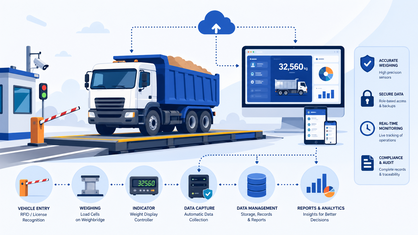
I have seen many clients buy expensive weighbridges, then use them like a paper scale. The hardware is accurate. The data pipeline is empty. Let me walk you through how I think about this, based on years of field work with truck scales.
From Weight Ticket to Business Record: What Data Should a Truck Scale Capture?
A weight ticket with just gross, tare, and net is not enough. You lose context the moment the truck leaves the yard.
A modern weighbridge should capture at least eight data fields: vehicle ID, driver ID, supplier or customer code, material code, gross weight, tare weight, net weight, and timestamp1. This structure turns each weighing into a searchable business record you can analyze later.
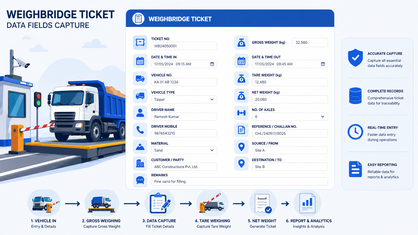
Why a richer record matters
When I install a truck scale for a client, I always ask: "What questions do you want to answer six months from now?" If the answer is "how much did we ship," a basic indicator works. If the answer is "which supplier sends underweight loads on Fridays," you need structured data.
Minimum data fields I recommend
| Field | Purpose | Team that uses it |
|---|---|---|
| Vehicle ID | Track truck behavior | Dispatch |
| Driver ID | Monitor routines | HR, Safety |
| Material code | Match to SKU | Inventory |
| Supplier/Customer code | Link to contracts | Purchasing, Sales |
| Timestamp | Find time patterns | Operations |
| Tare / Gross / Net | Core weight record | Finance, Compliance |
Without these links, a scale is just a ruler. With them, it becomes a data source.
Why Do Net Weight, Tare, Timestamp, Vehicle ID, and Material Code Matter?
Many operators treat these fields as paperwork. They are not. They are the difference between noise and signal in your daily reports.
Each field answers a different business question. Net weight answers "how much." Tare answers "is this truck clean." Timestamp answers "when do losses happen." Vehicle ID answers "who is behaving oddly." Material code connects weight to value. Together, they build a full picture.
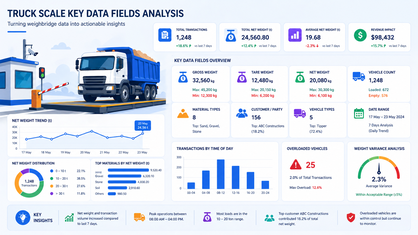
A real example from a sand and gravel plant
One client of mine weighed 300 trucks a day. The owner only looked at the daily total. After we tied plate number, material, customer, and time into each record, a pattern appeared. Tare weights in the afternoon shifted more than in the morning. At first, he blamed the load cells. We checked them. They were fine.
The real cause
The issue was residual material in truck beds. Afternoon drivers skipped cleaning before re-entering. No load cell upgrade could fix that. Only structured data exposed it.
| Field missing | Problem you cannot detect |
|---|---|
| No vehicle ID | Repeat offenders hide |
| No timestamp | Shift-based losses hide |
| No material code | Product-level loss hides |
| No tare history | Cleaning issues hide |
How Does Truck Scale Data Connect Purchasing, Inventory, and Dispatch Teams?
Weight data usually sits with the gate staff. Other teams never see it in time. That delay costs money every week.
When truck scale data flows into a shared system, purchasing sees supplier variance, inventory sees real stock movement, and dispatch sees truck turnaround time. One weighing event feeds three decisions, instead of ending as a paper slip in a folder.
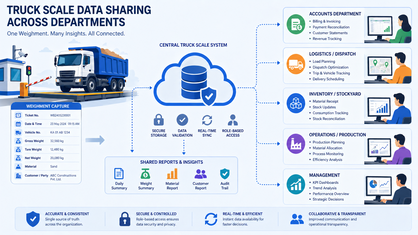
How each team uses the same data
Purchasing wants to know if a supplier ships short. If five trucks from the same supplier come in 1.5% under the invoice, that is a contract issue. Inventory wants to match weighed-in tons to system stock, so month-end counts do not drift. Dispatch wants to know average time on the scale, to plan truck arrivals and cut queues.
Data flow I suggest
| Source | Destination | Decision |
|---|---|---|
| Weighbridge indicator | ERP / inventory | Stock update |
| Weighbridge indicator | Purchasing dashboard | Supplier scoring |
| Weighbridge indicator | Dispatch board | Queue control |
One truck, one weighing, three departments benefit. That is the point.
What Should Buyers Ask Before Choosing a Data-Ready Weighbridge System?
Many buyers ask about capacity and accuracy first. Those matter, but they are not the hard part. The hard part is whether the system can talk to your software.
Before buying, ask four questions: Does the indicator support Modbus, RS485, or TCP/IP output2? Can the software export structured data to ERP? Does it support remote monitoring? Can it link photos, RFID, or license plate recognition to each record? If the answer is no, the scale is half-built.
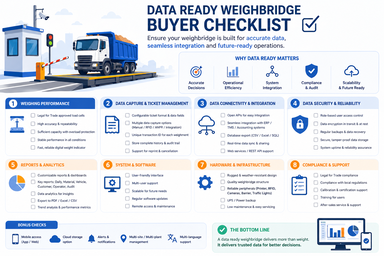
A checklist I give every buyer
| Question | Why it matters |
|---|---|
| API or database access? | ERP integration |
| RFID / ANPR ready? | Driver-free weighing |
| Cloud backup? | Audit and recovery |
| Multi-user roles? | Fraud control |
| Report templates? | Daily operations |
My honest advice
A truck scale is not just heavy equipment. It is the data entry point for your whole logistics chain. Spend a little more on the data side. It pays back faster than any steel upgrade. I have told this to every buyer I work with, and the ones who listened saw results within months.
Conclusion
A truck scale should not stop at the indicator. Structured data turns weighing into decisions, cutting loss and sharpening every team's work.