













On this page

Floor scales for pallets can create costly handling problems when buyers select them from a short specification sheet. An underestimated load can cause overload risk, while an oversized platform or poorly placed ramp can waste space and slow operators. I recommend reconstructing the complete weighing movement before comparing models, prices, or suppliers.
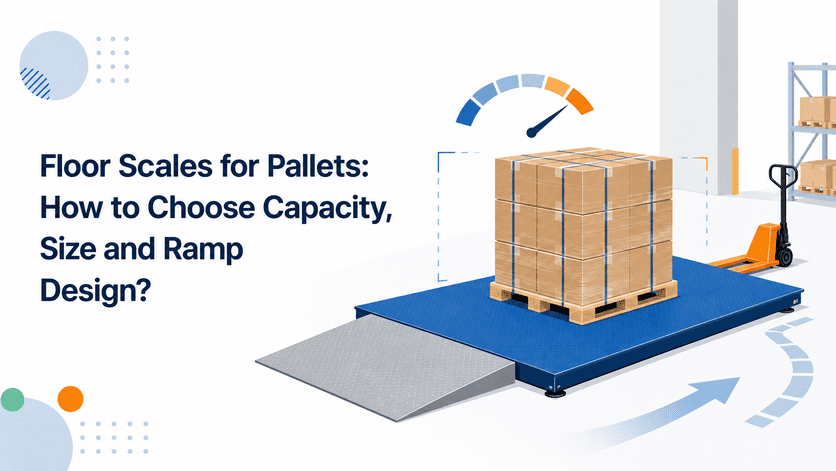
Floor scales for pallets should be selected by evaluating the heaviest complete load, pallet dimensions, placement tolerance, handling equipment, and travel path together. I recommend choosing capacity for the maximum applied load, sizing the platform for practical positioning, and adding ramps only when the actual movement method requires them.

I usually open a pallet scale discussion with three questions: What is the heaviest complete load? What are the pallet dimensions and positioning tolerance? How will the pallet enter and leave? These questions reveal requirements that a nominal capacity or pallet footprint alone cannot show.
How Should I Choose the Capacity of Floor Scales for Pallets?
An average product weight does not define the required scale capacity. A heavy shipment, pallet tare, container, fixture, or handling device may increase the load applied to the platform. However, I also avoid choosing the largest available capacity automatically because unnecessary capacity can affect resolution, configuration options, and procurement cost.
I select capacity from the maximum real load that the scale will receive, not from the average product weight. I include the pallet and any handling equipment that remains supported by the scale. I then compare the required capacity with the scale division, overload protection, platform structure, and verified operating limits.
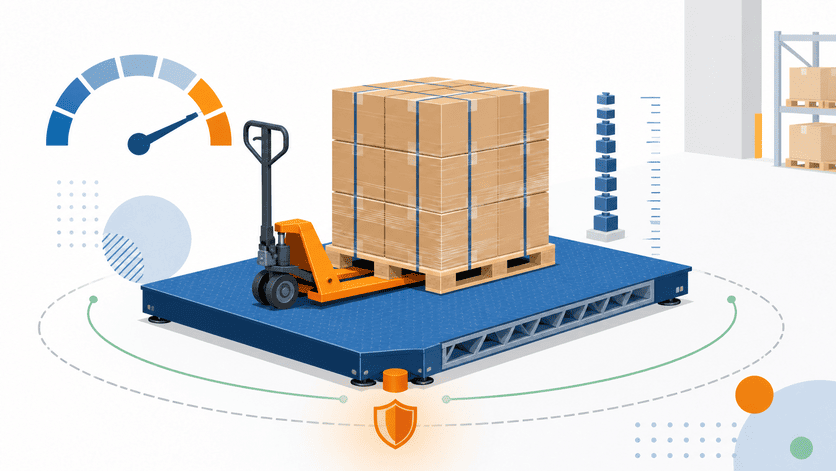
I Start With the Complete Applied Load
I ask buyers to separate the total load into clear components:
- Maximum product weight
- Pallet or container tare weight
- Fixtures, bins, cages, or packaging
- Handling equipment supported by the platform
- Possible load variation between normal and exceptional batches
I once worked with a customer who initially provided only the product weight. After I asked how the goods were packaged and moved, the customer identified a pallet and handling arrangement that had not appeared in the original inquiry. I did not treat that exchange as proof of a performance outcome. Instead, I used it to show why requirement clarification must happen before product selection.
The handling equipment question needs careful attention. A forklift commonly places a pallet on the platform and then withdraws, so the forklift itself does not normally form part of the static weighing load. A pallet truck may behave differently.1 Its wheels, forks, or operator movement may place additional forces on the scale or ramp, depending on the platform dimensions and movement method.
I recommend giving the supplier a simple movement description instead of writing only “pallet truck use.” For example:
I will lift the pallet with a hand pallet truck, push it up the entrance ramp, place it fully on the platform, lower the pallet, withdraw the truck, record the weight, and reverse the movement to exit.
That description helps the supplier identify which loads act on the platform and whether the pallet truck can be removed before weighing.
I Balance Capacity Against Usable Resolution
A higher capacity does not automatically create a better pallet scale.2 When buyers select far more capacity than the operation requires, they may receive a coarser display increment or pay for a structure that provides no operational benefit. The relationship varies by load cell, indicator, approval status, and manufacturer configuration, so I ask suppliers to confirm product-specific figures.
| Procurement question | Why I ask it | Evidence I request |
|---|---|---|
| What is the rated capacity? | I need to confirm the normal operating range. | Datasheet and model designation |
| What is the displayed division? | I need to judge whether readings are useful for the process. | Indicator specification |
| What is the minimum practical or approved load? | I need to avoid assuming that every displayed value is suitable. | Verification documents or technical guidance |
| What overload protection applies? | I need to understand protection limits without treating them as working capacity. | Manufacturer documentation |
| Is legal-for-trade use1 required? | I need to separate process weighing from commercial transactions. | Applicable local approval documents |
HENER states that its industrial weighing systems can be configured for high accuracy and that static weighing error can be controlled to specified levels in suitable configurations. I advise buyers to treat those statements as configuration-dependent supplier claims. Buyers should verify the model, capacity, division, calibration method, operating environment, and relevant certification documents before placing an order.
How Large Should Floor Scales for Pallets Be?
A platform that matches the nominal pallet footprint can still be difficult to use. Operators rarely place every pallet with perfect alignment, especially when columns, racks, doors, traffic routes, or turning limits affect their approach. A platform that leaves no positioning tolerance may cause repeated corrections and off-center loading.
I size floor scales for pallets around the pallet footprint, pallet construction, entry direction, and realistic placement tolerance. I expect the full load to sit within the intended weighing area without contacting the floor or nearby objects. I also check whether operators can approach, position, lower, and remove the load safely.

I Look Beyond Nominal Pallet Dimensions
The pallet length and width provide a starting point, but they do not complete the specification. I also ask:
- Does the site use one pallet standard or several pallet sizes?
- Do loads overhang the pallet?
- Does the pallet have runners, feet, or damaged boards?
- Can the operator approach from only one direction?
- Will the pallet truck remain partly on the platform?
- How accurately can operators position the load?
- Could the pallet touch a wall, guardrail, rack, or ramp edge?
- Does the area need barriers or guides that could interfere with weighing?
I pay particular attention to load isolation. The pallet and its contents should not bridge between the live weighing platform and a fixed surface. A stretched wrapping film, leaning product, connected hose, or pallet edge touching nearby equipment can create an external force path4. That contact may affect repeatability even when the scale itself is functioning correctly.
I Treat Placement Tolerance as an Operating Requirement
I do not prescribe one universal clearance around every pallet. A skilled forklift operator working in an open bay may need a different allowance from an employee using a hand pallet truck in a narrow production aisle. The correct tolerance depends on turning radius, visibility, load stability, traffic direction, and platform edge design.
I recommend mapping the operation with a simple table before selecting dimensions:
| Site condition | Possible design implication |
|---|---|
| One pallet size with a straight approach | I may consider a closely matched platform with verified clearance. |
| Several pallet formats | I may select dimensions around the largest realistic footprint. |
| Loads with regular overhang | I include the actual load envelope, not just the pallet deck. |
| Restricted turning area | I assess approach angle before increasing platform size. |
| Frequent off-center placement | I verify corner adjustment, load cell arrangement, and usable deck area. |
| Washdown or corrosive exposure | I compare deck material, sealing, drainage, and cleaning access. |
A larger platform can improve positioning tolerance, but it can also increase weight, price, ramp length, floor-space use, and shipping cost. It may also change the frame and load-cell configuration. I therefore select platform dimensions as part of the complete system rather than treating extra deck area as free insurance.
I ask the supplier for a dimensional drawing that shows the live platform, frame, cable exit, feet, ramp interface, and overall footprint. I also compare those dimensions with the site layout. A nominal deck size alone may not reveal how much installation space the complete floor scale occupies.
When Do Floor Scales for Pallets Need a Ramp?
Buyers sometimes add a ramp because the scale will sit above the floor. That assumption can create unnecessary cost or obstruct a traffic route. A forklift may place the pallet directly onto the platform, while a pallet truck usually needs a suitable transition. I determine the movement method before specifying any ramp.
Floor scales for pallets need ramps when wheeled handling equipment must travel onto or across an above-floor platform. I do not normally specify a ramp when a forklift deposits the pallet without driving onto the scale. I confirm the entrance, exit, turning space, wheel loads, ramp gradient, surface, and anchoring requirements.

I Define the Complete Travel Path
I once received an inquiry in which the customer had already requested a ramp. I asked whether the operator used a forklift or a pallet truck and whether the pallet needed to cross the scale. The discussion showed that the original ramp assumption needed reconsideration. I did not claim that one arrangement was universally superior; I clarified the movement before discussing accessories.
I use the following questions:
- How does the pallet approach the weighing area?
- Which equipment moves it?
- Does the equipment travel onto the platform?
- Does the pallet leave in the same direction or continue forward?
- Where does the operator stand?
- Could a ramp project into a doorway, aisle, or emergency route?
- Can the floor support anchors and concentrated wheel loads?
- Will water, dust, product, or debris collect around the ramp?
The answers usually point toward one of several configurations.
| Movement pattern | Configuration to evaluate |
|---|---|
| Forklift places and removes the pallet | I evaluate a platform without a ramp. |
| Pallet truck enters and reverses out | I evaluate a single-ramp arrangement. |
| Pallet truck passes straight through | I evaluate opposing entrance and exit ramps. |
| Traffic changes direction on the scale | I assess whether the platform and surrounding space support the turn. |
| Floor excavation is acceptable | I compare a pit-mounted platform with an above-floor ramp system. |
I Evaluate More Than Ramp Quantity
Ramp design affects the entire installation. A gentler transition generally requires more horizontal space, while a short ramp may create more effort or clearance concerns for some handling equipment.5 I do not publish one universal slope because the suitable geometry depends on the platform height, pallet truck wheels, load, surface, applicable safety requirements, and supplier design.
I ask the manufacturer to confirm:
- Ramp length, width, height, and gradient
- Rated loading conditions
- Compatibility with the selected platform
- Surface texture and slip resistance
- Edge protection or wheel guidance
- Attachment and anchoring method
- Clearance around moving parts
- Cleaning and drainage access
- Overall installed footprint
- Applicable local workplace and accessibility rules
I also check whether the ramp can transfer unwanted forces into the live deck. The ramp and scale should interface according to the manufacturer’s design without binding the platform6. I recommend professional site review when heavy vehicle movement, unusual foundations, hazardous areas, or regulated safety conditions apply.
How Should I Compare Pallet Floor Scale Suppliers?
A technically suitable model can still become a procurement problem when documentation, calibration support, spare parts, or integration details remain unclear. I compare suppliers by how well they convert an operating description into a complete configuration. I do not rely only on capacity, deck size, quoted accuracy, or the lowest unit price.
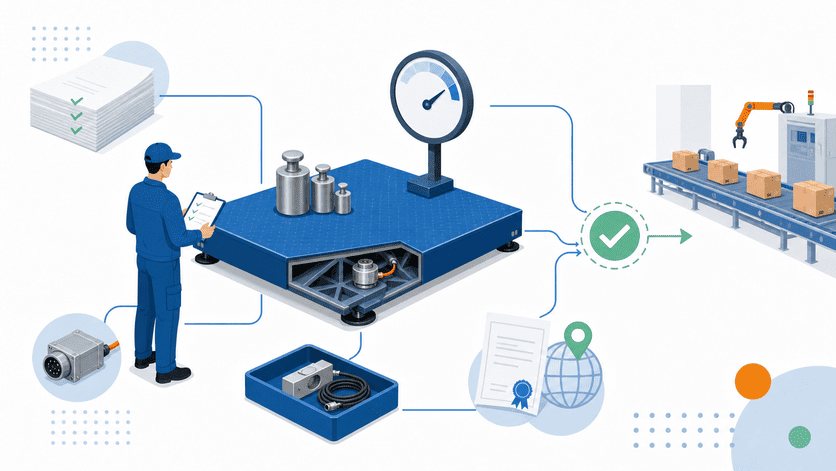
I compare suppliers by reviewing requirement clarification, structural manufacturing, load-cell selection, calibration procedures, documentation, data interfaces, spare-parts support, and final inspection. I also verify certification claims for the exact product and target market. A strong supplier should explain assumptions, exclusions, and site responsibilities before production begins.
I Ask for Configuration-Specific Evidence
I recommend sending every shortlisted supplier the same operating information. That approach makes quotations easier to compare and reduces hidden assumptions. My inquiry normally includes:
- Maximum complete load
- Minimum weight of interest
- Desired display increment
- Pallet dimensions and load overhang
- Handling equipment and wheel arrangement
- Entry and exit directions
- Installation surface and available space
- Indoor, outdoor, wet, dusty, or corrosive conditions
- Power supply and indicator location
- Required RS232/485, Modbus, 4–20 mA, Wi-Fi, Bluetooth, PLC, or ERP connection
- Legal metrology requirements
- Destination country and required documents
I then review the supplier’s manufacturing and quality-control process. HENER reports vertical manufacturing capabilities that include load-cell production, CNC processing, robotic welding, shot blasting, coating, assembly, and complete-scale calibration. HENER also reports corner-error adjustment, multipoint calibration, overload testing, repeatability testing, and final inspection before shipment.
I present those points as part of HENER’s supplied business context, not as independent laboratory findings. I encourage buyers to request the relevant inspection records, drawings, component specifications, and certification documents for the ordered configuration.
I Verify Certifications Instead of Reading Logos
A CE mark, ISO certificate, OIML reference, ingress-protection statement, or NTEP-related claim does not answer every procurement question.7 I verify the issuing body, certificate holder, model coverage, validity, standard, and destination-market applicability.
HENER states that its production system operates according to ISO 9001 and that relevant products can meet applicable CE and OIML requirements. HENER also states that certain components and indicators can be supplied with protection up to IP67. For North American projects, HENER can support NTEP-related sourcing through qualified partner manufacturers.
I advise buyers to verify each document because certification scope can differ by product, component, and configuration. I also recommend consulting a qualified local scale professional or metrology authority for legal-for-trade applications.
| Supplier evidence | What I verify |
|---|---|
| General datasheet | I match the model and options to the quotation. |
| Dimensional drawing | I confirm the platform, ramp, frame, and installed footprint. |
| Calibration record | I check serial numbers, test points, and stated results. |
| Quality certificate | I review issuer, scope, validity, and covered facility. |
| Component protection rating | I confirm whether it applies to the load cells, indicator, junction box, or complete system. |
| Communication protocol | I request interface details rather than accepting “ERP compatible.” |
| Spare-parts list | I check load cells, feet, junction boxes, cables, and indicators. |
| Warranty terms | I review exclusions, claim procedure, and shipping responsibility. |
Frequently Asked Questions
What information should I send when requesting a pallet floor scale quotation?
I recommend sending the maximum complete load, pallet dimensions, handling method, entry and exit direction, available floor space, environmental conditions, desired resolution, power supply, communication needs, and destination market. I also include photos or a layout drawing when fixed equipment or restricted aisles affect pallet movement.
Should I buy a floor scale with much more capacity than I currently need?
I recommend allowing for credible maximum loads and future operating requirements, but I do not automatically choose the highest capacity. Excess capacity may increase cost or reduce useful resolution. I compare rated capacity, display division, overload documentation, structural design, and actual load variation before selecting a model.
Can a pallet be larger than the scale platform?
I generally avoid configurations in which the pallet cannot remain fully supported or could touch surrounding surfaces. Some applications may permit a particular arrangement, but I ask the manufacturer to evaluate the load path, support points, overhang, off-center loading, and safety implications before approval.
Does every above-floor pallet scale need a ramp?
No. I add a ramp only when the handling method requires wheeled equipment to move onto or across the platform. A forklift may place a pallet directly on the deck. A pallet truck commonly requires a ramp unless the scale is installed flush with the surrounding floor.
How often should I calibrate a pallet floor scale?
I base the interval on usage, loading severity, environmental exposure, process risk, quality procedures, and local legal requirements. I recommend checking the scale after installation, relocation, repair, overload events, or suspected impact. A qualified scale service provider should establish and document the appropriate calibration schedule.
Conclusion: How Can I Select Floor Scales for Pallets With Less Risk?
I select floor scales for pallets by treating capacity, platform size, handling equipment, and ramp layout as one operating system. I begin with the heaviest complete load, define practical positioning tolerance, and map how the pallet enters and exits. I then verify resolution, drawings, calibration evidence, interfaces, certifications, and installation responsibilities. For an application-specific recommendation, I invite buyers to send HENER their pallet details, load range, site layout, and movement method so our team can prepare a suitable configuration for professional review.
"What is a "Legal Metrology Device"?", https://www.nist.gov/pml/owm/what-legal-metrology-device. NIST weights-and-measures guidance describes commercial weighing devices as instruments used to establish quantity for transactions and subjects them to applicable type-evaluation and inspection rules; exact obligations remain jurisdiction-specific. ↩
References
- Manual handling
- What Is The Difference Between The Scale Division, d, And ...
- Bias and Variance for Benchmarking Outcomes in Force Measurement
- Evaluation of Push and Pull Forces and Musculoskeletal ...
- Platform Scales with Ramp | Industrial Weighing
- CE marking – obtaining the certificate, EU requirements