













On this page

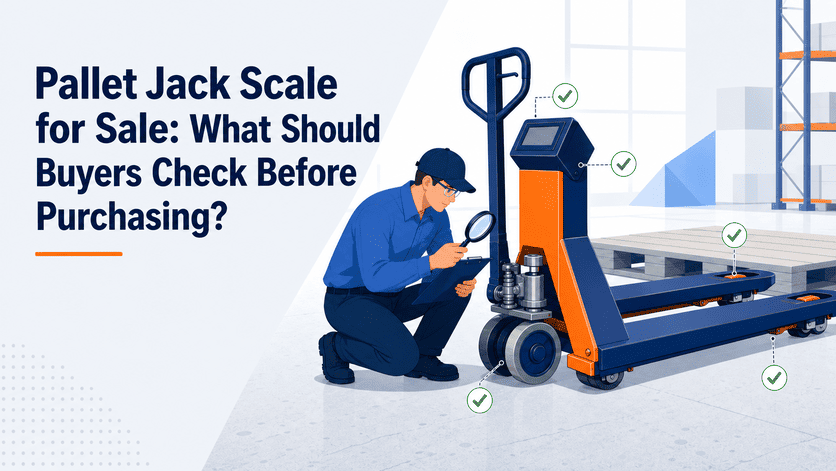
A pallet jack scale for sale can look suitable on a specification sheet yet perform poorly with a customer’s actual pallets, floors, and workflows. That mismatch leads to repeated weighing, complaints, repairs, and returns. I recommend evaluating task fit, construction quality, test evidence, and supplier consistency before comparing the final purchase price.
When evaluating a pallet jack scale for sale, I first check pallet compatibility, load range, floor conditions, weighing frequency, and load distribution. I then review fork construction, welding, load-cell installation, wiring, calibration records, repeatability results, and off-center-load tests. These checks reveal more purchasing risk than capacity and price alone.
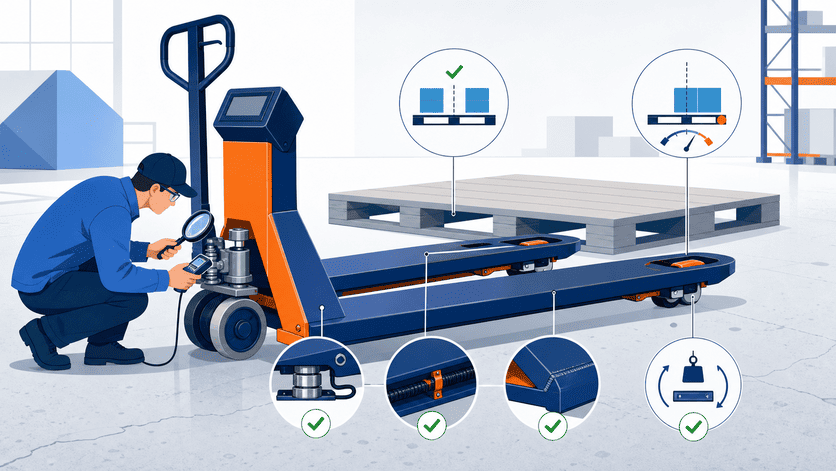
I have helped inspect, test, and calibrate pallet weighing equipment for distributors, OEM buyers, and end users. That experience has taught me that a reliable purchase starts with questions about the application. The following checks help buyers separate a workable warehouse solution from a product that only appears attractive in a catalog.
How Should I Match a Pallet Jack Scale to the Application?
Buyers sometimes begin with capacity, graduation, battery life, and unit price. Those details matter, but they do not confirm whether the equipment can enter the customer’s pallets or produce stable readings during daily work. A poor application match can make an otherwise acceptable scale difficult to use.
I recommend documenting pallet dimensions, underside structure, entry direction, typical load, maximum load, weight distribution, travel route, floor quality, and daily weighing frequency. A pallet jack scale should fit the physical pallet and the operating process. Buyers should confirm these conditions before requesting a quotation or selecting a model.
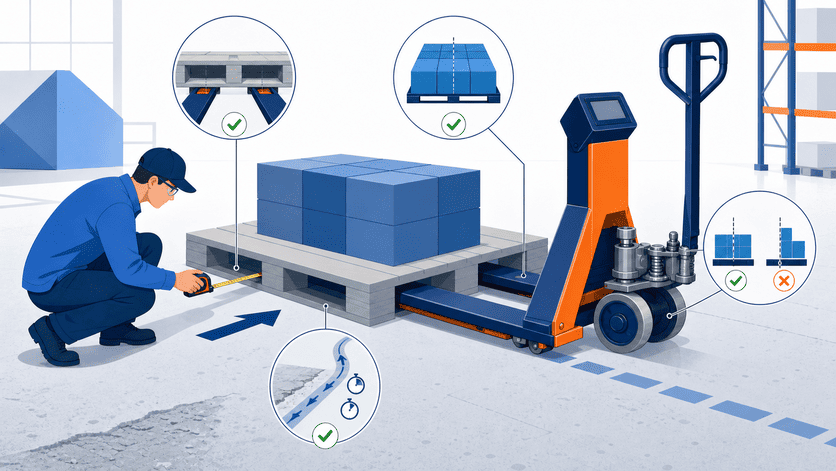
Check the Pallet Before Checking the Scale
A standard-looking pallet may still create compatibility problems. The customer may use closed-bottom pallets, unusual runners, low-clearance designs, or pallets that allow entry from only two directions. Fork width and length alone do not provide enough information.
I ask buyers to collect the following details:
- Overall pallet length and width
- Opening height beneath the pallet
- Distance between runners or support blocks
- Entry direction used in normal operations
- Bottom-board and stringer arrangement
- Condition of frequently reused pallets
- Whether loads overhang the pallet
- Whether the customer handles several pallet standards
A simple dimensional drawing can prevent an expensive purchasing mistake. Photographs also help, but I prefer photographs with a ruler or marked dimensions. Images without scale can hide important clearance differences.
Define Real Loads, Not Only Maximum Capacity
A rated capacity tells us the upper design limit for a verified model. It does not tell us how the unit will behave across the customer’s usual weighing range. If most loads weigh 100 to 300 kilograms, a model selected only because it supports a much higher maximum load may not provide the most useful resolution for that application1.
I normally separate load information into four categories:
- Minimum practical load: The lightest load that the customer expects to weigh.
- Typical load: The weight range that represents most daily transactions.
- Maximum routine load: The heaviest load handled under normal conditions.
- Exceptional load: An occasional load that may approach the equipment’s rated capacity.
Buyers should also consider load distribution. A compact machine part placed near one fork creates different mechanical conditions from evenly stacked cartons. An advertised accuracy statement may not describe performance under concentrated or off-center loads.
Map the Operating Environment
The surrounding environment affects weighing stability and equipment life. I have seen a scale pass calibration checks on a level test area and then produce less consistent results on a customer’s damaged warehouse floor. The scale had not necessarily failed. The operating conditions had changed.
| Application factor | Question I ask | Purchasing risk |
|---|---|---|
| Floor condition | Is the route level, smooth, and free of debris? | Unstable or changing readings |
| Travel distance | How far does the loaded unit travel? | More shock, vibration, and wheel wear |
| Duty cycle | How many loads are handled per shift? | Faster wear and battery demand |
| Load type | Is weight evenly distributed? | Off-center error or structural stress |
| Environment | Is the area wet, dusty, cold, or corrosive? | Damage to electronics or components |
| Workflow | Is the load weighed while stationary? | Inconsistent operating practice |
I advise distributors to create an application form for downstream customers. This process reduces fit failures and gives the supplier enough information to recommend a suitable configuration. For safety, legal metrology, hazardous areas, or regulated transactions, buyers should also obtain application-specific advice from qualified local professionals.
What Performance Evidence Should I Request for a Pallet Jack Scale?
Capacity and displayed graduation are easy to compare, but neither one proves stable field performance. Buyers need evidence showing how a specific model was tested. Without defined test loads, procedures, and acceptance limits, an accuracy statement provides too little information for a responsible procurement decision.
I request unloaded checks, loaded checks, multi-point calibration data, repeatability results, and off-center-load results for the proposed pallet jack scale. I also confirm whether the evidence applies to the exact model and configuration. Buyers should connect every tolerance or performance figure to documented test conditions rather than treating it as universal.
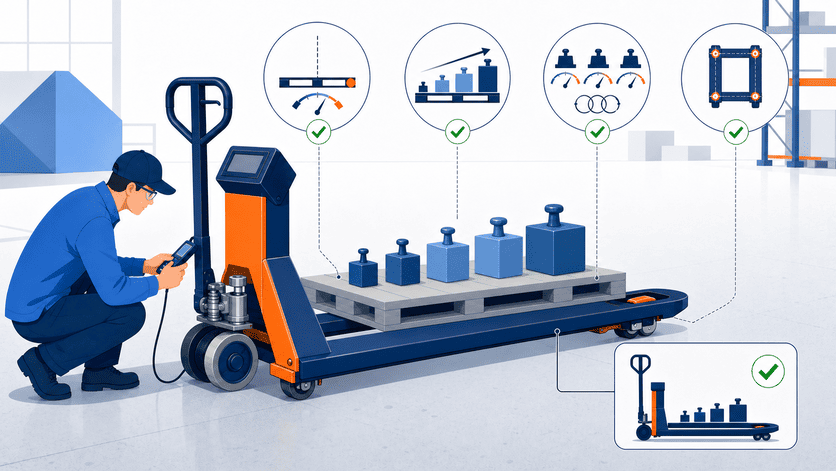
Multi-Point Calibration Shows More Than One Test Load
A single test at or near full capacity cannot show how the weighing system responds across its range. Multi-point calibration checks the indication at several known loads. The selected points should reflect both the model’s capacity and the buyer’s working range.
During calibration work, I have found that intermediate points often reveal issues that one high-load check does not show clearly. The specific calibration procedure and acceptance criteria must come from the applicable model documentation, quality plan, and local requirements.
A useful calibration record should identify:
- Scale model and serial number
- Rated capacity and displayed division
- Test date and test location
- Identification of reference weights or test equipment
- Applied load at each test point
- Displayed result at each test point
- Adjustment status before and after calibration
- Person or department responsible for the test
- Applicable acceptance criteria
Buyers should verify the calibration status and traceability of reference equipment. I do not treat an unsigned spreadsheet or an unlabeled photograph as adequate evidence.
Repeatability Matters in Daily Warehouse Work
Repeatability describes whether the scale provides similar results when the same load is applied several times under comparable conditions. It is especially important when workers use readings for receiving, inventory control, production records, or shipping checks.
A repeatability test should control key variables as far as practical. The operator should position the load consistently, use the same floor area, allow the display to stabilize, and record each result. If the supplier changes the position or test method between readings, the data becomes harder to interpret.
I ask three practical questions:
- How many repeated measurements were taken?
- What load and load position were used?
- What was the spread between the recorded readings?
I then compare the result with the buyer’s process tolerance. A warehouse that uses weight only as a rough internal check has different needs from an operation that bills or verifies goods by weight.
Off-Center Testing Reveals Load-Sensitivity Risk
Warehouse loads are rarely perfect. Workers may position a pallet slightly to one side. A pallet may contain a dense component in one corner. Uneven packaging may shift during movement. Off-center-load testing helps show how the weighing system responds to these realistic conditions.
When I take part in this type of inspection, I look for systematic changes as the test load moves between defined positions. I also check whether the result returns correctly after the load is removed. This process can help identify installation, mechanical, signal-balancing, or calibration issues.
However, buyers should not assume that every factory uses the same off-center test method. They should request:
- A diagram of test positions
- The applied test load
- Recorded results at each position
- The permitted deviation
- The referenced inspection procedure
- Confirmation that the tested configuration matches the order
Advertised accuracy should never be treated automatically as long-term field accuracy. Floor slope, impact, overload, temperature, poor loading habits, maintenance, and component wear can all influence real operating results.
Which Pallet Jack Scale Construction Details Should I Inspect?
A weighing system may display stable readings during a short demonstration yet develop problems after repeated warehouse use. Buyers can reduce this risk by examining the load-bearing structure and electronic assembly. Forks, welds, load-cell mounting, cable protection, connectors, and indicator installation all influence long-term serviceability.
For a pallet jack scale, I inspect whether the mechanical structure carries loads consistently and protects the weighing components. I also review weld condition, fork alignment, load-cell mounting, wiring routes, junction points, indicator fixing, and component identification. These details show whether the equipment is built for repeatable production and practical maintenance.
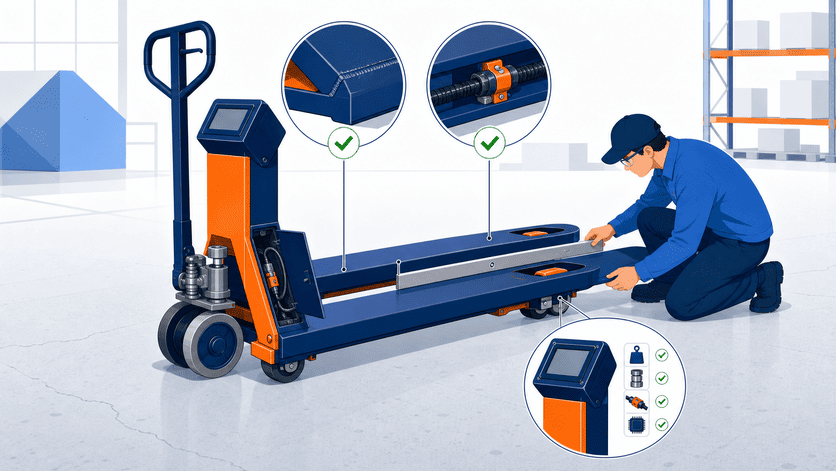
Inspect Forks and Load-Bearing Areas
The scale’s forks do more than move a pallet. They form part of the force path that transfers weight to the sensing components. Damage, distortion, poor alignment, or inconsistent construction may affect both handling and weighing.
I focus on observable details rather than broad claims about strength. My inspection usually includes:
- Fork straightness and alignment
- Consistency between left and right fork dimensions
- Clearance around moving or load-sensitive parts
- Weld continuity in specified load-bearing areas
- Visible cracks, undercut, excessive spatter, or incomplete finishing
- Wheel and roller alignment
- Fastener installation and retention
- Surface coating around joints and edges
- Labels showing model, capacity, and serial identification
A visual inspection cannot replace an engineering review or a defined load test. However, it can reveal inconsistencies that justify closer investigation. Buyers should ask the supplier for relevant drawings, material specifications, welding controls, and test records when those documents are important to the project.
Review Load-Cell Installation
Load cells convert mechanical force into an electrical signal.2 Their rated specification matters, but installation quality is equally important. A suitable component can still perform poorly if it is mounted incorrectly, exposed to unintended side forces, or connected through poorly protected wiring.
I check whether the load cells are seated consistently and whether cables have enough protection from pinching, abrasion, moisture, and moving components. I also look for clear component markings. Those markings support incoming inspection, spare-parts planning, and future troubleshooting.
Buyers should confirm:
- Load-cell model and rated capacity
- Number and arrangement of load cells
- Material and environmental protection rating
- Mounting method
- Cable routing and strain relief
- Connector or junction arrangement
- Availability of compatible replacement parts
- Individual or assembly-level test records
Any ingress protection claim, such as an IP rating, should be tied to the relevant component and supporting test document. An indicator rated to a particular level does not automatically give the complete scale the same protection.
Examine the Indicator and Wiring Assembly
The indicator is the part that operators see, but the wiring behind it often determines whether the system remains dependable. Loose terminals, exposed connectors, poorly secured cables, or inconsistent assembly can create intermittent faults that are difficult to reproduce.
I have encountered cases where the weighing components were functional, but cable movement caused unstable readings. A simple assembly issue then became an after-sales complaint. This experience is why I ask suppliers to show internal wiring workmanship, not only the exterior display.
| Inspection area | What I look for | Why it matters |
|---|---|---|
| Indicator mounting | Secure position and readable angle | Operator use and vibration control |
| Cable routing | Protection from wheels and moving joints | Lower risk of abrasion |
| Connectors | Secure, identified, and protected | Easier fault diagnosis |
| Battery access | Controlled but serviceable | Faster maintenance |
| Wiring labels | Consistent identification | Better spare-parts support |
| Sealing | Appropriate for the stated environment | Reduced contamination risk |
Buyers should ask which components are standard and which are optional. They should also confirm whether replacements remain compatible across future production batches.
How Should Distributors Evaluate a Pallet Jack Scale Supplier?
A low quotation is not automatically a poor choice, and a high quotation does not guarantee lower risk. Distributors need to evaluate what the price includes. Missing inspection records, unclear configurations, incompatible spare parts, or inconsistent production can create costs long after the initial shipment has arrived.
When I assess a supplier offering a pallet jack scale for sale, I compare application support, production consistency, inspection evidence, change control, packaging, documentation, and after-sales response. I also calculate the commercial effect of repeated weighing, customer disputes, downtime, replacement parts, and warranty handling instead of comparing unit prices alone.
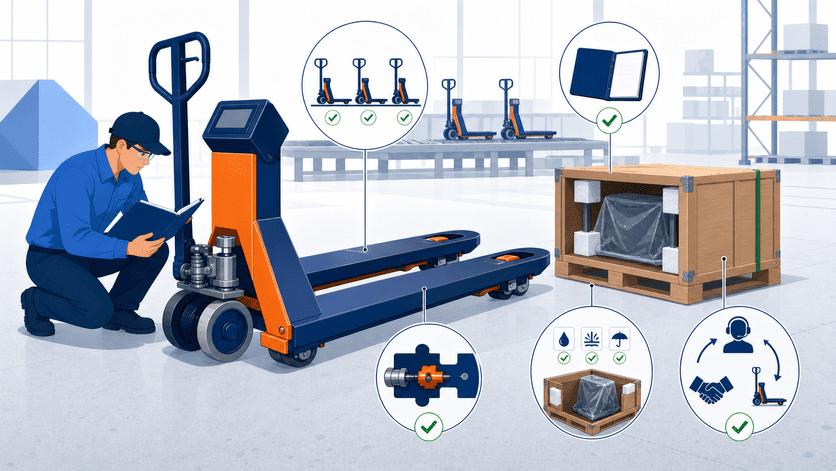
Build a Supplier Evidence Checklist
A supplier should be able to explain how it converts the approved specification into consistent finished products. A polished brochure does not answer that question. I prefer records tied to the quoted model, production batch, or individual serial number.
My distributor checklist includes:
- Approved specification: Capacity, division, fork dimensions, wheel material, indicator, load cells, battery, and communications.
- Application confirmation: Pallet type, floor conditions, load range, work pattern, and environment.
- Incoming inspection: Controls for steel parts, load cells, indicators, batteries, cables, and wheels.
- In-process inspection: Fork alignment, welding, assembly, wiring, and component identification.
- Final testing: Zero, load, multi-point, repeatability, off-center loading, and functional checks.
- Packing inspection: Protection for forks, indicators, cables, chargers, documents, and loose accessories.
- Traceability: Serial numbers, batch records, test results, and component references.
- Change control: Notification before key components or specifications are changed.
- Spare-parts support: Part numbers, compatibility, lead times, and troubleshooting documents.
- Warranty procedure: Defined evidence requirements, response path, and responsibility allocation.
I recommend requesting a pre-shipment inspection plan before placing a large order. The plan should state the sample size, test method, responsible party, acceptance limits, and handling of nonconforming units.
Compare Total Purchasing Risk
The lowest unit price may still be commercially appropriate if the product fits the task and the supplier provides consistent evidence. The important point is that buyers should compare observable risks, not make assumptions based only on price.
| Cost area | Questions for distributors |
|---|---|
| Product fit | Will the forks enter customers’ common pallets? |
| Weighing stability | Will typical floors and loading patterns affect results? |
| Installation | Does the scale require local setup or calibration? |
| Returns | Who pays freight and inspection costs? |
| Repairs | Are load cells, indicators, wheels, and cables replaceable? |
| Training | Can operators follow a simple, repeatable weighing method? |
| Documentation | Are manuals and test records available in the required language? |
| Compliance | Do documents match the destination market and application? |
Distributors should also consider model range. One configuration may not suit every customer. A supplier that supports controlled options for fork size, capacity, wheels, indicators, communications, and branding may reduce the need to coordinate several vendors. However, every customization should remain documented and testable.
Verify Quality and Compliance Documents
HENER operates its production system according to ISO 90013 and supplies weighing products designed around relevant OIML and CE requirements. HENER also states that certain configurations can support accuracy, protection, and communication options for defined applications. Buyers should verify the current certificate, issuing body, model coverage, technical file, declaration, and applicable test evidence before relying on any claim.
For North American projects, buyers should confirm whether the exact weighing device and configuration require NTEP evaluation or another local approval.4 HENER can discuss supply-chain support through qualified partners, but buyers must verify the legal status of the final configuration with the relevant local authority or qualified metrology professional.
I treat a certificate as a document to examine, not as a general promise that every model suits every market or transaction.
A capable supplier should welcome detailed questions. Clear answers reduce procurement uncertainty for both sides.
Frequently Asked Questions
What capacity should I choose for a pallet jack scale?
I recommend choosing capacity from the customer’s maximum routine load, exceptional load, pallet weight, and required resolution. Buyers should not simply select the highest available capacity. The chosen model should cover expected loads while providing useful readings across the normal working range.
Can a pallet jack scale provide accurate readings on an uneven floor?
An uneven or sloped floor can affect load position and weighing stability. I recommend weighing on a firm, level area whenever possible. Buyers should test the proposed model under realistic floor conditions and define an operating procedure that requires the unit and load to remain stationary during weighing.
Which calibration records should a supplier provide?
I request the model and serial number, test date, reference equipment identification, applied loads, displayed results, acceptance limits, and final status. The record should cover relevant multi-point, repeatability, and off-center checks. Buyers should also verify the calibration status or traceability of the reference equipment.
Do I need a certified or trade-approved pallet jack scale?
The answer depends on the country, application, and whether weight determines price, payment, or regulatory reporting. I recommend consulting a qualified local metrology professional or authority. Buyers should verify that approval documents cover the exact model, indicator, load-cell configuration, software, and intended transaction.
How can distributors reduce pallet jack scale warranty claims?
Distributors can reduce claims by confirming pallet compatibility, floor conditions, load behavior, duty cycle, and operator practices before sale. I also recommend retaining serial-numbered test records, supplying clear operating instructions, stocking compatible service parts, and agreeing on a documented troubleshooting and warranty process with the manufacturer.
Conclusion
A pallet jack scale for sale should be evaluated as an application-fit and supply-risk decision, not just a price comparison. I recommend checking pallets, loads, floors, duty cycles, fork construction, welds, load cells, wiring, calibration evidence, and supplier controls. Buyers should also verify every performance or compliance claim for the exact model and market. If you are sourcing for distribution, OEM supply, or an industrial project, contact HENER to review your application, required configuration, inspection plan, and supporting documents before ordering.