













On this page

You searched this because you're writing an RFQ, reviewing a quote, or comparing suppliers—and the terminology doesn't match. You're worried you might order the wrong thing.
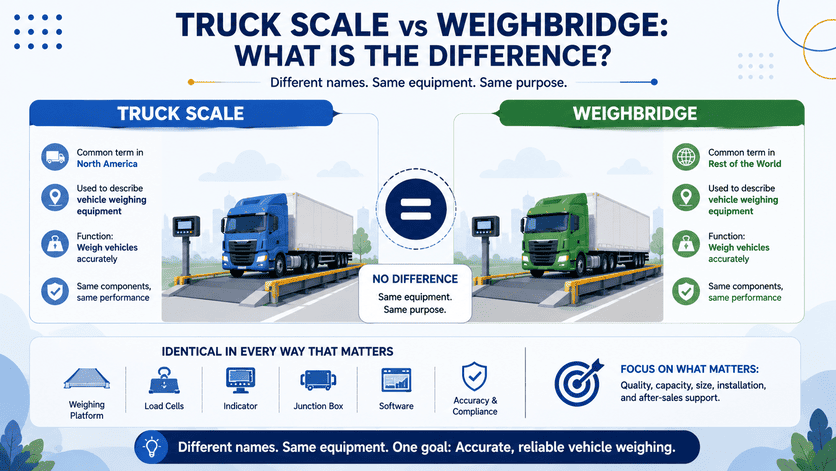
Truck scale and weighbridge are the same equipment. There is no technical difference.1 The terms refer to identical heavy-duty vehicle weighing platforms—the only difference is regional language preference2. North America says "truck scale," UK and Commonwealth countries say "weighbridge," and both describe the same product.
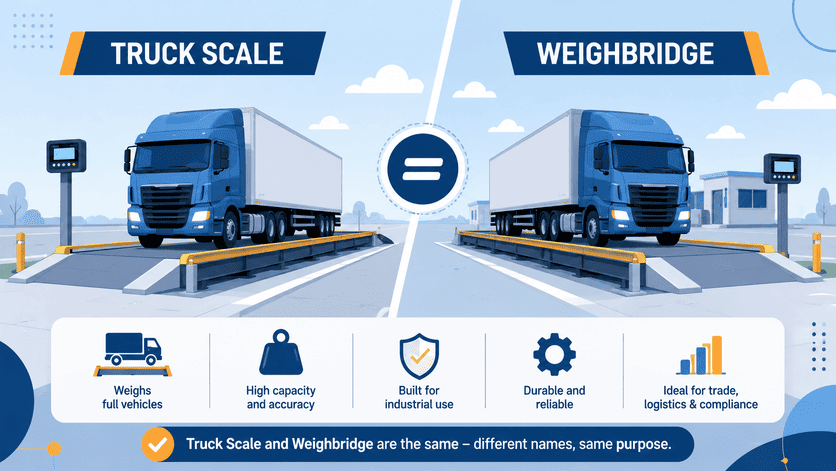
I've been exporting industrial weighing equipment for years. This question comes up in my inbox at least twice a week. A buyer in Australia asks for a "weighbridge quotation." A buyer in Texas asks for a "truck scale quote." When I open both requests, the specifications are nearly identical: 60-ton capacity, 18-meter platform, above-ground installation, steel deck. Same product. Different word.
The real problem isn't terminology. The real problem is that terminology confusion leads to specification confusion—and specification confusion leads to wrong quotes, wrong equipment, and wasted project time.
Let me break this down so you can move past the naming question and focus on what actually matters for your procurement.
Why Do Different Regions Use Different Terms?
Language habits vary by market. Buyers in different countries grew up with different terms for the same equipment. This isn't about technical standards—it's about geography.
North America predominantly uses "truck scale." The UK, Australia, Africa, and most Commonwealth countries use "weighbridge." Europe uses both terms depending on the local language. None of these indicate different product categories, different engineering standards, or different performance levels.
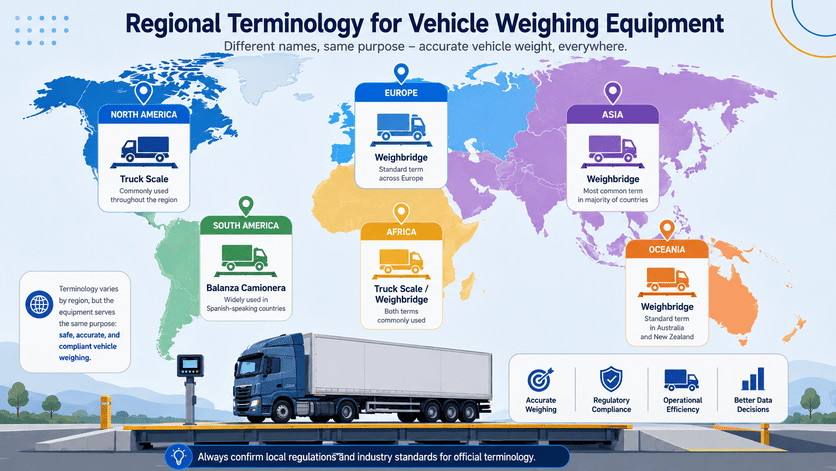
Here's how the terminology breaks down by region based on what I see in daily procurement inquiries:
| Region | Common Term | Context |
|---|---|---|
| United States, Canada | Truck scale | RFQs, project specs, supplier catalogs |
| United Kingdom | Weighbridge | Government documents, trade standards3 |
| Australia, New Zealand | Weighbridge | Industry standard term |
| Africa (English-speaking) | Weighbridge | Tender documents, project contracts |
| Middle East | Both used | Depends on buyer's reference market |
| Europe (English documents) | Both used | Often follows supplier's origin |
| South America | Local translation | "Báscula camionera" or similar |
What This Means for Your Procurement
When you write an RFQ, your supplier will understand both terms. But here's the risk: if your internal documents say "weighbridge" and your supplier's quotation says "truck scale," your procurement team might flag it as a mismatch. I've seen this delay approvals.
My suggestion: pick whichever term your organization uses internally, and add a one-line clarification in your RFQ header. Something like: "Weighbridge (also known as truck scale) — vehicle weighing platform for gross/tare weighing." This eliminates confusion at every level of the approval chain.
The term you choose does not affect certification. It does not affect product quality. It does not affect whether the equipment meets OIML or any other metrology standard4. The equipment is identical.
Does Terminology Affect What Suppliers Quote You?
Yes—but not because the product changes. The risk is miscommunication in specifications, not in the product itself. If your RFQ is vague and you only write "one weighbridge," different suppliers might assume different configurations.
Terminology alone doesn't change what you receive. But vague terminology combined with incomplete specifications causes suppliers to guess—and guessing leads to mismatched quotations, wrong configurations, and project delays.
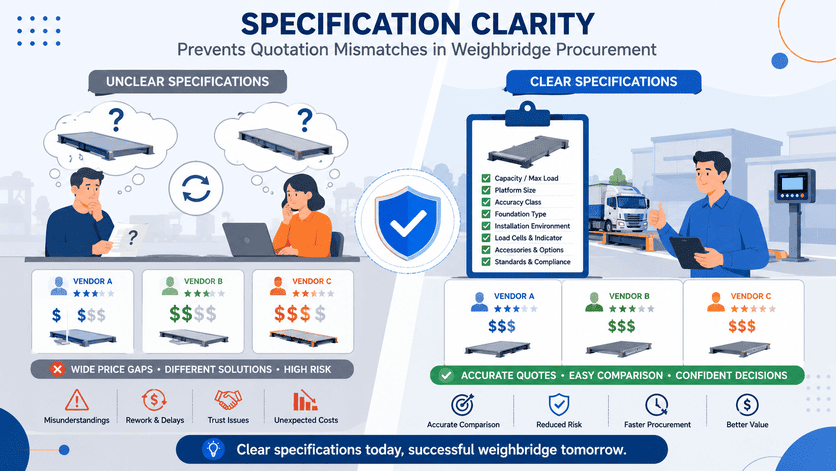
I had a customer in East Africa send me an inquiry: "Please quote weighbridge, 80 ton." That's all. No platform length. No installation type. No mention of whether they needed a concrete deck or steel deck. No indication of pit-mounted or surface-mounted.
I sent back a clarification form. Another supplier didn't—they just quoted their standard 80-ton model with a 3x18m steel deck, surface-mounted. The buyer expected a 3.4x24m pit-mounted concrete deck weighbridge because that's what "weighbridge" means in their local market context.
The Specification Checklist That Actually Matters
Instead of worrying about whether to write "truck scale" or "weighbridge," focus your RFQ on these parameters:
| Specification | Why It Matters |
|---|---|
| Weighing capacity (ton) | Determines load cell configuration and structural design |
| Platform dimensions (W x L) | Must match your longest and widest vehicles |
| Installation type | Pit-mounted vs above-ground affects civil work and cost |
| Deck material | Steel deck vs concrete deck affects weight, durability, and price5 |
| Number of sections | Single-deck vs modular affects transport and installation |
| Load cell type and quantity | Affects accuracy, maintenance, and replacement |
| Indicator requirements | Digital, remote display, printer, data output |
| System integration | Software, LPR, barriers, ERP connection |
| Environmental conditions | Temperature range, corrosion risk, traffic volume |
| Certification requirements | OIML, CE, NTEP, or local metrology approval |
When your RFQ includes these details, it doesn't matter whether you call it a truck scale, weighbridge, vehicle scale, or platform scale. Every competent supplier will quote the same configuration.
What Should You Specify Instead of Worrying About the Name?
The name is settled—it's the same product. Now focus on the decisions that actually affect your project outcome: capacity, size, installation, and connectivity.
Your real decisions are: what maximum vehicle weight do you need to measure, how long is your longest truck, do you want above-ground or pit installation, and does your weighing data need to connect to other systems?
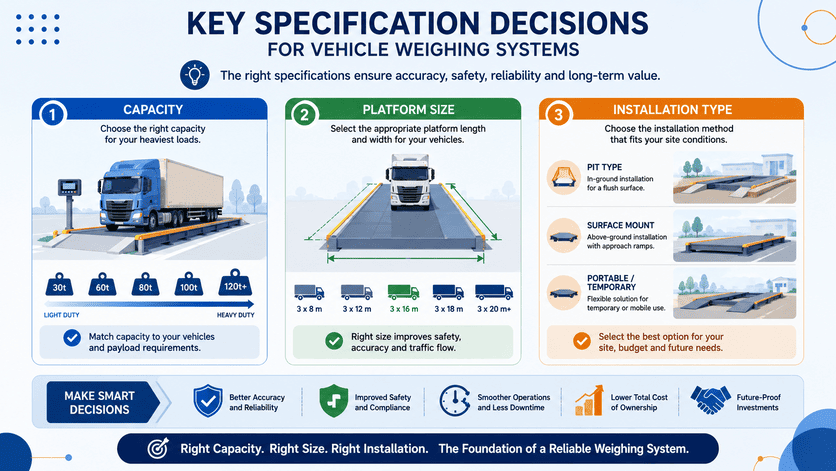
Let me walk through the four core decisions I help buyers make every week.
Capacity Selection
Most truck scales (or weighbridges—same thing) come in standard capacities: 30 ton, 60 ton, 80 ton, 100 ton, 120 ton, and 150 ton. Your choice depends on the heaviest loaded vehicle that will cross the platform.
Don't just match your heaviest truck's gross weight. Add a safety margin. If your heaviest vehicle is 55 tons gross, choose 60 or 80 tons. This protects against overloaded vehicles, extends load cell life, and reduces long-term maintenance.
Platform Dimensions
| Vehicle Type | Recommended Platform Length |
|---|---|
| Standard rigid truck | 9m – 12m |
| Semi-trailer | 16m – 18m |
| Road train / B-double | 21m – 24m |
| Mining truck | Custom, based on axle spacing |
Platform width is typically 3m or 3.4m. Choose 3.4m if your vehicles are wide-body or if drivers tend to approach at slight angles.
Installation Type
Above-ground (surface-mounted) is faster to install, easier to maintain, and costs less in civil work. Pit-mounted sits flush with the road surface, looks cleaner, and works better for high-traffic sites where vehicles need smooth entry and exit.
Your site conditions, drainage, and traffic flow will determine which is better. Neither is superior in weighing performance.
How Do You Prevent Terminology Confusion in Project Documents?
In cross-border procurement, your RFQ goes through multiple hands: procurement officer, project manager, engineer, finance approver, shipping coordinator. If terminology isn't consistent, someone will raise a flag.
Use one term consistently in all your project documents. Add a parenthetical alias on first mention. Include clear technical specifications so that terminology becomes secondary to measurable parameters.
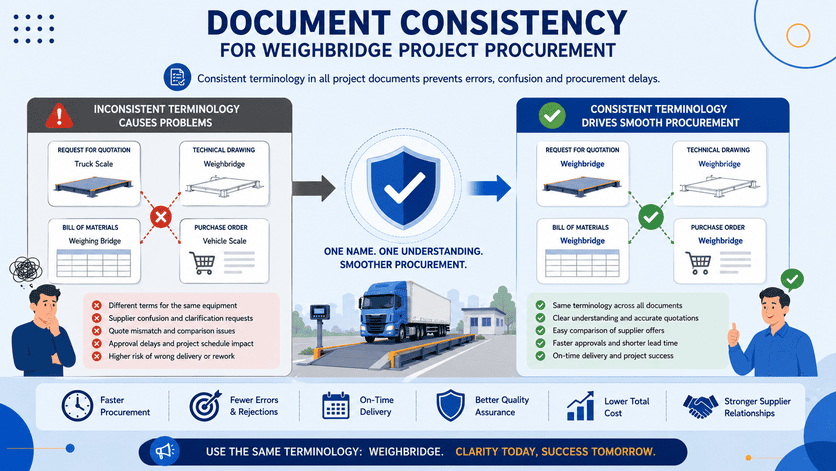
Here's what I recommend to my customers when they're setting up project documentation:
Document Consistency Framework
| Document Type | Recommendation |
|---|---|
| RFQ / Tender | Use your preferred term + alias on first page |
| Technical specification | Define by capacity, dimensions, and installation type |
| Purchase order | Match the supplier's quotation term exactly |
| Shipping documents | Use the same term as purchase order |
| Installation manual | Match supplier's documentation term |
| Internal reports | Use your organization's standard term |
The key principle: once you issue a purchase order, use the exact term from the accepted quotation. If the supplier quoted "truck scale 80T 3x18m," your PO should say "truck scale 80T 3x18m"—even if your internal RFQ said "weighbridge." This prevents customs issues, inspection mismatches, and receiving confusion.
I've seen a shipment held at port because the buyer's import documents said "weighbridge" while the commercial invoice said "truck scale." Customs flagged it as a potential mismatch.6 It took three days and a letter of explanation to clear. Three days of demurrage charges—over a synonym.
A Simple Fix
Add this line to your RFQ template:
"Equipment description: Weighbridge (truck scale) — heavy-duty vehicle weighing platform for static gross/tare weighing of commercial vehicles."
One sentence. Problem solved. Every supplier, every approver, every customs officer understands what you're buying.
Does the Term Affect Certification or Compliance?
No. Absolutely not. Whether your certificate of conformity says "truck scale" or "weighbridge," the metrology requirements are identical. The test procedures are identical. The accuracy class is identical.
Certification bodies evaluate equipment based on technical performance—accuracy, repeatability, temperature behavior, and load cell specifications. The product name on the certificate is administrative, not technical. OIML R76 applies equally whether the document says "truck scale" or "weighbridge."
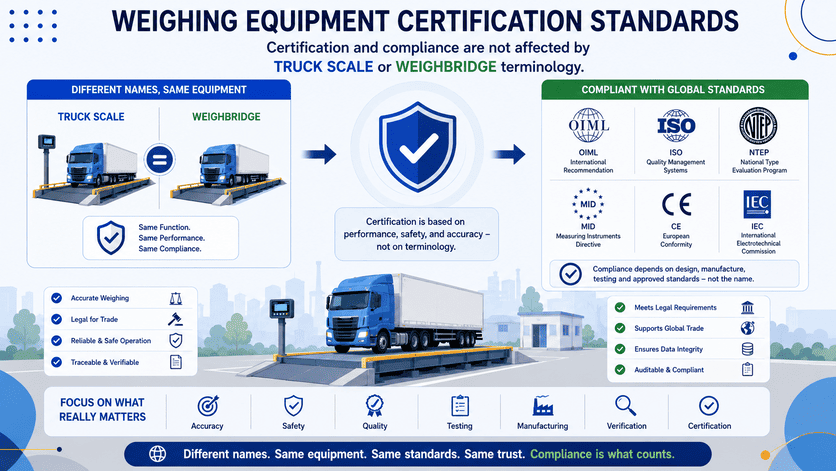
I want to address this directly because I've had buyers ask: "If I call it a weighbridge, will it meet different standards than a truck scale?" The answer is no.
Standards Apply to Performance, Not Names
| Standard | What It Evaluates | Term Used |
|---|---|---|
| OIML R76 | Non-automatic weighing instruments | Generic—applies to all |
| EN 45501 | European metrological requirements | "Weighing instrument" |
| NTEP (US) | Commercial weighing devices | "Vehicle scale" or "truck scale" |
| NMI (Australia) | Trade-approved weighing | "Weighbridge" |
Notice that different certification bodies use different terms. This reflects regional language, not different product categories. An OIML-certified scale from China can be called "truck scale" for a US buyer and "weighbridge" for an Australian buyer. Same certificate. Same product. Same performance.
If your project requires specific certification, specify the standard (OIML Class III, accuracy 3000d, for example) rather than relying on the product name to imply compliance.
Conclusion
Truck scale and weighbridge are the same equipment with different regional names. Stop comparing terms—start specifying capacity, platform size, installation type, and integration needs. That's what determines your project success.