













On this page

I see many buyers choose capacity first, then face unstable readings later. The pain starts when the goods fit the weight rating but not the platform.
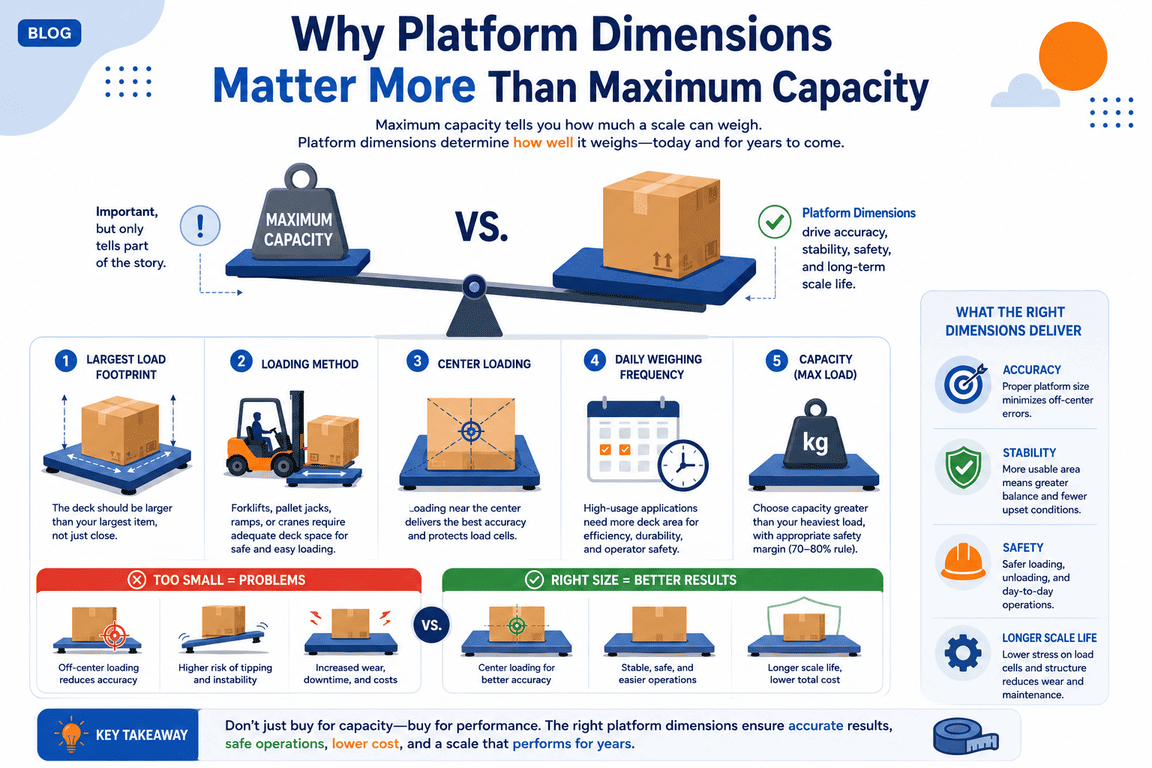
I choose platform scale size by checking the largest product footprint, loading method, center position, and daily weighing frequency before capacity. Maximum capacity matters, but usable deck area often decides stability, accuracy, safety, and long-term scale life.
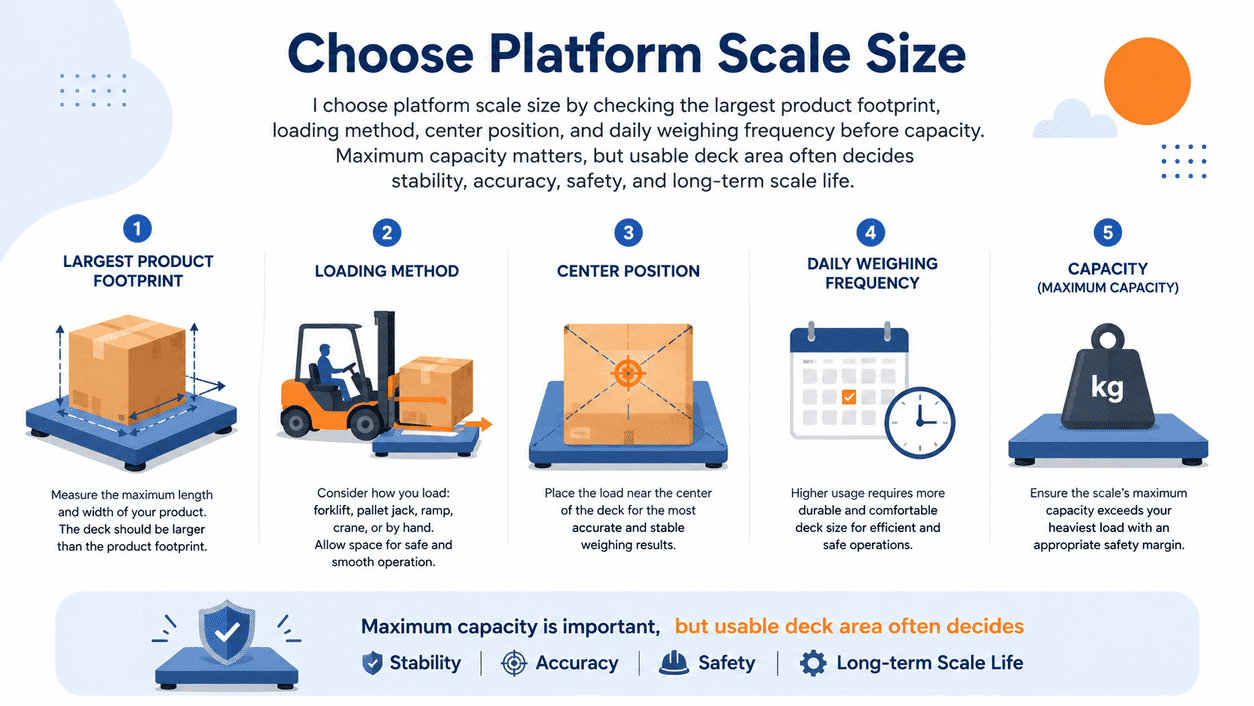
I learned this lesson many times on factory floors. A customer may ask me for a 300 kg platform scale or a 1 ton platform scale. I always ask one more question before I talk about price. I ask, “What is the size of the goods?” This small question can prevent many future problems.
A platform scale is not only a number on a display. It is a working surface. The deck must support the load in a stable way. The goods should sit inside the platform edges. The center of gravity should be close to the center. The operator should load and unload without fighting the scale every time.
I once worked with an export packaging factory that bought a 600 kg platform scale. The capacity was enough. Their wooden crates were not heavy enough to overload it. The real problem was that the crates were slightly larger than the deck. The operators let the crate edges hang outside the platform. The scale still worked at first. Later, readings became less stable. Corner error became more obvious. The team first thought they needed a larger capacity scale. I found that they needed a larger platform and a lower deck design instead.
This is why I treat platform size as a core technical choice, not a small option in a catalog.
Capacity vs. Usable Platform Area: What Buyers Often Misunderstand?
I often hear buyers say only one number. They say 500 kg, then expect the whole weighing problem to disappear.
Capacity means the maximum safe weighing load. Usable platform area means the real space where the goods can sit flat, centered, and stable. I check both because a high-capacity scale can still fail in daily use when the deck is too small.
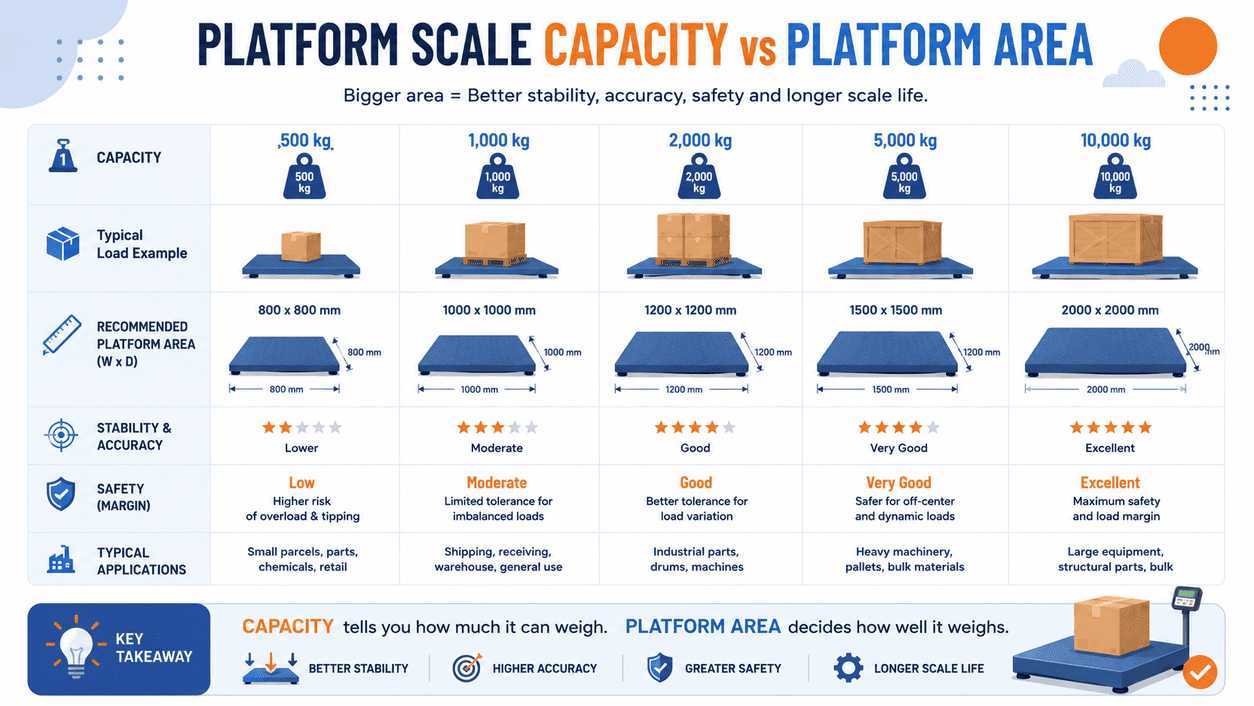
I treat capacity as the vertical limit. I treat platform area as the practical working space. Both limits matter, but they solve different problems. Capacity protects the load cells and structure from overload. Platform area protects the process from poor placement, unstable loading, and slow operation.
I have seen many purchasing teams compare two platform scales only by capacity. One scale may be 600 kg with a 600 × 800 mm deck. Another may be 600 kg with a 1,000 × 1,000 mm deck. On paper, both are 600 kg scales. In real work, they are very different tools.
| Buying Question | What I Check | Why I Check It |
|---|---|---|
| Is the capacity enough? | Maximum product weight plus safety margin | I need to avoid overload and load cell damage |
| Is the deck large enough? | Product length and width | I need the load to sit fully on the platform |
| Is the load easy to center? | Shape, balance, and operator access | I need stable readings and lower corner stress |
| Is the process fast? | Loading frequency and handling method | I need the scale to support real workflow |
I usually recommend that buyers avoid choosing the smallest possible deck. A tight fit may look acceptable in a quotation. It often becomes slow and risky in daily work. The operator needs space to place the load correctly. If the goods must be adjusted by hand every time, the scale is not really efficient.
Oversized Goods, Off-Center Loading and Corner Accuracy Risks?
I worry when goods hang over the platform edge. The scale may show a number, but the structure is already under uneven stress.
Oversized goods create off-center force and corner loading risk. I avoid this by choosing a platform that keeps the whole load inside the deck and allows the center of gravity to stay near the middle during normal operation.
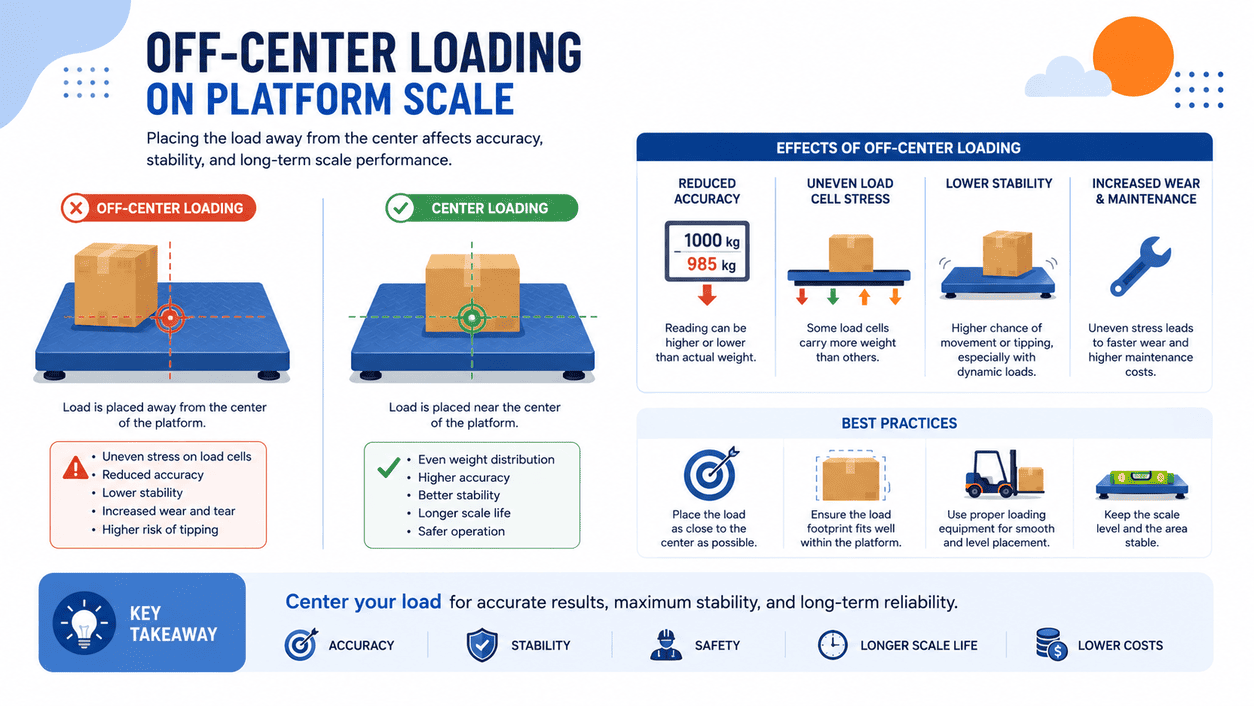
A platform scale measures through load cells under the deck. In many designs, load cells sit near the corners. The system is adjusted so that the scale gives correct readings when loads are placed across the deck. This does not mean the scale likes extreme corner loading every day.
When a box, crate, or pallet is larger than the deck, the operator may place it with one side hanging outside. The visible weight may still look normal. The force path is not normal. One corner may carry more stress than expected. One side of the frame may bend slightly over time. The reading may drift when the same item is placed in different positions.
| Loading Condition | Common Result | My Practical Concern |
|---|---|---|
| Load sits fully inside deck | Stable reading | Normal use condition |
| Load hangs over one edge | Shaking or slow stabilization | Poor support and uneven force |
| Load is always placed on one corner | Corner error may increase | Load cells and frame work harder |
| Load is pushed from a cart at an angle | Impact force appears | Mechanical fatigue may grow |
| Tall goods with high center of gravity | Tipping risk appears | Safety becomes a real issue |
I do not treat corner accuracy as a lab detail only. I connect it with daily habits. If the operator always puts a heavy drum near one side, the scale may pass basic testing but still perform badly in the real station. I prefer a platform size that makes correct placement natural. I do not want the operator to think too much. The scale should guide good use by its size and structure.
For this reason, I ask about the loading direction. I ask if workers use a trolley, forklift, hand pallet truck, roller table, or manual lifting. A good deck size is not only bigger. It must match the way the goods move onto the scale.
How Cartons, Drums, Crates and Small Pallets Require Different Deck Sizes?
I see many goods share the same weight range, but they do not share the same platform requirement. Shape changes everything.
Cartons need edge support, drums need diameter clearance, crates need full base contact, and small pallets need fork access and stable landing. I choose deck size based on footprint, not only gross weight.
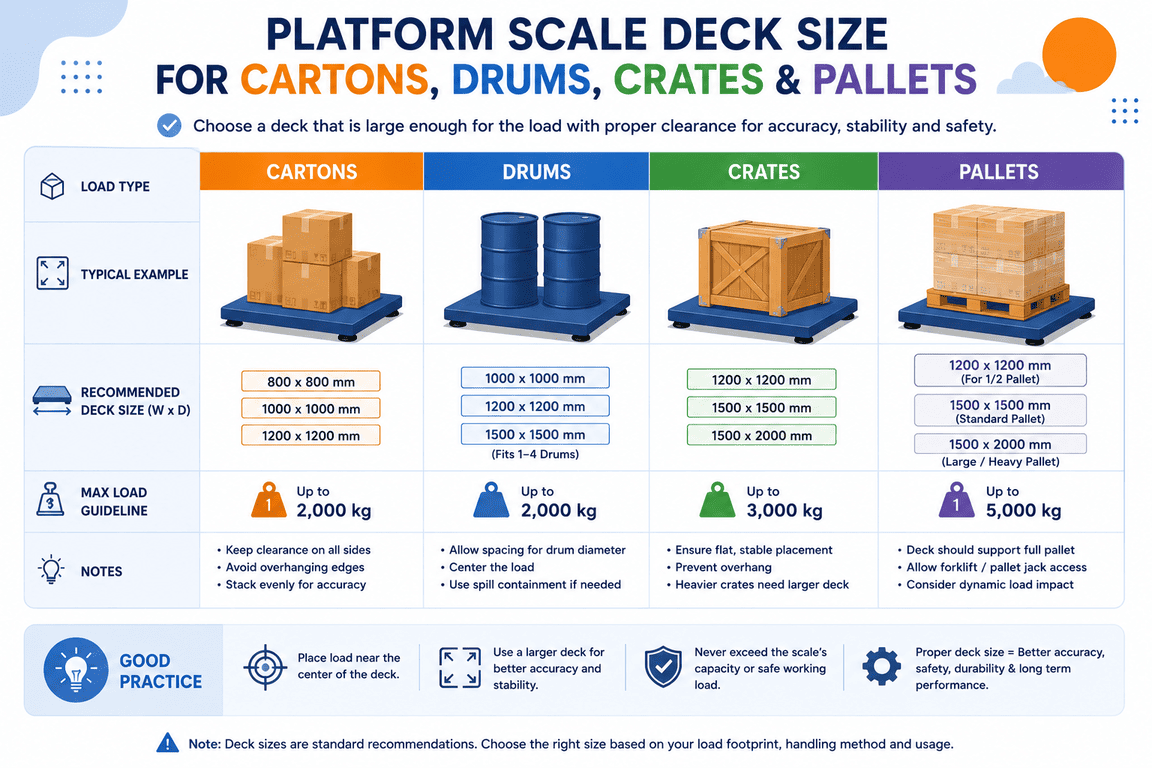
Different products create different weighing problems. A 100 kg carton may need a larger deck than a 250 kg metal part if the carton is long and light. A drum may be heavy but compact. A wooden crate may be rigid, but it may have bottom runners that must sit on the deck. A small pallet may require room for forklift or pallet truck alignment.
| Goods Type | What I Measure First | Platform Size Concern | Design Note I Consider |
|---|---|---|---|
| Cartons | Longest length and widest width | Edges should not hang outside | A flat deck is usually enough |
| Drums | Diameter and height | Base must sit fully on deck | Low deck helps safer loading |
| Wooden crates | Base runner spacing | Runners must contact the deck well | Larger deck prevents corner stress |
| Small pallets | Pallet length and width | Pallet feet must land inside scale | Ramp or low-profile design may help |
| Mixed goods | Largest regular footprint | Operators need easy placement | I choose margin, not minimum size |
I often start with the largest regular item, not the rare extreme item. If the largest item appears every day, I size the platform around it. If it appears once a month, I may discuss a special handling plan. This keeps the buyer from spending too much on a scale that is too large for normal work.
In food processing, I often see drums and plastic crates. The load is not always heavy, but the work is fast. A low platform helps workers roll or lift products with less effort. In packaging factories, long cartons and wooden cases create the main issue. In hardware and light industry, mixed goods make the case more complex. I usually recommend a deck with enough space for the largest common base shape.
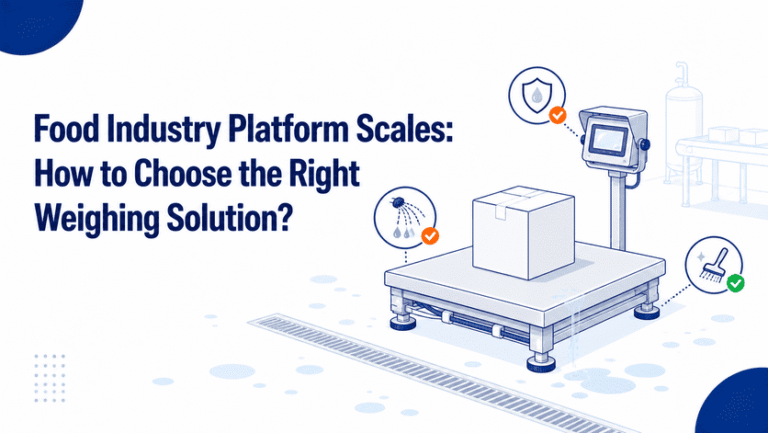
I also think about cleaning and surface material. A stainless steel platform may be important for food or wet areas. A painted steel deck may be enough for dry warehouses. The size choice still comes first because a clean scale with the wrong deck size is still a poor tool.
A Simple Method to Choose Platform Scale Size Before Ordering?
I do not like guessing platform size from a catalog. A wrong guess can turn a simple purchase into a daily operation problem.
I choose platform scale size by measuring the largest product length and width, checking centering difficulty, confirming loading tools, counting daily weighing frequency, and adding a practical margin around the load footprint.
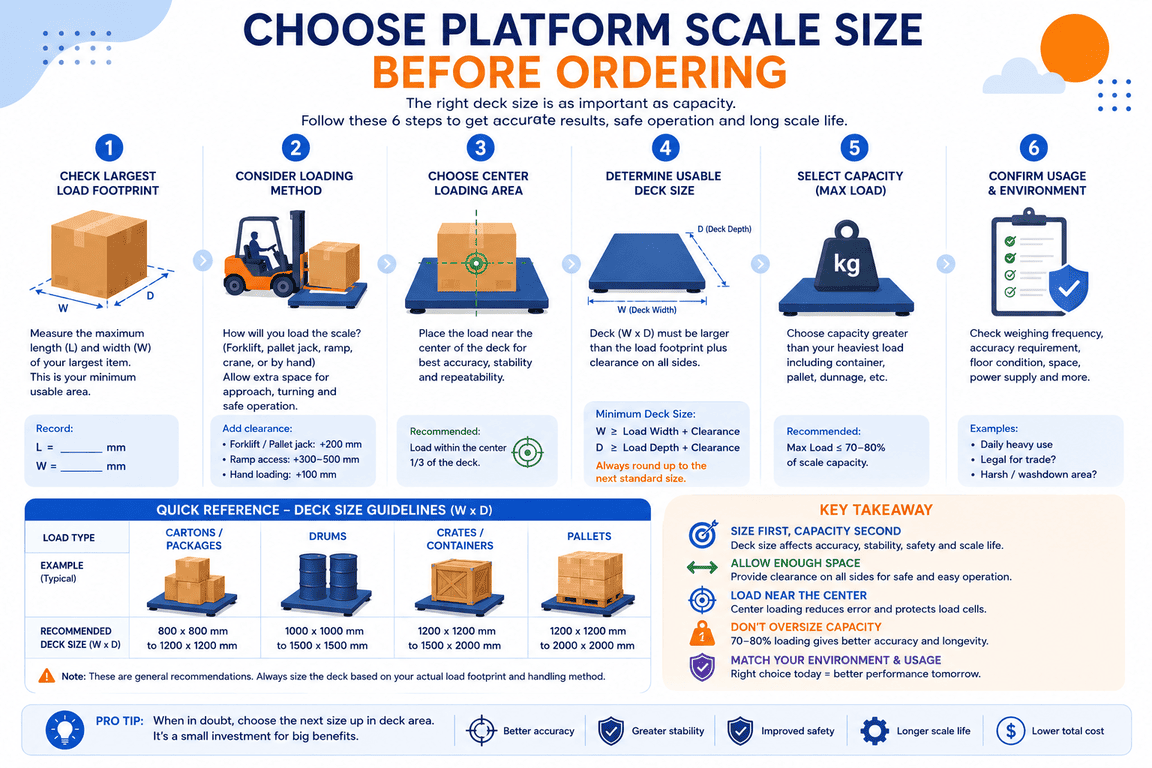
I use a simple method before I recommend a platform scale. I ask the buyer to measure real goods, not only read product names from a list. I prefer photos with a tape measure. I also ask for a short video if the loading method is unclear. This helps me see the real floor condition.
| Step | My Question | My Action |
|---|---|---|
| 1 | What is the heaviest regular item? | I set capacity with a safety margin |
| 2 | What is the largest length and width? | I set the minimum deck size |
| 3 | Can the item sit centered easily? | I add more deck margin if needed |
| 4 | How is the item loaded? | I choose low deck, ramp, or pit type if needed |
| 5 | How many times per day is it weighed? | I improve ergonomics for high-frequency work |
| 6 | Is the area wet, dusty, or corrosive? | I choose material and protection level |
My basic rule is simple. I want the full base of the goods inside the platform. I also want room for small placement errors. If the load is hard to align, I add more margin. If the load is tall, I choose more deck area and a lower structure to reduce tipping risk.
For example, if a wooden crate is 900 × 900 mm, I do not like choosing a 900 × 900 mm platform as the final answer. It may fit in theory. It will not fit well in fast work. I may move toward 1,000 × 1,000 mm or larger, based on loading direction. If workers use a forklift, I also check fork clearance and approach space. If workers use a trolley, I check ramp height and floor layout.
At HENER SCALE, I prefer to act as a selection partner, not only a scale seller. I know the buyer wants a clear answer. I also know the right answer depends on the goods, people, and process. A good platform scale should make weighing feel simple. It should not force workers to balance a load on an undersized deck.
Conclusion
I choose platform scale size by studying real goods first. Capacity matters, but deck dimensions often decide accuracy, safety, and daily efficiency.