













On this page

I have seen strong truck scales fail on weak foundations. The problem grows slowly, and the customer starts losing trust in every weight ticket.
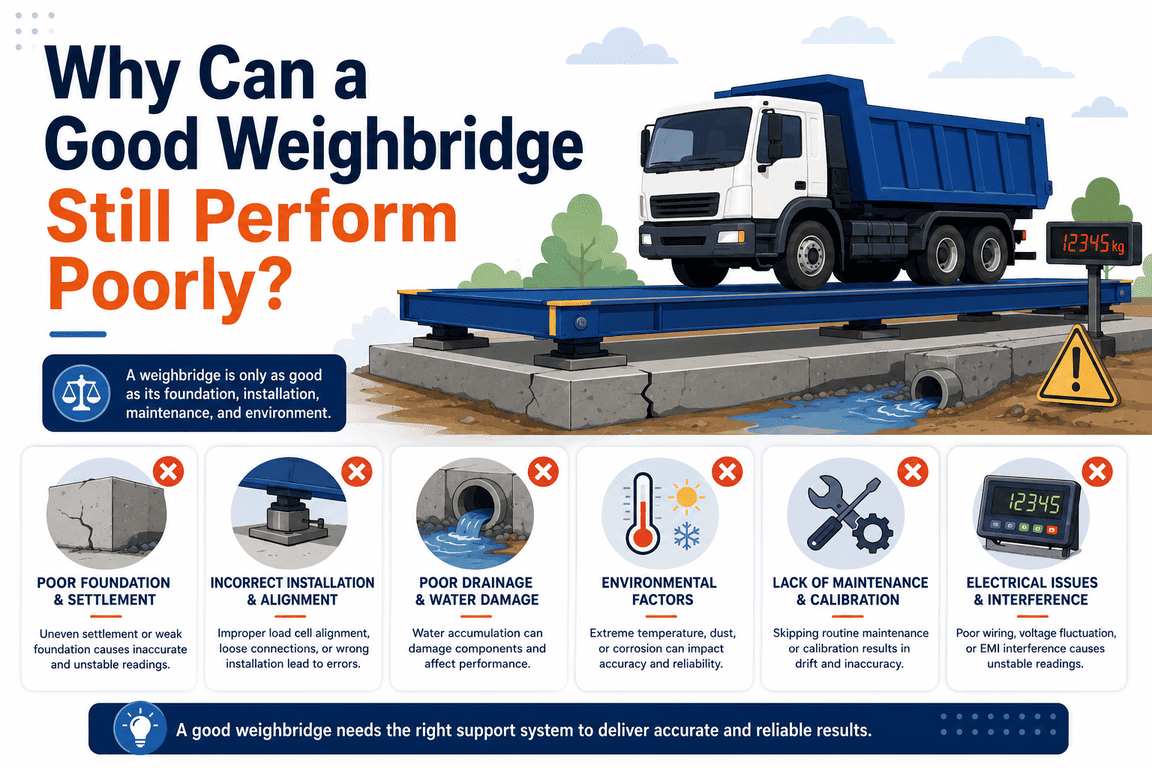
A good weighbridge can perform poorly when the civil foundation has poor drainage, weak concrete, uneven settlement, or wrong limit gaps. The scale may pass the first test, but unstable ground and bad installation can later cause slow zero return, corner error, and poor repeatability.
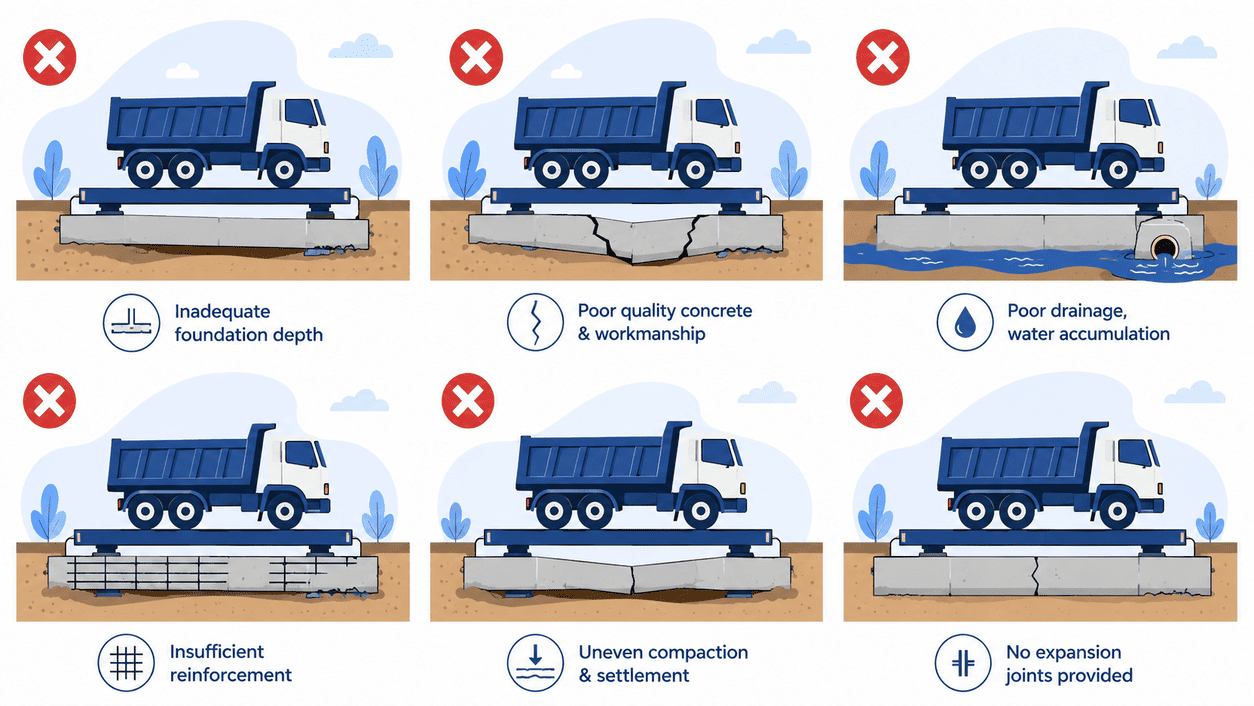
I often tell customers that a truck scale is not only a steel structure with load cells. It is a full weighing project. The foundation carries every truck, every impact, and every rainy season. If I ignore the civil work, I may still deliver a good scale, but the site may destroy its performance. This is why I always look at the ground before I talk about accuracy.
Why Does Foundation Quality Matter as Much as Load Cell Accuracy?
I often hear one complaint first. The customer says the load cell must be bad because the weight keeps changing after some months.
A truck scale foundation matters as much as load cell accuracy because it controls how force reaches each load cell. If the foundation moves, cracks, or holds water, the load cells receive uneven force, and the scale cannot stay stable even when the sensors are good.
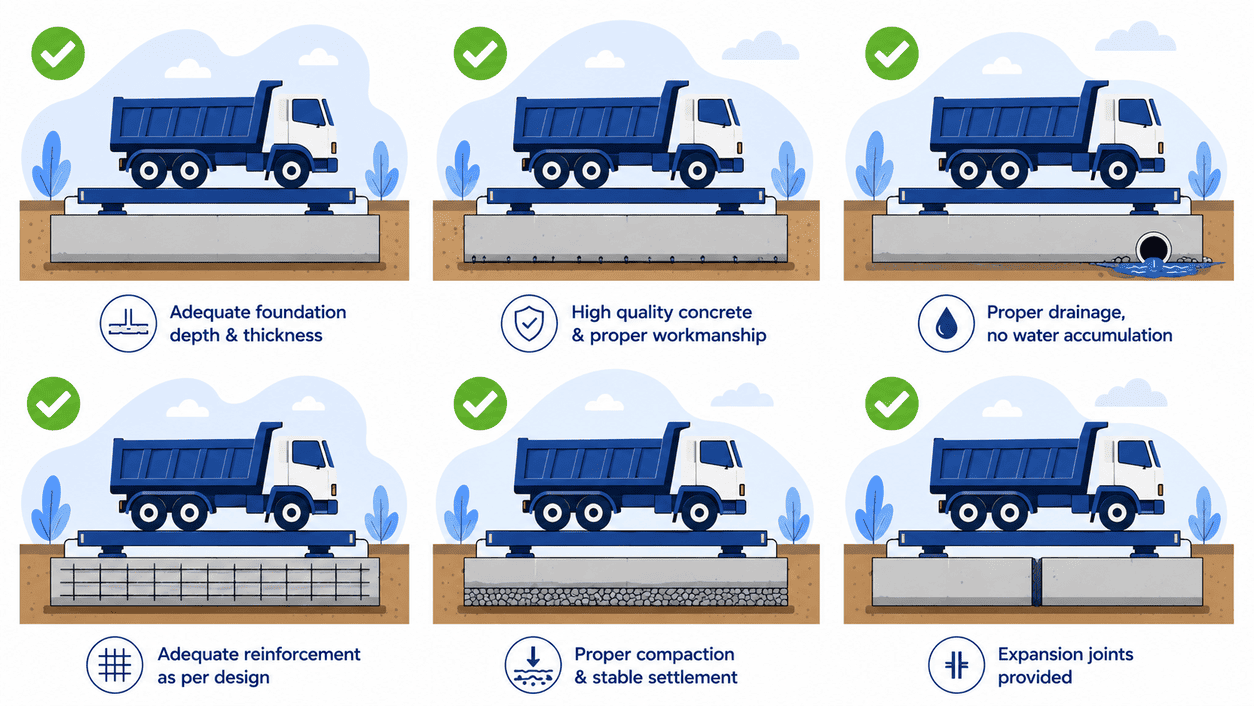
I learned this lesson many times on real sites. A load cell measures force, but the foundation decides how that force travels. If the weighbridge sits on a stable base, each load cell works in a balanced way. If one pier sinks by only a few millimeters, the force path changes. The display may still turn on. The instrument may still be calibrated. The steel deck may still look perfect. The weight result may still be wrong.
I use this simple check when I review a truck scale project
| Item I Check | What I Want to See | What Can Go Wrong |
|---|---|---|
| Soil condition | Stable and compacted ground | Uneven settlement after traffic load |
| Concrete quality | Correct grade and proper curing | Cracks, low strength, and loose anchor points |
| Load cell base | Flat, level, and strong surface | Side force and uneven loading |
| Foundation layout | Matches the scale drawing | Wrong support position and frame stress |
| Site water flow | Water leaves the scale area | Rust, soft soil, and slow settlement |
I do not treat foundation work as a small accessory. I treat it as the first part of the weighing system. When I work with operations managers like Carlos, I explain that the purchase order is only one part of the decision. The civil drawing, site survey, and installation plan also decide long-term accuracy. A truck scale may leave my factory within tolerance. It may also fail in the field if the foundation cannot support the same level of precision.
How Do Drainage, Settlement, and Concrete Strength Become Hidden Risks?
I have visited sites where the scale looked normal from the road. I walked closer and saw water sitting near one side of the foundation.
Drainage, settlement, and concrete strength are hidden risks because they damage the foundation slowly. Water softens soil, settlement changes load distribution, and weak concrete reduces support strength. These problems often appear after weeks or months, not during the first calibration.
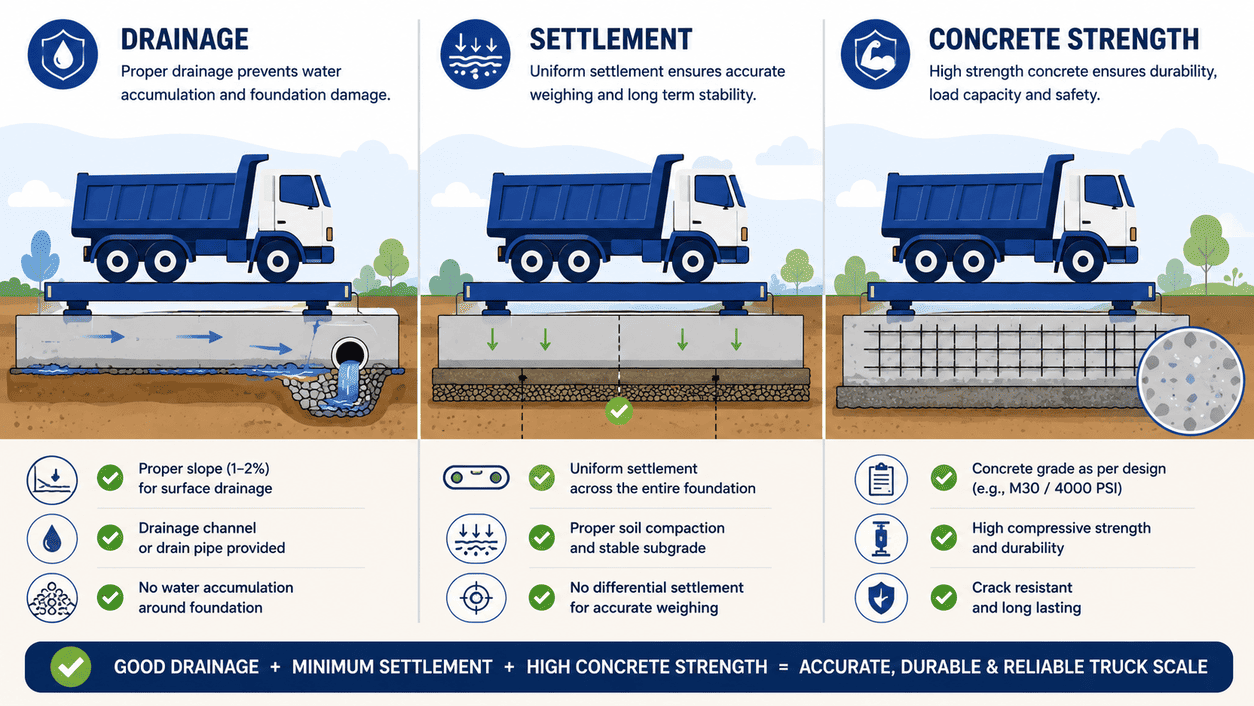
I once handled a case where the truck scale passed the first acceptance test. The customer used it for grain trucks. Three months later, he called me and said the same vehicle showed differences of several dozen kilograms. The team first wanted to replace load cells. I asked them to inspect the foundation before touching the sensors. They found that rainwater had collected along one side of the pit area. The soil under that side had softened. One support point had settled slightly. The load cells were not the root problem.
I separate these three risks in my project review
| Risk | How I Find It | What It Causes |
|---|---|---|
| Poor drainage | I check water flow after rain or washing | Corrosion, soft soil, and unstable zero |
| Uneven settlement | I check level marks and pier height | Corner error and repeatability drift |
| Weak concrete | I check grade, curing time, and cracks | Loose supports and poor load transfer |
Drainage looks simple, but it can decide the life of the foundation. I prefer a site where water leaves the scale area fast. I also prefer drainage channels that stay open and easy to clean. Mud, grain dust, and waste can block drains over time. When water stays around the foundation, the soil loses strength. When soil loses strength, the foundation starts to move.
Concrete strength also needs respect. Some customers want to install the weighbridge quickly after pouring concrete. I understand the pressure. Trucks are waiting. Business cannot stop. Yet concrete needs proper curing time. If the base has not reached enough strength, anchors and supports may not hold well. The scale may work at first, but heavy traffic can expose the weakness later.
How Does Poor Foundation Design Create Corner Error and Repeatability Problems?
I never judge a truck scale by one empty zero reading. I want to know whether each corner carries load in the same way.
Poor foundation design creates corner error and repeatability problems by causing uneven support, side force, and frame stress. When one area carries more load than another, each truck position gives a different result, and the same vehicle may not repeat the same weight.
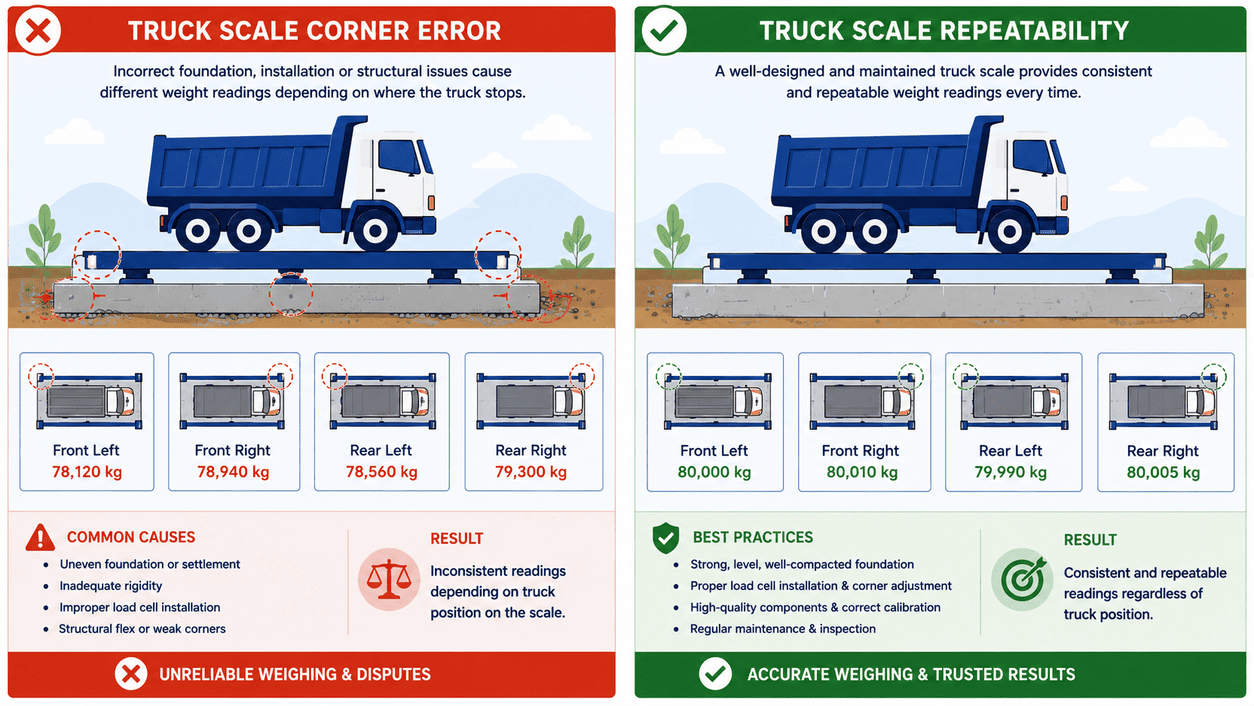
Corner error is one of the clearest signs that force distribution is not right. A truck scale needs each load cell to receive load according to the design. If one load cell base is low, high, tilted, or not aligned, the weighbridge cannot transfer load evenly. The instrument can compensate during calibration, but it cannot fully correct a moving civil problem. If the foundation keeps settling, the correction keeps losing meaning.
I look for these causes before I blame the electronics
| Problem Area | Site Symptom | Weighing Symptom |
|---|---|---|
| Uneven pier height | One module does not sit naturally | Large corner difference |
| Wrong limit gap | Scale deck touches or rubs side parts | Slow zero return |
| Poor anchor position | Support parts shift under load | Weight changes after truck movement |
| Weak approach slab | Truck impact hits scale hard | Unstable repeatability |
| Bad alignment | Vehicle enters at an angle | Side force and friction |
Limit space is a detail that many people miss. A truck scale needs room to move slightly under load and temperature change. If the gap is too small, the deck may touch the foundation wall or stopper. When contact happens, part of the truck load bypasses the load cells. The display may become slow. Zero may not return smoothly. The operator may think the indicator is bad. I first check whether the steel structure is free.
Repeatability has the same logic. If the same truck enters the scale three times and gets three different results, I ask what changed between the three runs. The tire position changed. The approach speed changed. The deck movement changed. If the foundation is solid and the system is free from friction, the results should stay close. If the foundation has stress, each run may load the structure in a slightly different way.
At HENER SCALE, I like to say that accuracy is not only a factory number. It is the result of design, manufacturing, installation, and daily site control. A good load cell cannot repair a bad force path. A good instrument cannot remove friction from a wrong limit gap.
What Should Buyers Confirm Before Installation Starts?
I believe the best time to solve truck scale problems is before concrete is poured. After that, every correction costs more time and money.
Before installation starts, buyers should confirm soil condition, drainage direction, vehicle route, foundation drawing, concrete grade, curing time, grounding protection, cable path, and maintenance access. These points help the scale stay accurate after real trucks, rain, dust, and daily operation begin.
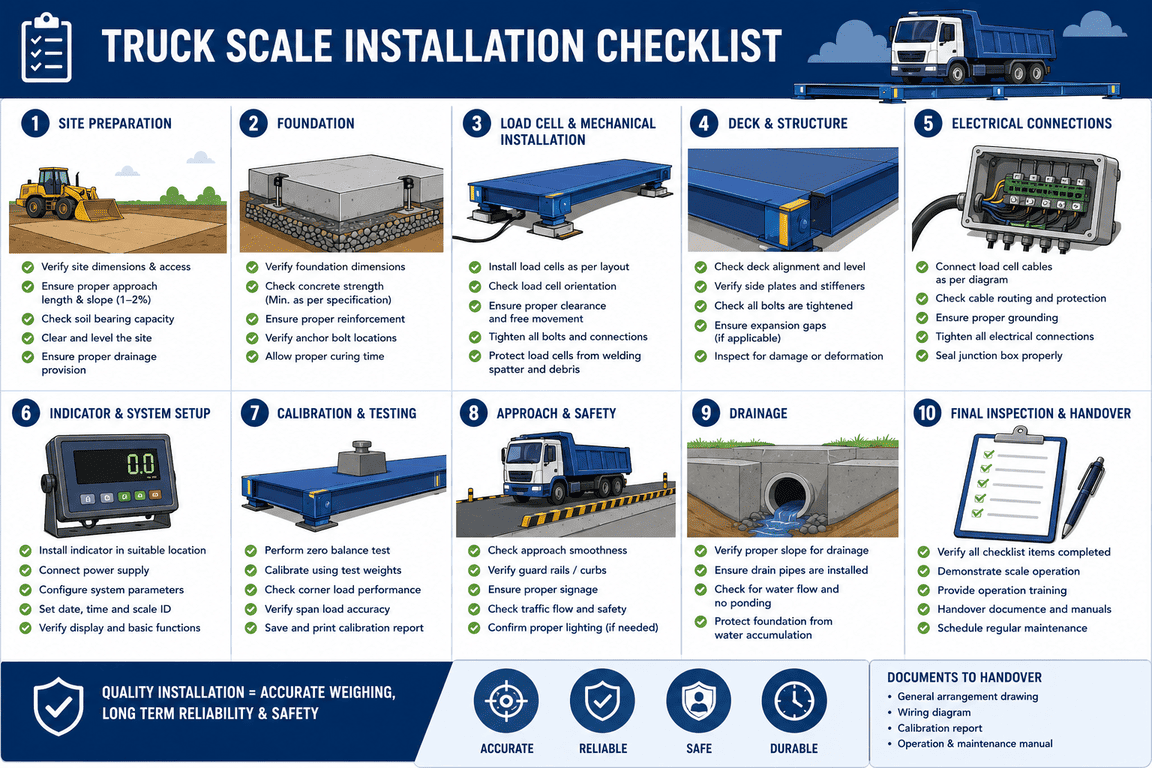
I do not want my customer to buy only equipment. I want him to plan a working weighing station. This matters more for busy sites, such as grain receiving yards, logistics hubs, mines, and factories. At these places, the truck scale is not a quiet machine. It faces heavy loads, dust, rain, traffic pressure, and operator mistakes every day. The civil plan must match that reality.
I ask every buyer to confirm this checklist
| Item | My Question | Why It Matters |
|---|---|---|
| Soil and ground | Has the site been compacted and checked? | Weak ground can settle under truck load |
| Drainage direction | Where will rainwater go? | Standing water damages the foundation |
| Vehicle route | Can trucks enter and leave straight? | Bad routes create impact and side force |
| Concrete grade | Does it meet the drawing requirement? | Low strength reduces long-term stability |
| Curing time | Will the concrete cure long enough? | Early loading can cause cracks |
| Grounding | Is lightning and surge protection planned? | Electronics need safe protection |
| Cable path | Are cables protected from water and rodents? | Signal issues can look like scale errors |
| Maintenance space | Can technicians clean and inspect the pit? | Small problems become large when unseen |
I also ask buyers to check the foundation drawing before local construction begins. The drawing should match the truck scale model, size, capacity, and load cell layout. A small change on site can become a big problem later. If a contractor moves a support point because it looks easier, the scale may not load correctly. If the approach slab is too short or weak, trucks may hit the scale with more shock.
I prefer to discuss the site with the buyer, the civil contractor, and the scale technician together. Each person sees a different risk. The buyer understands traffic flow. The contractor understands concrete work. The scale technician understands load transfer and calibration. When these people talk early, the project becomes safer.
I also suggest that buyers keep photos and records during construction. Photos of rebar, cable pipes, grounding points, drainage pipes, and concrete pouring help later service work. If a problem appears after three months, these records save time. I can compare the original plan with the actual site. I can find whether the problem comes from the equipment, foundation, traffic route, or maintenance.
Conclusion
I trust a truck scale only when the foundation, drainage, concrete, installation, and calibration work together. Good weighing starts before the scale arrives.