













On this page

A weighbridge for trucks can look simple from a distance, but the wrong choice creates real problems: unstable weighing, incomplete truck positioning, repeat operations, and weight-data disputes. I have seen many buyers start with price or maximum capacity first. I prefer a safer route: start with the actual vehicles and working conditions.
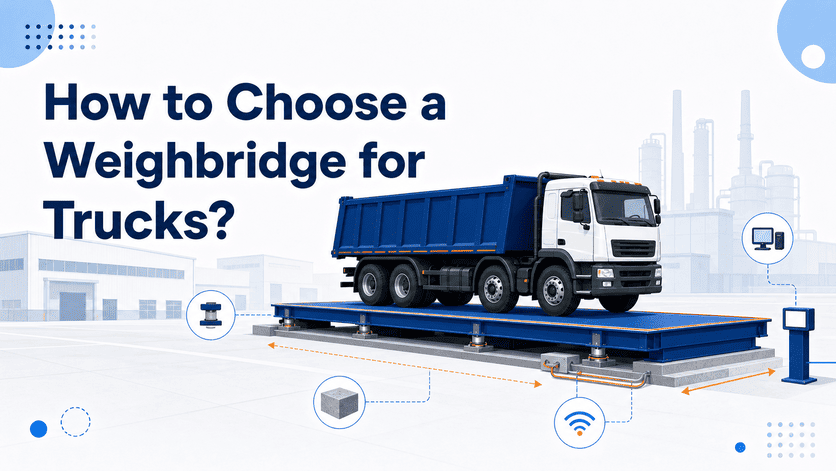
To choose a weighbridge for trucks, I first match the platform length, width, capacity, structure, load cells, foundation, and data options to the real trucks being weighed. The best choice is not always the biggest or cheapest model. It is the model that allows full, stable, repeatable weighing under normal and credible overload conditions.
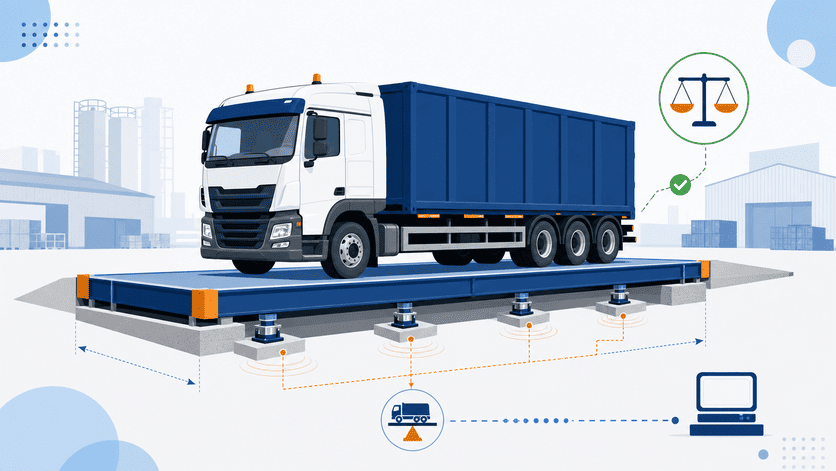
I manufacture and inspect industrial weighing equipment, so I look at this decision from the factory side: structure, welding, load-cell assembly, calibration, repeatability testing, and final inspection. However, I also separate factory capability from site realities. Installation quality, local certification, maintenance, and operating discipline still matter after delivery.
What Vehicle Data Should I Check Before Choosing a Weighbridge for Trucks?
Many buyers start by asking for a 60-ton or 80-ton truck scale. That sounds logical, but it often skips the most important question. If the longest truck cannot sit fully and stably on the deck, the rated capacity alone will not solve the weighing problem.
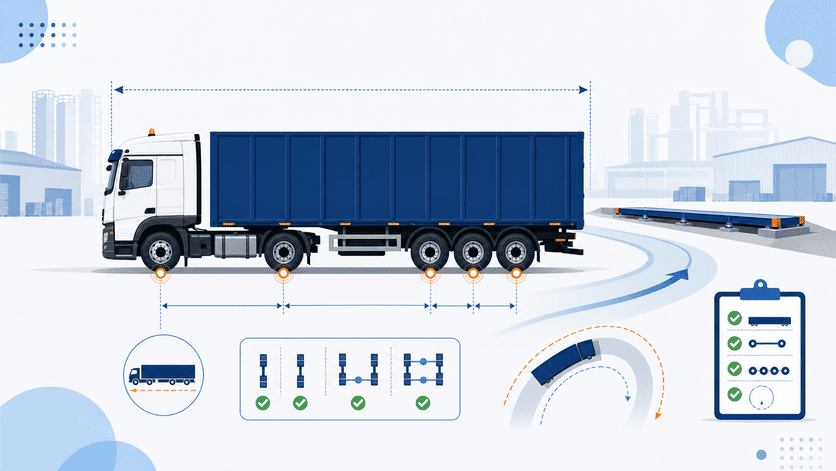
I recommend collecting real vehicle data before choosing a weighbridge for trucks. I check the longest vehicle, most common vehicle, axle configuration, wheelbase, trailer type, turning space, and weighing workflow. This information helps determine effective platform length, width, capacity, and approach design more accurately than tonnage alone.
Start with the longest truck, not the catalog model
When I review a truck weighbridge inquiry, I want to know the vehicle before I discuss the steel. A platform can have excellent fabrication, but it still becomes the wrong choice if the truck does not fit the weighing process.
I usually ask for:
- Maximum vehicle length
- Most common vehicle length
- Truck and trailer combination
- Axle number and axle spacing
- Wheelbase
- Maximum loaded weight
- Typical loaded weight
- Weighing direction
- Available entrance and exit space
- Whether the whole vehicle must be weighed at once
A common mistake is treating all “trucks” as similar. A rigid truck, semi-trailer, fuel tanker, dump truck, container truck, and agricultural vehicle may all need different platform planning. The vehicle’s full length matters, but axle position also matters because the load must transfer correctly through the deck, load cells, and foundation.
Use effective platform length
I also pay attention to effective weighing length, not just nominal deck length. The full truck should be positioned safely on the weighing area without forcing the driver to stop with wheels too close to the edges or ramps. If a site uses trailers, I ask whether the tractor and trailer must be weighed together or separately.
Here is a simple planning table I use during early discussions:
| Vehicle factor | Why I check it | Risk if ignored |
|---|---|---|
| Longest truck length | Determines platform fit | Incomplete weighing or repeat positioning |
| Axle configuration | Affects load distribution | Unstable readings or uneven stress |
| Trailer use | Changes total vehicle length | Platform may be too short |
| Turning area | Affects safe entry | Driver correction and wasted time |
| Weighing frequency | Affects durability needs | Premature wear under heavy use |
| Loaded material | Affects overload risk | Capacity may be too low |
I avoid guessing from legal weight alone
Legal vehicle weight is useful, but it is not enough. Some sites handle uneven loading, temporary overload, bulk material variation, or vehicles that arrive from multiple contractors. I do not treat these conditions as rare until the buyer confirms them.
I prefer to design around real weighing behavior, not only around a number printed in a regulation or tender sheet.
This approach is especially important for factories, mines, logistics yards, farms, construction material sites, and ports. These sites often weigh vehicles under time pressure. If the platform is too short or the traffic flow is poorly planned, the operator may need to weigh twice, reposition the truck, or manually resolve disputes. That creates more risk than the money saved by buying a smaller deck.
How Do I Select the Right Capacity for a Weighbridge for Trucks?
Capacity selection feels easy at first. Many buyers simply choose the highest tonnage within budget. However, that can waste money, while choosing too low can create overload risk. I see capacity as a balance between normal loads, credible overload events, and weighing frequency.
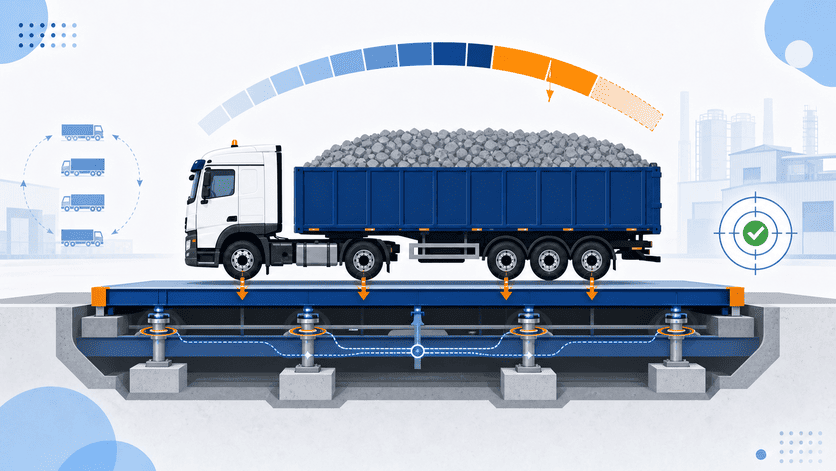
To select capacity for a weighbridge for trucks, I compare typical gross vehicle weight, maximum expected load, possible overload events, and daily weighing volume. I do not choose capacity only from the legal maximum. I also check load-cell rating, structural design, foundation support, and required accuracy under realistic use.
Match capacity to real operating risk
A truck weighbridge should handle normal operations comfortably. It should also have reasonable protection for credible overload events. That does not mean every buyer needs the highest-tonnage platform. It means the selected model should fit the real site.
I usually divide capacity thinking into three layers:
-
Normal operating weight
This is the weight the scale sees most days. -
Maximum expected weight
This is the heaviest truck the site reasonably expects. -
Credible overload condition
This includes uneven loading, material variation, driver error, or unusual site events.
When I manufacture or inspect a platform, I look at how the structure, load cells, junction box, indicator, and calibration process work together. The nominal capacity is only one part of the full system. A high-capacity label does not automatically mean the system is suitable if the structure, load transfer, installation, and calibration are not aligned.
Consider frequency, not only weight
A truck scale used ten times per day does not face the same operating demand as one used hundreds of times per day. Higher traffic can increase fatigue stress on the deck, ramps, load-cell mounts, and foundation connection points.1 I do not claim factory testing can predict every long-term site result. Still, from a manufacturing perspective, I know repeated loading makes structural consistency and component quality more important.
Here is how I normally frame capacity decisions:
| Operating condition | Selection focus | My practical concern |
|---|---|---|
| Low-frequency weighing | Fit and basic durability | Avoid overspending |
| High-frequency logistics yard | Structural fatigue and workflow | Reduce downtime risk |
| Mining or aggregates | Heavy loads and impact | Check deck strength and load-cell protection |
| Agriculture | Seasonal peaks and dirt exposure | Plan cleaning and access |
| Factory dispatch | Data accuracy and process control | Link weighing data if needed |
Do not use capacity to fix platform-fit problems
A larger capacity does not fix a platform that is too short. If a vehicle cannot stand fully on the weighing deck, the reading may not represent the full vehicle weight.2 I have seen buyers focus on 80-ton or 100-ton capacity while ignoring a trailer length issue. That is the wrong order.
I prefer this sequence:
- Confirm vehicle fit
- Confirm capacity
- Confirm structure
- Confirm foundation
- Confirm calibration and inspection
- Confirm data and operating workflow
For HENER projects, I can provide truck weighbridge options with different capacities, modular structures, load-cell configurations, and communication interfaces. But I still ask for vehicle and site details first. A good capacity choice should reduce operating risk, not just look strong in a quotation.
Is a Longer or Higher-Tonnage Weighbridge for Trucks Always Better?
It is tempting to buy the biggest platform available. A longer and heavier-rated model sounds safer. However, oversized specifications can increase cost, shipping volume, foundation work, installation time, and maintenance complexity without improving the real weighing process.
A longer or higher-capacity weighbridge for trucks is not automatically better. I choose a larger deck or higher tonnage only when vehicle length, site traffic, overload risk, or future fleet changes justify it. The best truck weighing system fits the workflow instead of simply maximizing specifications.
Bigger can help, but only when the site needs it
There are valid reasons to choose a longer deck. For example, a site may weigh long semi-trailers, container trucks, or mixed fleets. A logistics center may also want flexibility because different carriers arrive every day. In those cases, more platform length can reduce positioning problems.
However, I do not treat “longer” as a universal answer. A longer weighbridge may require:
- More steel structure
- Higher freight cost
- Larger foundation area
- More installation space
- More civil work
- More approach planning
- Additional drainage consideration
- More surface coating area
If the longest truck is already fully supported on a suitable shorter deck, extra length may not improve accuracy or efficiency. It may only increase cost.
Higher capacity also has trade-offs
The same logic applies to higher capacity. A higher-tonnage truck scale may require stronger beams, heavier plates, different load cells, and a more robust foundation. That can be necessary for mining, heavy construction materials, ports, or high-overload risk environments. But it may not be necessary for a warehouse that weighs standard delivery vehicles.
I often compare choices like this:
| Buyer assumption | My manufacturing-side question | Better decision path |
|---|---|---|
| “Higher capacity is safer.” | What overload event are we protecting against? | Select capacity based on real risk |
| “Longer platform is more accurate.” | Does the full vehicle already fit? | Match deck length to vehicle length |
| “Thicker steel means better quality.” | How is the structure designed and tested? | Review full construction and inspection |
| “Lowest price saves money.” | What happens if trucks must reweigh? | Compare total operating risk |
| “Automation is always needed.” | Does the site need unattended weighing? | Add data functions only when useful |
I plan for future fleet changes, but I avoid speculation
Future-proofing has value. If a buyer knows that longer trailers or heavier trucks will be introduced within a clear period, I consider that during selection. However, I avoid designing around vague possibilities. “Maybe one day we will use larger trucks” is not enough by itself.
A practical compromise is to define:
- Current fleet
- Confirmed future fleet
- Possible but unconfirmed vehicles
- Site expansion limits
- Budget limits
- Civil construction limits
This keeps the decision grounded. A truck weighbridge is a capital asset, so I understand why buyers want room for growth. Still, I believe a good specification should have a reason behind every added meter and every added ton.
What Makes a Weighbridge for Trucks Durable Beyond Steel Plate Thickness?
Many people judge durability by deck plate thickness first. I understand why. Steel thickness is visible and easy to compare. But in manufacturing, I see durability as a system result. Plate thickness matters, but it does not work alone.
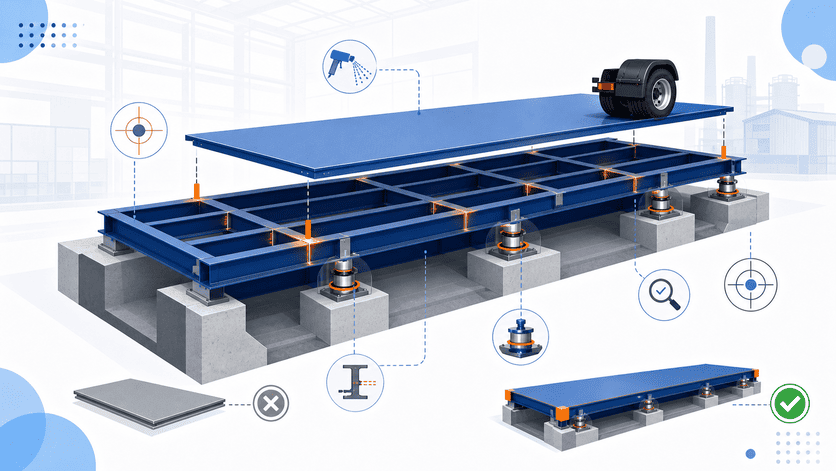
A durable weighbridge for trucks depends on structural design, beam layout, welding quality, load-cell protection, surface treatment, component quality, assembly accuracy, calibration, and inspection. I do not judge a truck scale by steel plate thickness alone because poor design or weak components can still reduce usable performance.
Structural design matters as much as material quantity
A thick plate on a weak structure is not a good solution. The platform needs a load path that transfers vehicle weight consistently to the load cells. Cross beams, main beams, module joints, end plates, and load-cell mounting points all matter.
In factory inspection, I focus on details such as:
- Beam alignment
- Welding consistency
- Module flatness
- Load-cell seat accuracy
- Bolt hole positioning
- Surface treatment coverage
- Deck deformation control
- Cable protection paths
- Access for maintenance
These details are not always visible in a simple product photo. That is why I encourage buyers to review technical drawings, structural descriptions, production photos, and inspection procedures before choosing only by plate thickness.
Load cells and indicators are not minor accessories
The load cell is the sensing heart of the system.3 The indicator is the operator’s interface. The junction box, cables, grounding, and sealing also affect stability. A heavy steel deck with poor electronic components will not satisfy a buyer who needs stable readings.
For industrial truck scales, I usually pay attention to:
- Load-cell capacity and safety margin
- Protection rating, such as IP67 where required
- Sealing method
- Cable shielding
- Junction box quality
- Indicator resolution and interface
- Temperature compensation
- Compatibility with data systems
At HENER, our manufacturing scope covers truck scales, weighing platforms, load cells, indicators, junction boxes, and remote displays. This helps me think about the whole weighing system instead of treating each part as separate. However, I still tell buyers that local installation, grounding, maintenance, and calibration schedules influence final site performance.
Factory testing reduces risk, but it does not replace site responsibility
During production and inspection, I can check fabrication quality, assembly, repeatability, overload response, calibration, and final appearance. These steps help reduce manufacturing-side risk. They do not guarantee that every site will perform perfectly under every condition.
A site can still create problems through:
- Poor foundation levelness4
- Inadequate drainage
- Bad grounding
- Damaged cables
- Dirt buildup under the deck
- Vehicle impact
- Lack of periodic calibration
- Unauthorized repair
- Local legal non-compliance
So I separate two questions:
- Is the weighbridge manufactured and tested properly?
- Is the weighbridge installed, used, and maintained properly?
Both answers matter. A strong supplier should provide technical documents, installation guidance, calibration support, and spare parts. A responsible buyer should also plan civil work, site protection, and local certification requirements.
Which Foundation, Installation, and Data Options Should I Plan for a Weighbridge for Trucks?
A truck weighbridge is not only a product. It is part of a traffic process. If the foundation, ramps, drainage, power supply, operator station, and data output are poorly planned, even a well-made scale can become inconvenient to use.
When I plan a weighbridge for trucks, I consider pit or pitless installation, foundation drawings, approach space, drainage, grounding, cable routing, indicator location, data communication, and software needs. I only recommend automation when it improves workflow, traceability, or labor efficiency for that specific site.
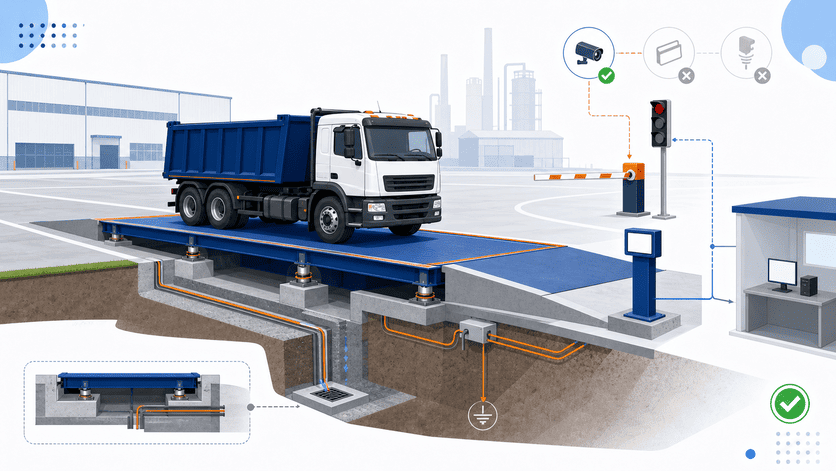
Pit or pitless installation
Both pit and pitless designs can work. The better choice depends on site layout, construction preference, drainage, cleaning access, and traffic requirements.
| Installation type | Advantages | Points I check |
|---|---|---|
| Pit-mounted weighbridge | Lower profile and easier vehicle entry | Drainage, cleaning, access, civil accuracy |
| Pitless weighbridge | Easier maintenance access and drainage | Ramp length, space, traffic flow |
| Modular surface-mounted design | Faster transport and assembly | Foundation levelness and module connection |
| Customized structure | Better fit for special sites | Drawing confirmation and production control |
I do not choose installation type from appearance alone. A pit installation may look neat, but poor drainage can create serious maintenance problems.5 A pitless system may be easier to access, but it needs enough ramp and approach space.
Data options should follow the weighing process
Not every site needs a fully unattended system. Some operations only need a reliable indicator and printed ticket. Other sites need ERP integration, PLC communication, camera records, license plate recognition, remote displays, or automatic barriers.
I normally group data options into levels:
-
Basic weighing
- Indicator
- Printer
- Manual record
-
Connected weighing
- RS232/RS485
- Modbus
- Ethernet
- 4–20mA where applicable
-
Operational visibility
- Remote large display
- Computer software
- Weighing reports
- Operator permissions
-
Unattended vehicle weighing
- License plate recognition
- Cameras
- Automatic barriers
- Traffic lights
- Weighing software
- ERP or site system connection
I support these functions when the buyer’s process requires them. However, I do not push automation into every quotation. Automation adds value when it reduces manual errors, improves traffic control, or creates reliable records. It adds complexity when the site does not have the process discipline to use it.
Documentation and local compliance
I also remind buyers to check local legal metrology requirements. Some markets require specific approvals, verification, or certification before commercial weighing.6 Factory documents can support the process, but local compliance depends on the destination country and the appointed authority.
For technical documentation, I recommend requesting:
- General arrangement drawing
- Foundation drawing
- Load-cell and indicator specifications
- Wiring diagram
- Installation guide
- Calibration guidance
- Packing list
- Inspection report
- Warranty terms
- Spare parts list
For North American projects, some buyers may need NTEP-related supply chain support. For other markets, buyers may focus on OIML, CE, or local verification. I always prefer to clarify this early, because certification requirements can affect component selection, documentation, and project timing.
Frequently Asked Questions
What is the difference between a weighbridge and a truck scale?
A weighbridge and a truck scale usually refer to the same type of vehicle weighing system.7 “Weighbridge” is more common in many international markets, while “truck scale” is common in North America. I use both terms, but the selection logic remains the same.
How long should a truck weighbridge be?
A truck weighbridge should be long enough for the complete vehicle or required vehicle combination to stand fully and stably on the weighing deck. I do not recommend a universal length without checking truck length, trailer use, axle spacing, and site workflow.
Is a pit or pitless weighbridge better for trucks?
Neither design is always better. A pit-mounted weighbridge has a lower profile, while a pitless weighbridge usually provides easier maintenance access and drainage. I choose between them based on site space, civil work, cleaning needs, traffic flow, and local installation conditions.
Does thicker steel make a truck weighbridge more durable?
Thicker steel can help, but it does not define durability by itself. I also check beam design, welding, load-cell protection, surface treatment, assembly accuracy, calibration, and inspection. A balanced structure with quality components usually matters more than one isolated material number.
Can a truck weighbridge connect to ERP or weighing software?
Yes, many truck weighbridges can connect to ERP systems, PLCs, weighing software, remote displays, printers, and automation devices. I usually confirm the required communication protocol first, such as RS232, RS485, Modbus, Ethernet, WiFi, Bluetooth, or 4–20mA.
Conclusion
Choosing a weighbridge for trucks is really a vehicle-fit and operating-risk decision. I always start with the actual fleet, then I confirm platform size, capacity, structure, components, foundation, calibration, and data needs. The best choice is not automatically the longest, heaviest, or cheapest model. It is the system that supports stable weighing in real conditions. If you are planning a truck weighbridge project, contact HENER with your vehicle details, site layout, and weighing process, and I can help you build a practical specification.
References
- [PDF] Design and Evaluation of Steel Bridges for Fatigue and Fracture
- What Affects Long-Term Truck Scale Design and Fabrication ...
- What are Load Cells? - DwyerOmega
- Choosing the Right Weighbridge: An Expert Guide - hener scale
- Weighbridge Maintenance Checklist: Routine Tasks and ...
- International Organization of Legal Metrology - Wikipedia
- Truck Scale vs Weighbridge: What Is the Difference? - Henerscale