














On this page

A weighbridge can look healthy while bad weight data is already starting. I have seen small site habits become expensive weighing disputes.
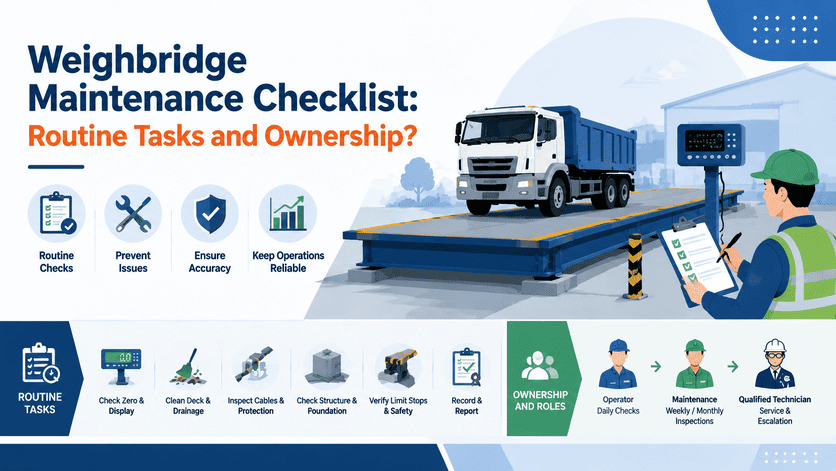
A weighbridge maintenance checklist should assign who observes, who cleans, who records, who inspects, and who escalates. It should cover deck condition, debris, drainage, cables, junction boxes, indicators, foundation movement, calibration, and legal verification. I adjust the frequency by traffic, environment, and local rules.
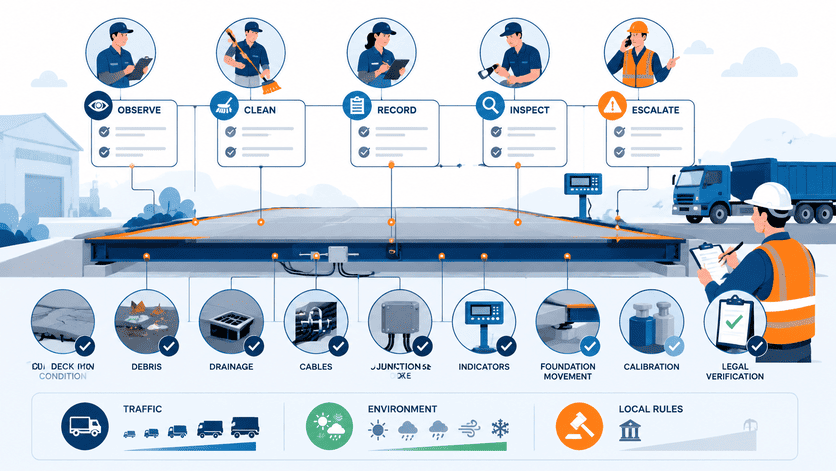
I do not treat weighbridge maintenance as a paper form that sits in a drawer. I treat it as a working ownership system. In many operating sites, the scale fails slowly before it fails clearly. The indicator may still show a number. The truck may still pass over the deck. The ticket may still print. But the site may already have drift, deck binding, cable damage, water inside a junction box, or foundation movement.1 I use this checklist method to help site teams see the risk early, assign the right person, and call a supplier or qualified technician before the weight data becomes unreliable.
Who Should Own Each Weighbridge Maintenance Task?
A checklist without ownership creates confusion. I have seen operators notice problems, but nobody knows who should act first.
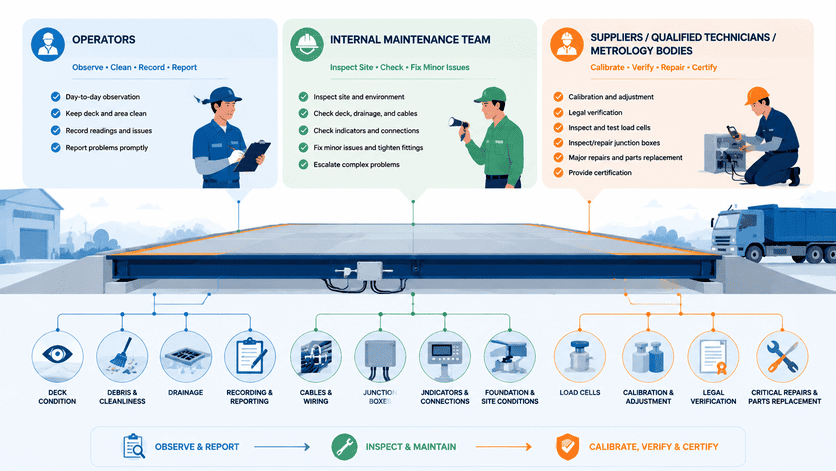
I split weighbridge maintenance into three ownership levels: operators observe, clean, record, and report; internal maintenance teams inspect site conditions and obvious issues; suppliers, qualified technicians, or metrology bodies handle calibration, verification, load cells, junction boxes, and critical repairs.
I Separate Simple Observation From Technical Repair
I do this because each role sees a different part of the problem. The operator sees the weighbridge every hour. The internal maintenance team understands the yard, drainage, power, and basic site condition. The supplier or qualified technician understands the load cells, junction box, indicator, wiring, calibration, and structural design limits. I never want an operator to open a junction box or replace a load cell. That creates safety risk and accuracy risk. I also do not want a site to wait for a technician when the real issue is mud packed under the deck.
| Task area | I usually assign this owner | I expect this action |
|---|---|---|
| Daily deck check | Operator | I ask the operator to look for debris, damage, and abnormal readings. |
| Cleaning around the deck | Operator or yard team | I ask the team to remove mud, stones, and loose material when safe. |
| Drainage and foundation observation | Internal maintenance team | I ask them to check water, settlement, cracks, and blocked drains. |
| Cable and junction box condition | Internal maintenance team for visual check only | I ask them to report damage and avoid opening sealed parts. |
| Calibration and verification | Supplier, qualified technician, or legal metrology body | I ask them to follow local rules and the equipment manual. |
| Load cell or indicator repair | Supplier or qualified technician | I ask them to confirm the fault and repair critical components. |
This ownership split helps the site move faster. It also protects the scale from unplanned damage caused by well-meaning but untrained repair work.
What Should Operators Check Every Day?
Daily checks are simple, but they protect the weighbridge from slow problems. I trust operators because they see the first warning signs.
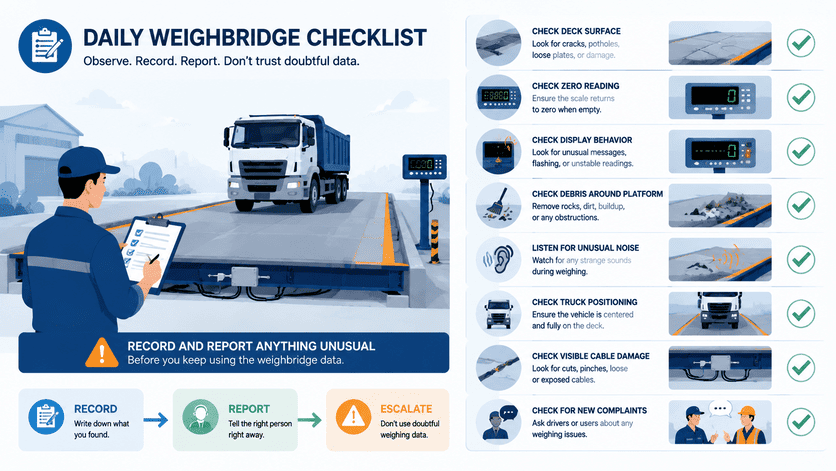
I ask operators to check the deck surface, zero reading, abnormal display behavior, debris around the platform, unusual noise, truck positioning, visible cable damage, and any new weighing complaint. I ask them to record and report anything unusual before they keep using doubtful data.
I Keep Daily Tasks Clear And Safe
I keep the daily list short because operators are busy. A checklist that takes too long will not survive real site work. The daily task is not repair. The daily task is observation, cleaning, recording, and reporting. I ask the operator to look at the indicator before the first weighing. I ask them to confirm that the display returns close to zero when the deck is empty. I ask them to notice if the number drifts, jumps, alarms, or behaves differently from yesterday. I also ask them to listen for scraping, knocking, or unusual contact when a vehicle enters.
| Daily item | What I ask the operator to do | Why I care |
|---|---|---|
| Empty deck reading | I ask the operator to check zero behavior. | Drift can show early electrical or mechanical issues. |
| Deck and approach area | I ask the operator to look for mud, stones, scrap, or cargo spills. | Debris can cause deck binding or unsafe vehicle movement.2 |
| Truck position | I ask the operator to guide proper positioning when needed. | Poor positioning can create repeatability problems. |
| Indicator behavior | I ask the operator to record alarms, flicker, or unstable readings. | Display issues can point to signal, power, or component problems. |
| Visible damage | I ask the operator to report broken covers, exposed cables, or impact marks. | Small damage can become a larger fault quickly. |
In muddy, dusty, or high-traffic sites, I may ask for these checks more than once each day. I adjust the routine by the real site, not by a fixed calendar.
What Should Internal Maintenance Teams Inspect Weekly Or Monthly?
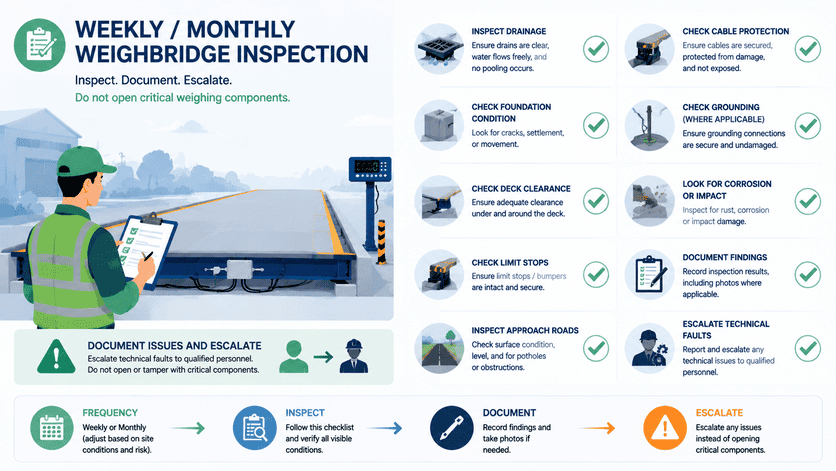
Some problems are not visible from the scale house. I ask internal maintenance teams to inspect the site around the weighbridge.
I ask internal maintenance teams to inspect drainage, foundation condition, deck clearance, limit stops, approach roads, cable protection, grounding condition where applicable, and signs of corrosion or impact. They should document issues and escalate technical faults instead of opening critical weighing components.
I Look Beyond The Indicator
The most common mistake I see is simple. A site says, “The indicator still shows weight, so the scale is fine.” I do not accept that as a maintenance result. A weighbridge is a mechanical structure, a civil foundation, and an electronic measurement system at the same time. A good indicator display does not prove that the deck is free, the foundation is stable, the drainage is clear, or the cables are safe.
| Inspection area | Weekly or monthly focus | When I escalate |
|---|---|---|
| Drainage | I check whether water collects under or around the scale. | I escalate when water reaches components or weakens the foundation area. |
| Foundation | I look for settlement, cracks, or movement. | I escalate when the deck height changes or truck movement feels abnormal. |
| Deck clearance | I check whether mud, stones, or steel parts touch the deck. | I escalate when binding may affect weighing. |
| Limit stops | I check for obvious contact, looseness, or impact marks. | I escalate when movement is restricted or noisy. |
| Cables | I inspect visible protection and routing. | I escalate when insulation is damaged or cables are crushed. |
| Corrosion | I look at exposed steel, bolts, covers, and cable entries. | I escalate when corrosion threatens structure or sealing. |
I also ask the team to connect these findings to site conditions. A mine, cement yard, grain site, port, and food plant do not age the same way. Heavy trucks, dust, mud, washdown, salt air, vibration, and traffic volume all change the frequency.
How Should I Separate Routine Maintenance From Calibration?
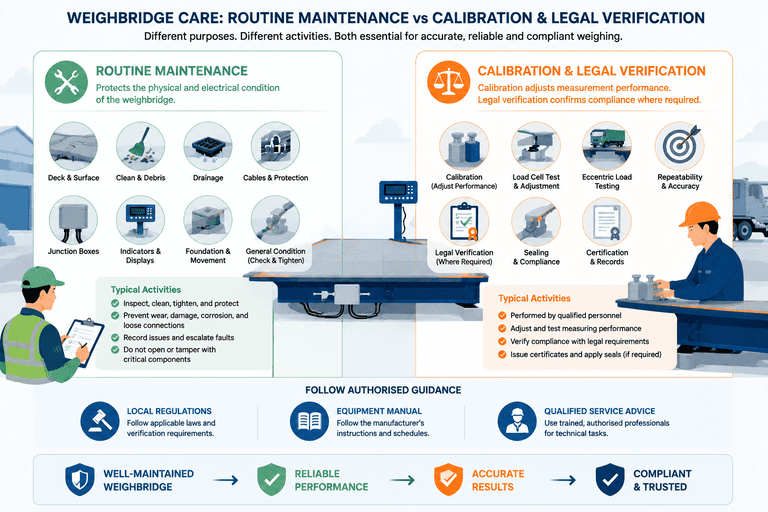
Calibration matters, but it is not the whole maintenance plan. I have seen calibrated scales become unreliable because the site ignored debris and drainage.
I separate routine maintenance from calibration and legal verification. Routine maintenance protects the physical and electrical condition of the weighbridge. Calibration adjusts measurement performance. Legal verification confirms compliance where required.3 I follow local regulations, the equipment manual, and qualified service advice.
I Treat Calibration As One Control Point
I respect calibration because weight data affects money, inventory, compliance, and customer trust. But I do not let calibration replace daily care. If a scale is calibrated while the deck is binding, the result may not protect the site for long. If water enters a junction box after calibration, the certificate does not stop signal drift. If a truck hits the side rail and shifts a limit stop, the last test does not remove the new mechanical problem.
| Control type | What I use it for | Who should handle it |
|---|---|---|
| Routine observation | I use it to find early visible or operating problems. | Operator or site supervisor |
| Routine cleaning | I use it to prevent debris, mud, and loose material from affecting movement. | Operator, yard team, or maintenance team |
| Site inspection | I use it to check foundation, drainage, clearance, and visible damage. | Internal maintenance team |
| Calibration | I use it to adjust or confirm weighing performance. | Supplier or qualified technician |
| Legal verification | I use it to meet trade or local compliance needs where required. | Legal metrology body or approved party, based on local rules |
| Critical repair | I use it to restore failed components or signal systems. | Supplier or qualified technician |
I always tell customers to confirm local requirements. I am a manufacturer and supplier. I can support equipment, parts, documents, and technical guidance. I do not replace local legal metrology rules or the authority responsible for trade approval.
What Warning Signs Mean The Weighbridge Needs Escalation?
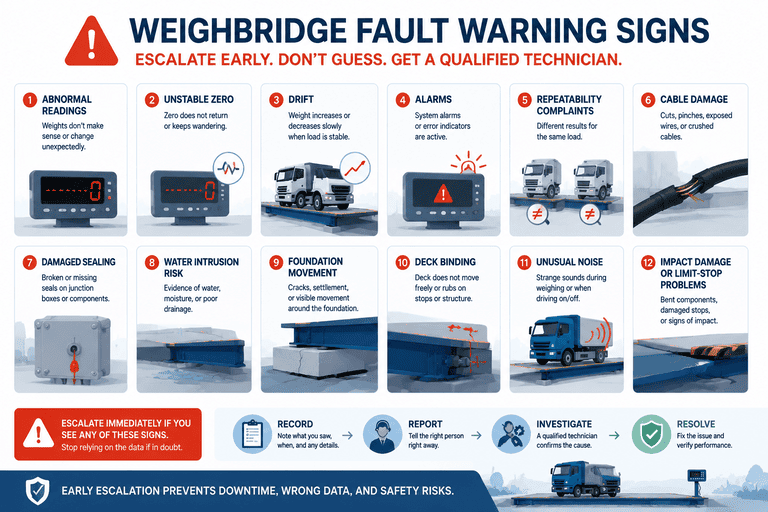
A weighbridge rarely sends a polite warning before a serious data issue. I teach site teams to notice small changes early.
I escalate when I see abnormal readings, unstable zero, drift, alarms, repeatability complaints, cable damage, damaged sealing, water intrusion risk, foundation movement, deck binding, unusual noise, impact damage, or limit-stop problems. A qualified technician should confirm the cause.
I Do Not Wait For A Complete Failure
I have handled many after-sales conversations where the site waited too long because the scale still produced tickets. That is why I ask for early escalation. The ticket is not proof. It is only an output. The real question is whether the weighing system is still working under the right mechanical and electrical conditions.
| Warning sign | What I think it may suggest | What I ask the site to do |
|---|---|---|
| Weight does not return to zero | I consider drift, debris, binding, or signal problems. | I ask the operator to stop trusting doubtful data and report it. |
| Same truck gives different results | I consider positioning, mechanical contact, load cell issues, or calibration risk. | I ask the site to record examples and call support. |
| Indicator alarms or flickers | I consider power, cable, junction box, or instrument issues. | I ask the site not to open sealed parts and to request technical help. |
| Scraping or knocking noise | I consider deck contact, limit-stop issues, or impact damage. | I ask maintenance to inspect visible mechanical areas safely. |
| Water near components | I consider sealing, drainage, and corrosion risk. | I ask the site to improve drainage and call a technician if components may be affected. |
| Cracks or settlement | I consider foundation movement. | I ask the site to stop guessing and arrange inspection. |
I prefer one early service call over months of hidden weighing error. A truck scale supports daily decisions. Bad data can move into purchasing, sales, stock records, freight claims, and customer disputes.
How Often Should I Use A Daily, Weekly, Monthly, And Annual Checklist?
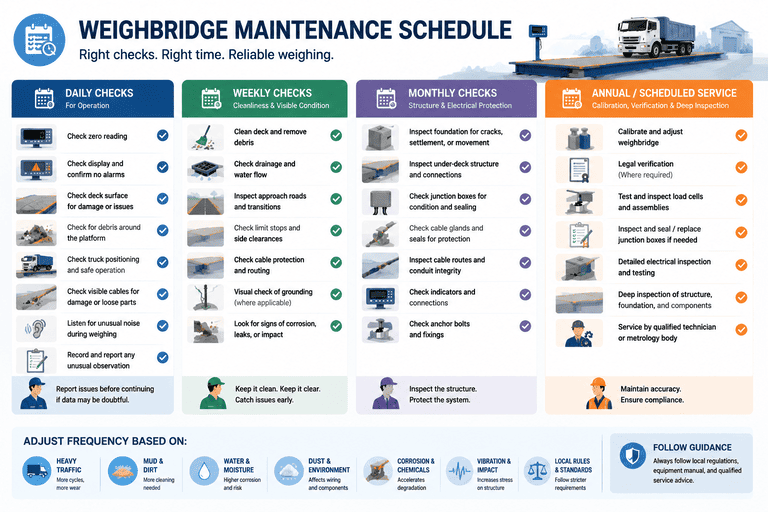
A fixed schedule looks neat, but real sites are not neat. I always adjust frequency by traffic, environment, load, and compliance needs.
I use daily checks for operation, weekly checks for cleanliness and visible site condition, monthly checks for structure and electrical protection, and annual or scheduled service for calibration, verification, and deeper inspection. I increase frequency for heavy traffic, mud, water, dust, corrosion, vibration, and strict local rules.
I Use A Reference Framework, Not A Universal Rule
I share the following schedule as a starting point. I do not present it as a rule for every site. A clean warehouse yard may need a different rhythm from a mining site. A coastal site with salt air may need closer corrosion checks. A cement plant may need more cleaning because dust and material buildup move fast. A washdown food site may need more attention to sealing and stainless parts. A high-volume logistics gate may need more frequent observation because small faults affect many tickets in one day.
| Frequency | I focus on these tasks | I usually assign the task to |
|---|---|---|
| Daily | I check zero, display behavior, deck surface, truck positioning, debris, and visible damage. | Operator or site supervisor |
| Weekly | I clean around the deck, inspect approaches, check drainage paths, and review operator notes. | Yard team and internal maintenance team |
| Monthly | I inspect deck clearance, limit stops, cable protection, foundation signs, corrosion, and impact marks. | Internal maintenance team |
| Quarterly or as needed | I review repeatability concerns, site condition changes, traffic changes, and recurring alarms. | Site manager with supplier support when needed |
| Annual or required interval | I arrange calibration, verification where required, deeper inspection, and critical component checks. | Supplier, qualified technician, or metrology body |
I ask every site to revise this table after the first months of operation. The weighbridge itself gives feedback through dirt buildup, fault records, ticket disputes, and service findings.
How Do I Build A Practical Weighbridge Maintenance Record?
A checklist only works when the record is clear. I want the next person to understand what happened and who acted.
I build a maintenance record with date, shift, operator name, empty reading, visible condition, cleaning action, abnormal signs, photos, escalation owner, service result, and next action. This record helps the site track repeat faults and prove responsible operation.
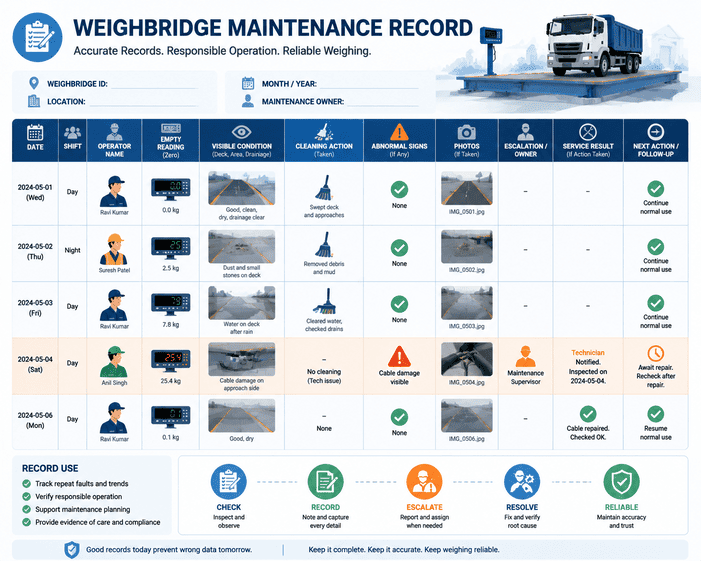
I Make The Record Useful, Not Decorative
I do not like checklists that only show ticks. A tick can hide a real problem. I prefer short notes, clear photos, and ownership. If the operator writes “zero unstable after rain,” that note is useful. If the maintenance team adds “water found near cable route,” the supplier has a better starting point. If the technician later confirms a junction box sealing issue, the site can connect the fault to weather and drainage.
| Record field | What I ask the team to write | Why it helps |
|---|---|---|
| Date and shift | I ask for the exact working period. | It links the issue to traffic, weather, and production. |
| Operator name | I ask for the person who observed the issue. | It gives the service team a contact for details. |
| Empty deck reading | I ask for the observed zero condition. | It helps track drift and repeat faults. |
| Site condition | I ask for notes about mud, water, dust, impact, or debris. | It connects environment to weighing performance. |
| Abnormal sign | I ask for direct notes, not vague comments. | It helps a technician narrow the cause. |
| Photo or video | I ask for clear images when safe. | It reduces guessing during remote support. |
| Escalation owner | I ask who took the next step. | It prevents the issue from being ignored. |
| Service result | I ask for the confirmed cause and action. | It improves future maintenance decisions. |
I also suggest keeping this record near the weighing operation and in a digital file if possible. A site with good records makes after-sales support faster.
Conclusion
I maintain a weighbridge by assigning ownership, watching early signs, protecting site conditions, and using qualified support before bad data harms operations.