













On this page

I see many weighing disputes start with one small mistake. A team resets zero, trusts the display, and later finds shipment weights do not match.
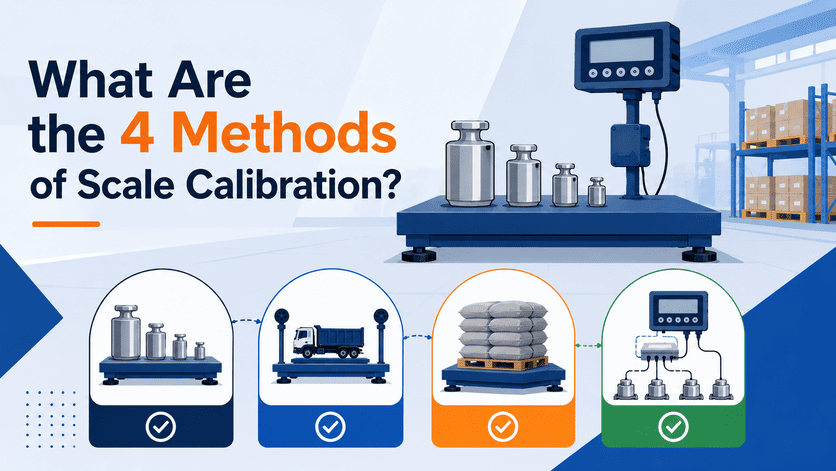
The 4 common scale calibration methods are standard weight calibration, substitution calibration, material calibration, and electronic or digital calibration.1 I treat standard weight calibration as the most reliable baseline, while I use the other methods only when scale type, capacity, site limits, and compliance needs allow it.

I always separate calibration from zero adjustment and legal verification before I talk about methods. Calibration checks how the scale responds to known or controlled loads. Zero adjustment only brings an empty scale back to zero. Legal verification or certification is a formal process done under local rules, often by approved bodies.2 I have seen buyers mix these ideas together. I have also seen them overtrust a simple reset. In my factory work at HENER, I treat calibration as one part of a wider accuracy system. I look at the load cell, junction box, indicator, platform structure, foundation, load position, repeatability, and final inspection. A good number on the display matters. The way that number is created matters more.
Why Do I Treat Standard Weight Calibration as the Reference Method?
I see weak calibration create real losses. A small platform scale can pass daily use, then fail when a known weight exposes the error.
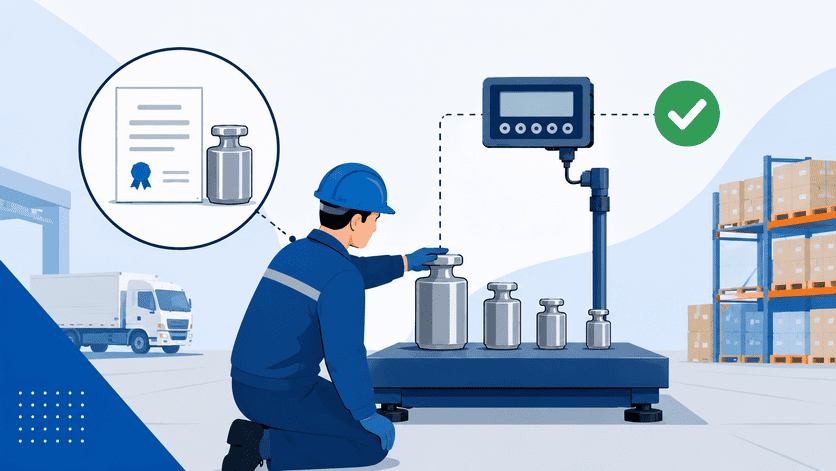
Standard weight calibration uses certified or traceable test weights with known mass values.3 I treat it as the clearest reference method because it compares the scale reading against a real known load, not only against a setting inside the indicator.
What I Check Before I Trust the Reading
I use standard weight calibration as the baseline because it gives me the cleanest question: when I place a known load on the scale, does the display show the correct weight? This sounds simple. In real factory work, it is not only about putting weight on the platform. I also check where the load sits. I check the four corners on platform scales and floor scales.4 I check repeatability by applying the same load more than once. I check if the reading moves after the load stays on the scale. I check if the zero returns after unloading. I do this because a scale can look correct at one point and still fail at another point.
| Item I check | Why I check it | What it can show |
|---|---|---|
| Zero return | I need the empty scale to come back to zero | Drift, dirt, cable issue, mechanical friction |
| Corner response | I need stable weight across the platform | Load cell mismatch, leveling issue, structure issue |
| Mid-load and high-load points | I need accuracy across the range | Linearity error, indicator setting issue |
| Repeatability | I need the same result for the same load | Sensor problem, unstable foundation, loose part |
| Final inspection | I need shipping confidence | Assembly issue before delivery |
I do not say standard weights are always easy to use. A small bench scale or platform scale can be checked with practical test weights. A large truck scale with 60 tons or more is different. It may not be practical to place full-capacity standard weights on site. It may cost too much time and labor. It may also require cranes, forklifts, and safe access. This is why I call standard weights the reference method, not the only method for every case.
At HENER, I use known load testing, corner adjustment, multi-point checking, and final inspection before shipment where the scale type allows it. I still tell customers that factory calibration does not make a scale permanently accurate after sea transport, foundation installation, local wiring, and long-term use. I see calibration as a controlled check at a given time and place. I do not treat it as a lifetime guarantee.
When Do I Use Substitution Calibration for Large Scales?
I see large-capacity scales create a practical problem. The best known loads are heavy, costly, and hard to move to the job site.
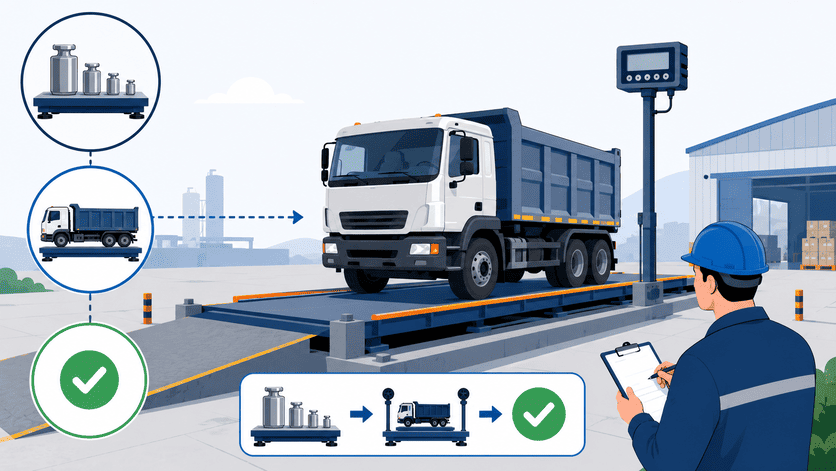
Substitution calibration uses available loads, such as vehicles or heavy objects, after they are first compared with known test weights.5 I use it as a controlled compromise for large scales when full standard weight loading is not practical.
Why Control Matters More Than Convenience
I use substitution calibration most often in discussions about truck scales, axle scales, and other large weighing systems. The idea is simple. I first use standard weights to establish a reliable reference at part of the scale capacity. Then I use a substitute load to extend the test range. The substitute load may be a truck, concrete block, steel material, or another stable heavy object. The key point is control. I do not treat any random loaded vehicle as a reliable calibration load. I need the substitute load to be stable. I need it to be weighed carefully. I need the process to avoid load shifting, moisture change, fuel change, or material loss.6
| Condition | Good practice | Risk if ignored |
|---|---|---|
| Substitute load stability | I use a load that does not change during testing | The reference value becomes uncertain |
| Initial comparison | I compare it with standard weights first | The scale may be adjusted against an unknown load |
| Load position | I place the load in controlled positions | Corner or section errors may be hidden |
| Repeat run | I repeat the movement and reading | One lucky reading may mislead the user |
| Technician skill | I use trained personnel or local experts | The method can create false confidence |
I do not present substitution calibration as equal to full standard weight calibration. I also do not use it as a shortcut to skip basic mechanical checks. A truck scale can show errors because of foundation settlement, platform binding, weak welding, poor grounding, water inside the junction box, or damaged cables. If I only look at the indicator number, I may miss the real problem. I have seen cases where the customer wanted a new indicator, but the real issue was load cell output imbalance. I have also seen cases where the scale looked wrong because the approach road pushed force into the deck.
For dealers and project contractors, substitution calibration can be useful because it reduces site cost. It also makes large-scale testing more realistic. But I still see it as a conditional method. I choose it when standard weights are limited, capacity is high, and local rules allow the process. If trade settlement or public weighing is involved, I always ask the customer to follow local metrology requirements.7 I can support equipment quality and factory testing. I do not replace the local legal verification body.
How Can Material Calibration Reflect Real Working Loads?
I see factories weigh the same product every day. The scale may pass a test point, but still struggle when real material behaves badly.
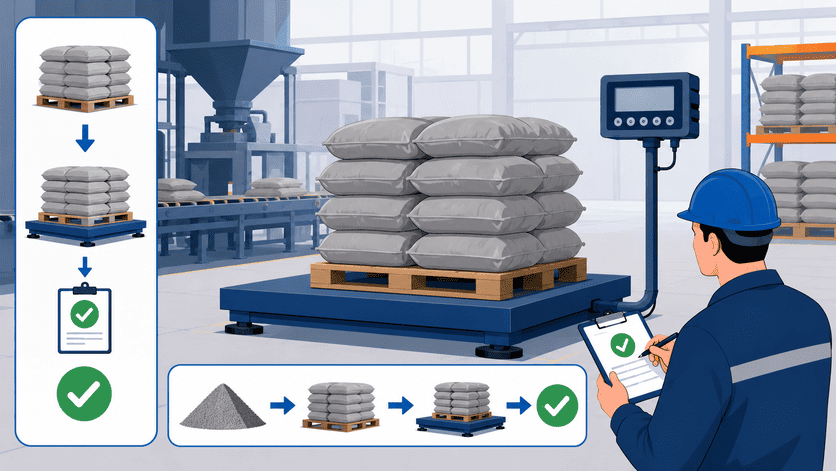
Material calibration uses the actual product or working material as the load reference. I use it to observe real operating behavior, but I only trust it when the material is stable, measurable, and controlled during the test.
Why Real Material Can Help and Also Mislead
I use material calibration when the customer needs to understand how the scale performs in the real process. This can apply to hopper scales, batching systems, conveyor-related weighing, floor scales in production, or warehouse receiving. Real product tells me things that test weights may not show. Powder may stick to the hopper. Grain may shift. Wet material may change weight.8 Bags may sit unevenly on a platform. Pallets may bend. A forklift may load from one side. These real conditions matter because the scale is used by workers, not by a laboratory table.
| Material factor | What I watch | Why it matters |
|---|---|---|
| Moisture | I check if water content changes | The load value can change during testing |
| Flow behavior | I check if material sticks or bridges | The scale may not receive the full load |
| Load shape | I check how the product sits on the platform | Uneven force can affect corner response |
| Container tare | I check the empty container weight | Tare error can hide product weight error |
| Time | I check if the reading changes during holding | Creep, leakage, or settling can appear |
I do not use material calibration as the first proof of accuracy when known test weights are available. Material can reflect the working world, but it can also hide too many unknowns. If a customer fills a bin with material and says, “This must be 1,000 kg,” I ask how that value was known. If the value came from another scale, I ask if that scale was calibrated. If the value came from process records, I ask how stable the material was. This is not because I want to make the process hard. I ask because I want the final number to mean something.
In my manufacturing experience, material calibration is most useful after the scale is already checked by a stronger reference method. Then I can use real material to confirm process behavior. For example, a platform scale may pass standard weight testing. Then I can observe how the operator places pallets on it. A hopper scale may pass load cell signal checks. Then I can watch whether material remains on the wall after discharge. This helps buyers avoid replacing a complete scale when the true issue may be product build-up, poor loading, vibration, or tare control.
What Are the Limits of Electronic or Digital Calibration?
I see many users like digital calibration because it feels fast. The indicator accepts settings, the display looks neat, and the problem seems solved.
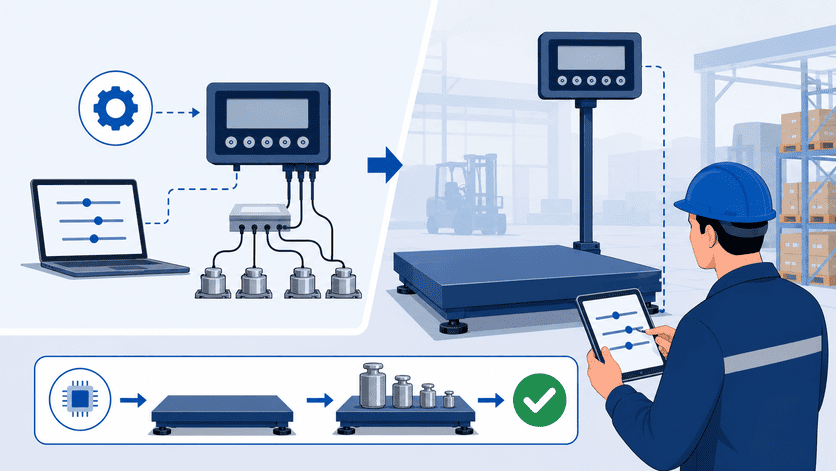
Electronic or digital calibration uses indicator settings, load cell data, simulation, or stored parameters to help setup and adjustment. I use it as a helpful tool, but I do not treat it as proof of real accuracy without load verification.
Why Indicator Settings Cannot Replace Real Load Testing
I use electronic and digital calibration in modern weighing systems because it saves setup time and improves service efficiency. Many indicators allow span setting, zero setting, linearity setting, digital filtering, division value setting, and communication output setting. Some systems can store parameters or use simulated signals. Some digital load cell systems can show each load cell output separately. This helps a technician find a weak sensor, a wiring issue, or a corner imbalance faster. It also helps system integrators connect the scale to ERP, PLC, RS232, RS485, Modbus, 4-20mA, WiFi, or other systems.
| Digital function | How I use it | What it cannot prove alone |
|---|---|---|
| Zero setting | I remove no-load offset | It cannot prove loaded accuracy |
| Span setting | I align display response | It needs a known load to be meaningful |
| Filtering | I reduce unstable readings | It can hide vibration or mechanical problems |
| Cell output display | I compare sensor behavior | It does not replace load testing |
| Communication setup | I send data to a system | It does not confirm the weight is correct |
I never tell a customer that electronic calibration alone proves the scale is accurate. A display can be adjusted to show a number, but the scale platform may still have a structural issue. A load cell may still be overloaded. A junction box may still be affected by moisture. A floor scale may still touch a wall. A truck scale foundation may still move under load. Digital tools help me see signals. They do not replace the physical truth of placing a load on the weighing structure.
At HENER, I see electronic and digital calibration as part of a full weighing solution, not as a magic button. It is useful for OEM dealers because it makes installation and service more efficient. It is useful for factories because it supports data records, inventory control, production tracking, and automatic systems. It is useful for project integrators because it helps connect weighing data with access control, cameras, barriers, license plate recognition, and software. But I still ask one direct question: has the system been checked with a real load under site conditions? If the answer is no, I do not treat the calibration as complete.
Conclusion
I use standard weights as my baseline, and I choose other calibration methods only when scale type, site limits, real loads, and local rules support them.
References
- [PDF] Calibration Procedures for Weights and Measures Laboratories
- The International Definition of Calibration, Verification, Validation ...
- [PDF] OIML R 111-1:2004 - Part 1: Metrological and technical requirements
- Test Weights for Scales - Mettler Toledo
- [PDF] NIST Handbook 44: Specifications, Tolerances, and Other Technical ...
- A Guide to Measurement Uncertainty and Traceability
- International Legal Metrology FAQs | NIST
- Assessment of Grain Harvest Moisture Content Using Machine ...