



On this page

Choosing between a weighbridge and a truck scale can feel like a trick question — because, in most cases, buyers are looking at the same category of equipment described by two different vocabularies. The real problem starts when these terms are used loosely in quotes and catalogs, blurring critical differences in installation form, weighing method, and legal suitability. That confusion can lock you into the wrong foundation, the wrong approval path, or the wrong equipment entirely.
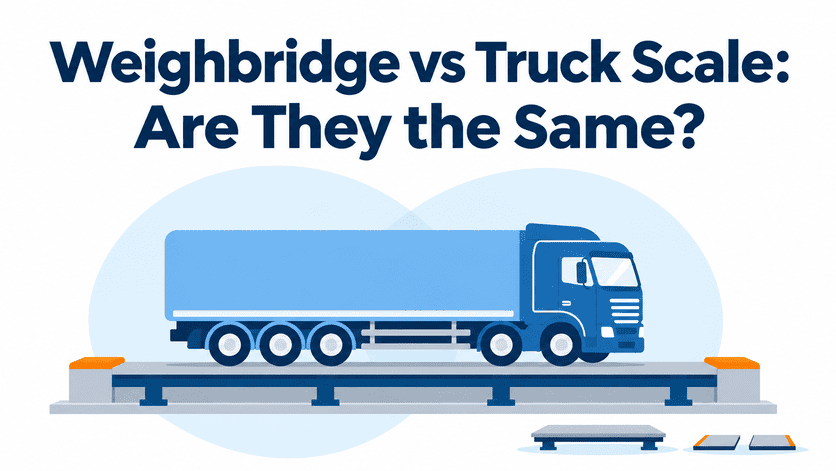
A weighbridge and a truck scale refer to overlapping — but not identical — categories of vehicle weighing equipment. "Weighbridge" is the Commonwealth, African, Middle Eastern, and Asian term, typically pointing to a full-length platform for whole-vehicle static weighing. "Truck scale" is the North American umbrella term that covers full-length platforms plus axle scales, portable weighing pads, and other truck-weighing devices.1 They share the same intent, but differ in scope — and that scope difference is where purchasing mistakes happen.
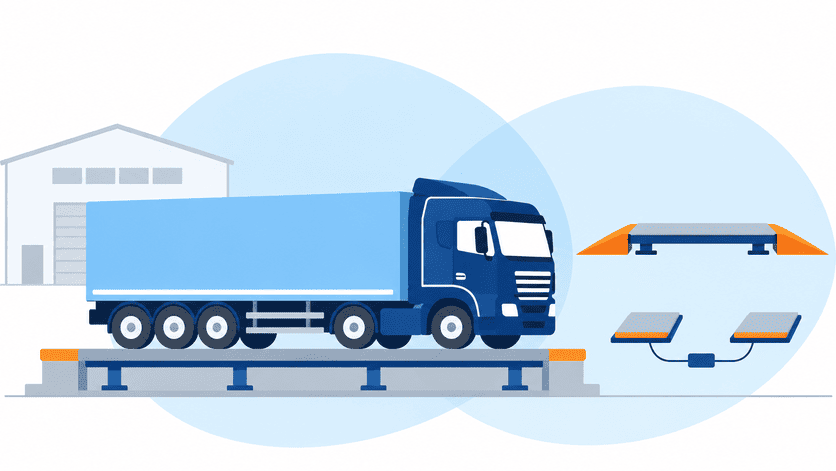
Understanding the terminology alone won't help you write a better purchase order. What matters is knowing which installation form, which weighing method, and which approval regime match your vehicles, your throughput, and your site. Below, I break down the real distinctions that affect your budget and your operations — not just the words on the nameplate.
Why Do Different Regions Use Different Names for Truck Weighing Equipment?
If you have ever sourced weighing equipment from international suppliers, you have probably noticed the same product showing up under two names depending on who you are talking to. This is not a marketing gimmick. It is a vocabulary split rooted in regional industry convention — and it matters because misunderstanding the scope behind each term leads to mismatched quotes.
In our export inquiries at HENER, the same request regularly arrives as "weighbridge" from a buyer in Kenya or Saudi Arabia and "truck scale" from a buyer in Texas or Ontario. When I see either term, my first question back is always the same: are you looking for full-length static weighing, or axle-by-axle weighing? The answer determines the equipment, not the label.

The Commonwealth Convention: Weighbridge
In the UK, Australia, most of Africa, the Middle East, South Asia, and Southeast Asia, "weighbridge" is the dominant term. It almost always implies a large, full-length platform — commonly in the 3×18 m class or larger — designed to weigh an entire truck and its payload in a single static reading. The word itself carries a built-in assumption: one platform, one vehicle, one weight reading.
This assumption shapes procurement conversations. When a buyer in Zambia or the UAE requests a weighbridge, they typically mean:
- A full-length steel or concrete-deck platform
- Pit-mounted or surface-mounted (pitless) installation
- Capacity ranging from 40 t to 120 t or more
- Used for commercial settlement, mine dispatch, or port entry/exit
The North American Convention: Truck Scale
In the United States and Canada, "truck scale" is the standard industry term. But here is the critical difference: it functions as an umbrella category, not a single product type. Under the "truck scale" label, a North American buyer or distributor might be referring to:
| Equipment Type | What It Weighs | Typical Use Case |
|---|---|---|
| Full-length truck scale (equivalent to a weighbridge) | Entire vehicle, single static reading | Quarries, grain elevators, transfer stations, logistics hubs |
| Axle scale (single or tandem) | One axle group at a time | Overload checks, internal weight control |
| Portable wheel/axle weighing pads | Individual wheels or axle groups | Law enforcement, temporary sites, mobile operations |
| Onboard truck scales | Vehicle payload during loading | Waste collection, aggregate hauling |
This means a North American distributor saying "I need truck scales" could be requesting anything from an 80-foot full-length platform to a pair of portable axle pads. If I quote a full-length weighbridge without asking, I may be quoting entirely the wrong product — and entirely the wrong price.
Why This Matters for Procurement
The vocabulary gap creates a specific risk: a supplier or buyer treats the two terms as exact synonyms and skips the scoping conversation. I have seen this play out in real inquiries. A buyer asks for a "truck scale," receives a quote for a full-length platform with pit foundation, and is surprised by the civil works cost — because they actually needed portable axle pads for temporary overload checks. The reverse also happens: a project specifier writes "weighbridge" in a tender document, a supplier bids a set of axle scales at a lower price, and the equipment does not meet the legal-for-trade requirements of the project.
Key takeaway: The term tells you where the buyer is from. The scoping questions tell you what they actually need.
Does the Weighing Method — Full-Vehicle vs. Axle-by-Axle — Really Change the Outcome?
This is the scope difference that actually costs money. Buyers who treat full-length weighing and axle-by-axle weighing as interchangeable options are setting themselves up for disputes, compliance gaps, or wasted throughput. The weighing method is not a preference — it is a technical decision with downstream consequences.
A full-length platform weighs the entire truck in one static reading, giving a single gross or net weight. An axle scale or portable pad weighs axle groups sequentially and sums them. Both approaches measure truck weight, but they differ significantly in accuracy behavior, legal acceptance, throughput, and operator procedure.
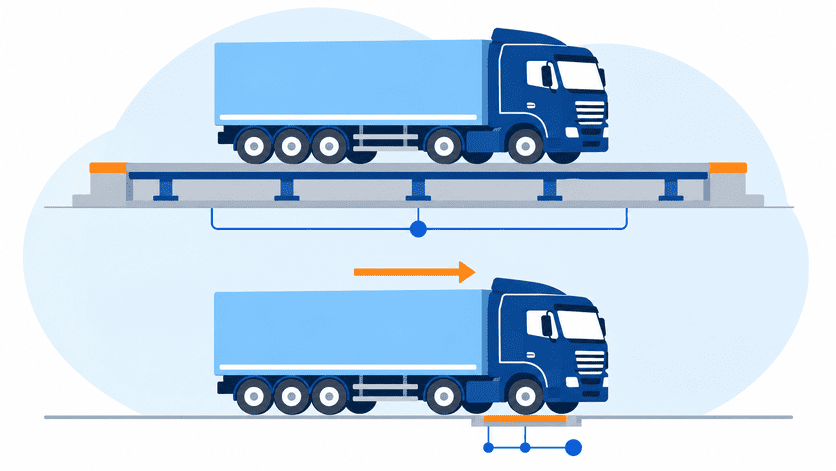
Accuracy and Summation Error
When you weigh an entire vehicle on a single platform, every load cell beneath the deck contributes to one reading. The scale's approved accuracy class applies to that single measurement.
When you weigh axle by axle and sum the results, each individual reading carries its own tolerance. Those tolerances accumulate. This is called summation error, and it is a well-documented phenomenon in truck weighing. The total summed weight may deviate more from the true gross weight than a single full-length reading would.
How much this matters depends on what the weight data is used for:
- Commercial settlement (buying/selling goods by weight): Summation error can translate directly into financial disputes. Most trade metrology authorities require or strongly prefer full-length static weighing for legal-for-trade transactions.
- Internal weight control: Axle-by-axle weighing may be perfectly adequate for tracking production output, managing inventory, or preventing overloading — where the tolerance is wider and the legal stakes are lower.
- Overload enforcement: Many jurisdictions accept axle-group weights for overload screening, but may require a full-length reweigh for penalty assessment. Buyers should verify this with the relevant local transport or metrology authority.
Legal-for-Trade Suitability
Whether a weighing system qualifies for legal-for-trade use depends on its metrological approval, not on its name. Approval regimes such as OIML R76 (non-automatic weighing instruments), OIML R134 (automatic instruments for weighing road vehicles in motion), and NTEP in the United States define accuracy classes and testing protocols.2
A few important points for buyers to verify:
- Full-length truck scales and weighbridges are commonly approved under OIML R76 or NTEP for static legal-for-trade weighing, provided they meet the applicable accuracy class.
- Axle scales may or may not be approved for legal-for-trade settlement depending on the jurisdiction and the specific product's certification.
- Portable weighing pads are often used for enforcement screening but may not carry the same legal-for-trade approval as a permanent installation.
I want to be direct here: I am not a metrology authority, and neither is any equipment manufacturer. Approval requirements vary by country and even by application within a country. Before committing to an installation, confirm the specific approval requirements with the local weights-and-measures office or the relevant regulatory body in your market.
Throughput and Driver Procedure
Full-length platforms are faster per vehicle. The truck drives on, stops, gets weighed, and drives off. One procedure, one reading, usually under two minutes per vehicle — faster with an unmanned weighing system.3
Axle-by-axle weighing requires the truck to stop, advance, stop again, advance again — once for each axle group. This adds time per vehicle and increases the chance of operator error or incomplete readings. For a site weighing 100+ trucks per day, the throughput difference adds up quickly.
| Factor | Full-Length Platform | Axle-by-Axle |
|---|---|---|
| Readings per vehicle | 1 | 2–5 (depending on axle configuration) |
| Summation error risk | None | Present |
| Legal-for-trade acceptance | Generally accepted (verify per market) | Varies by jurisdiction |
| Throughput per hour | Higher | Lower |
| Driver training required | Minimal | Moderate |
| Dispute risk | Lower | Higher |
Is a Pit-Type Weighbridge Different From a Pitless Truck Scale?
This is one of the two most common false equivalences I encounter in buyer inquiries. The assumption goes like this: "weighbridge = pit-type with concrete deck, truck scale = pitless with steel deck." It sounds neat. It is also wrong.
Pit versus pitless and concrete deck versus steel deck are independent design variables, available under either naming convention. They are driven by site conditions, not by terminology. Collapsing them into a single either/or distinction leads to poor site engineering decisions.
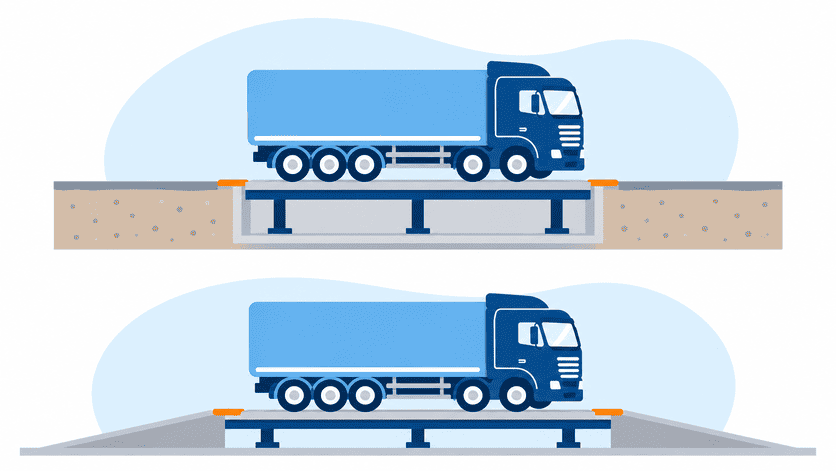
Pit-Mounted Installation
A pit-mounted installation places the weighing platform inside a concrete pit so the deck surface sits flush with the surrounding ground level. This design:
- Saves approach ramp space — trucks drive on and off at grade level
- Works well in tight sites where long approach ramps are not feasible
- Requires proper drainage — water accumulation in the pit is the single most common maintenance problem4
- Increases foundation cost due to excavation, concrete work, and drainage infrastructure
- Makes maintenance harder — load cells and cabling sit below grade and are less accessible
Pitless (Surface-Mounted) Installation
A pitless installation sets the platform on a shallow concrete foundation above grade, with approach ramps on each end. This design:
- Reduces foundation cost and construction time — less excavation, simpler concrete work
- Improves maintenance access — load cells and junction boxes are accessible from the sides or ends
- Eliminates the drainage problem — no pit to accumulate water
- Requires more land — approach ramps add significant length on each side (typically 4–6 meters per ramp, depending on platform height5)
- May not suit sites with limited available area or high traffic from multiple directions
Steel Deck vs. Concrete Deck
Similarly, the deck material is a design choice, not a product category:
| Feature | Steel Deck | Concrete Deck |
|---|---|---|
| Weight of platform | Lighter — easier to ship and install | Heavier — requires on-site concrete pour |
| Manufacturing | Factory-built modular sections | Steel frame factory-built; concrete poured on site |
| Shipping cost | Lower (lighter, stackable modules) | Higher or N/A (concrete added on site) |
| Durability in corrosive environments | Requires quality paint/coating | Concrete surface resists some chemical exposure |
| Installation time | Faster (pre-assembled modules) | Slower (concrete curing time) |
| Common in export markets | Yes — HENER and most export manufacturers ship modular steel-deck platforms | Common in permanent domestic installations |
At HENER, the vast majority of our export weighbridge and truck scale systems use modular steel-deck construction because it ships efficiently in containers and installs quickly on site. But we regularly support projects where the buyer's engineer specifies a concrete-filled deck for site-specific reasons — heavier traffic, corrosive materials, or local construction preferences. The point is: the deck type follows the project, not the product name.
Does One Term Imply Better Accuracy or Compliance Than the Other?
No. This is the second common false equivalence, and it is more dangerous than the first because it can lead buyers to believe they have met a compliance requirement simply by selecting one product label over another.
Accuracy class and legal-for-trade status are determined by metrological approval and proper site calibration — not by whether the equipment is called a weighbridge or a truck scale. A full-length weighbridge and a full-length truck scale of equivalent design, built to the same metrological standard, and calibrated on the same site, will deliver the same accuracy performance.
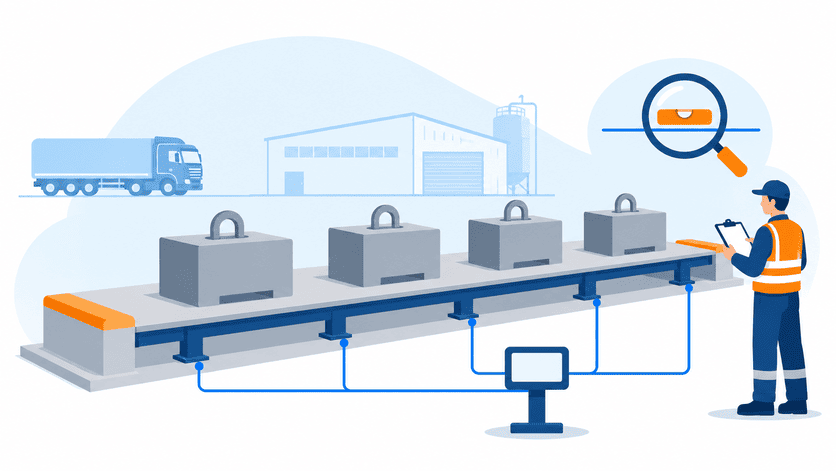
What Actually Determines Accuracy
Several factors contribute to the accuracy a truck weighing system delivers in the field:
- Load cell quality and specification — sensitivity, temperature compensation, creep performance, long-term stability
- Number and placement of load cells — proper load distribution across the platform
- Indicator (weighing controller) resolution and signal processing
- Foundation quality — a poorly poured or settling foundation will degrade accuracy regardless of the scale's design
- Calibration — initial calibration with certified test weights, plus ongoing periodic recalibration
- Environmental factors — wind loading, temperature extremes, vibration from adjacent equipment
At HENER, our production process includes individual temperature compensation and creep testing on every load cell, four-corner error adjustment on assembled platforms, and full calibration before shipment. But I always tell buyers: factory calibration establishes a baseline; field calibration after installation is what certifies your system for use.6 A qualified local calibration service, using traceable test weights, is essential.
Compliance Is Market-Specific
Different markets enforce different approval regimes:
- OIML member countries typically reference OIML R76 for static weighing instruments
- United States uses the NTEP (National Type Evaluation Program) certification process
- [European Union applies the Measuring Instruments Directive (MID) and relevant EN standards](7">https://eur-lex.europa.eu/eli/dir/2014/31/oj/eng)7
- Individual countries may have additional national requirements on top of or instead of these frameworks
The critical point for buyers and distributors: verify which approval regime applies in your market and confirm that the specific product model you are purchasing holds or can obtain that approval. The product name — weighbridge or truck scale — has no bearing on this.
What Questions Should You Actually Ask Before Buying?
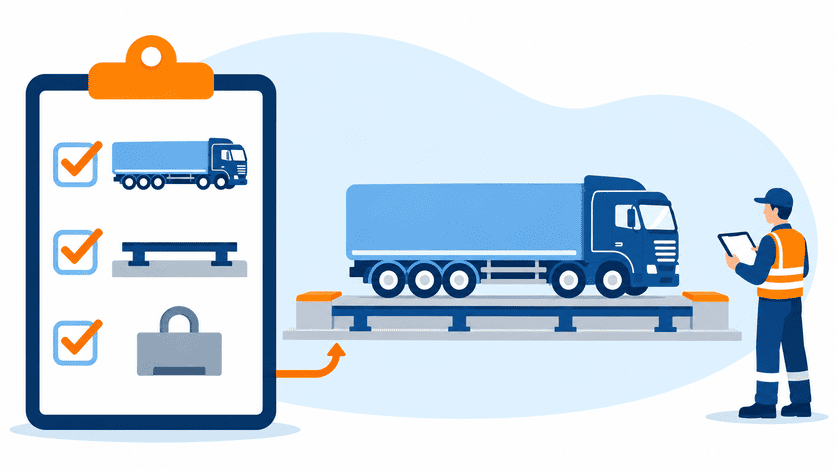
If the terminology debate dissolves once you define the actual weighing task, then the real value lies in the selection checklist — the questions that make the right equipment obvious. These are the questions we ask buyers at HENER before we quote, and they are the same questions any competent supplier or consultant should walk through with you.
Instead of asking "should I buy a weighbridge or a truck scale," ask these:
Vehicle and Load Profile
- What is the heaviest vehicle (gross vehicle weight) that will use the scale? This determines minimum capacity.
- What are the axle configurations? A 6-axle trailer combination requires a longer platform than a standard 2-axle rigid truck.
- What is the maximum axle load? This affects load cell sizing and platform structural design.
Weighing Method
- Do you need full-vehicle static weighing or axle-group weighing? This is the most consequential decision.
- Will the weight data be used for commercial settlement, internal records, or overload prevention? This determines the accuracy and approval requirements.
Throughput
- How many trucks per day? High-throughput sites (100+ vehicles/day) strongly favor full-length platforms with fast drive-on/drive-off procedures, potentially with unmanned weighing automation.
- Is two-direction traffic required? Some sites need bidirectional weighing, which affects platform length and approach design.
Site Conditions
- Available land area and approach length? Limited space may push toward a pit installation.
- Drainage and groundwater conditions? High water table or poor drainage argues against pit installations.
- Frost depth? In cold climates, foundation design must account for frost heave.
- Is relocation likely? Portable or modular systems suit temporary operations or sites that may move.
Approval and Compliance
- Which country's metrology regime applies? Confirm OIML, NTEP, MID, or national requirements.
- Is legal-for-trade certification required? If yes, confirm that the product model is certified or certifiable for your market.
System Integration
- What data outputs are needed? Ticket printing, ERP integration, PLC connection, remote display?
- Is unmanned operation planned? This adds requirements for license plate recognition, automatic barriers, cameras, and weighing software.
Answering these questions makes the terminology question disappear. You will know whether you need a full-length platform, an axle scale, or portable pads — and the right term will follow naturally from the equipment.
Frequently Asked Questions
Can I use an axle scale as a replacement for a full-length weighbridge?
It depends on the application. For internal overload checks and weight monitoring, axle scales can work well and cost less. For legal-for-trade commercial weighing, most jurisdictions require or prefer full-length static weighing due to summation error concerns. Confirm with your local metrology authority before substituting.
Is a pitless truck scale cheaper than a pit-type weighbridge?
Generally, yes — pitless installations require less excavation, simpler concrete work, and no drainage system. However, they need more land for approach ramps. Total installed cost depends on local construction prices, soil conditions, and available space. Get site-specific foundation quotes before deciding.
Do I need OIML or NTEP certification for my truck scale?
If the scale is used for commercial transactions (buying or selling goods by weight), most countries require some form of metrological approval. OIML R76 is referenced in many markets; NTEP applies in the United States. Check your local legal metrology requirements — this is not optional for trade use.
How long does a typical weighbridge or truck scale last?
With proper foundation engineering, quality manufacturing, regular calibration, and routine maintenance, a well-built truck scale platform can last 15–25 years8. Load cells and indicators may need replacement or refurbishment on shorter cycles. Environmental exposure, traffic volume, and maintenance practices are the biggest variables.
Can HENER supply both full-length weighbridges and axle scales?
Yes. Our product line covers modular full-length truck scales (commonly called weighbridges in export markets), portable axle weighing pads, platform scales, and the associated load cells, indicators, junction boxes, and software systems. We support OEM customization, project integration, and spare parts supply across these categories.
Conclusion
The weighbridge vs truck scale question is not a product comparison — it is a vocabulary comparison. "Weighbridge" is the Commonwealth and developing-market term for a full-length vehicle weighing platform. "Truck scale" is the North American umbrella that covers full-length platforms, axle scales, portable pads, and more. Treating them as identical without understanding the scope behind each term leads to mismatched quotes, wrong foundations, and compliance gaps.
The real decision is about installation form, weighing method, and site requirements — not about which word appears on the quotation. Define your heaviest vehicle, your weighing purpose, your throughput, your site constraints, and your market's approval regime. The right equipment — and the right terminology — will follow.
If you are specifying a truck weighing system and want to make sure the quote matches what you actually need, contact the HENER team for a scoping conversation. We have spent 23 years asking the right questions before quoting — and that process starts with understanding your application, not your search term.
References
- Truck scale
- National Type Evaluation Program (NTEP)
- Unmanned Weighbridge: A Complete Guide to Automated ...
- Weighbridges used for trade
- How Does Weighbridge Ramp Design Affect Site Safety?
- Calibration Procedures for Weights and Measures ...
- Directive - 2014/31 - EN - EUR-Lex - European Union
- Asset Management Plans and Periodic Evaluations of ...