



On this page

A truck axle weight calculator is the first thing most fleet managers search for when a driver calls in after getting flagged at a weigh station — even though the truck's total weight was supposedly under the limit. The frustration is real. You loaded within the gross vehicle weight rating, yet somehow a single axle is over the legal threshold. The core problem is not total weight. It is weight distribution across each axle group.
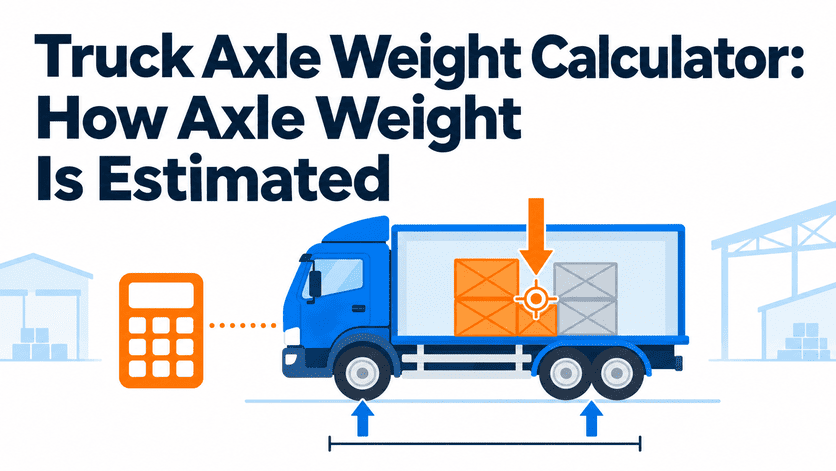
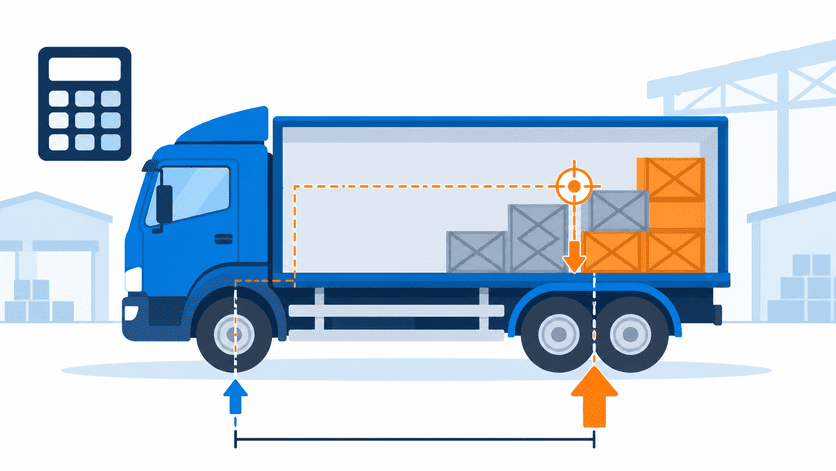
A truck axle weight calculator estimates how total vehicle weight distributes across each axle group based on the vehicle's wheelbase dimensions, the position of the load's center of gravity, and basic moment-balance physics. It gives you a useful planning number for loading decisions — but it is an estimate, not a legally defensible measurement. Enforcement, trade settlement, and dispute resolution require actual weighing on calibrated equipment.
Understanding the estimation logic can save your fleet real money — fewer overweight fines, less premature tire and suspension wear, and smarter loading decisions before the truck leaves the yard. Below, I walk through exactly how the calculation works, where it breaks down, and when you need to stop estimating and start measuring.
Why Can't You Just Divide Total Weight by the Number of Axles?
This is, hands down, the most common mistake I encounter when customers first reach out with axle weight questions. They take the gross weight, divide by the number of axles, and assume each axle carries an equal share. It sounds logical. It is wrong.
A truck is not a perfectly balanced beam with equal supports. The engine sits over or near the front axle. The fifth wheel or coupling point is at a specific location on the tractor frame. The cargo has a center of gravity that shifts depending on how and where it is loaded. These geometry differences mean that a 40-ton truck can put 7 tons on its steer axle or 9 tons on its steer axle — same total weight, different cargo position.

How Load Position Changes Everything
Think of a seesaw. If two children of equal weight sit at equal distances from the pivot, it balances. Move one child closer to the center, and the other side drops. Your truck works the same way, except the "pivot points" are the axle groups, and the "children" are the tractor's empty weight distribution and the cargo.
Here is a simplified example that illustrates the point:
| Scenario | Total Weight | Cargo CG Position | Steer Axle | Drive Tandem | Trailer Tandem |
|---|---|---|---|---|---|
| Cargo centered | 36,000 kg | Middle of trailer | ~5,800 kg | ~11,200 kg | ~19,000 kg |
| Cargo shifted forward 0.8 m | 36,000 kg | Closer to fifth wheel | ~6,400 kg | ~13,100 kg | ~16,500 kg |
| Cargo shifted rearward 0.8 m | 36,000 kg | Closer to trailer rear | ~5,400 kg | ~9,800 kg | ~20,800 kg |
These figures are illustrative only — actual values depend on your specific vehicle geometry, suspension type, and fifth-wheel placement. But the pattern is consistent: shifting the cargo center of gravity by less than a meter can move several tons between axle groups.1
This is precisely why a truck that passes a gross-weight check can still fail an axle-weight check at enforcement. The total is fine. The distribution is not. In our experience handling customer inquiries, the question "How much can my truck carry?" almost always needs to be reframed as "How much can my truck carry and where should the load sit?"
The Equal-Division Trap in Multi-Axle Configurations
The error compounds with more axle groups. A 5-axle tractor-semitrailer combination has a steer axle, a drive tandem, and a trailer tandem. Each group has a different distance from the cargo. Each group has a different legal weight limit. Dividing 36,000 kg by 5 gives you 7,200 kg per axle — a number that matches none of the real axle loads and violates the steer axle limit in most jurisdictions.2
The takeaway is simple: total weight compliance and axle weight compliance are two separate problems.3 A truck axle weight calculator addresses the second one.
How Does a Truck Axle Weight Calculator Actually Work?
The core math behind every truck axle weight calculator is static moment balance4 — the same principle used in structural engineering to find reaction forces at supports. If you know the forces acting on a beam and their positions, you can calculate the reaction at each support point.
For axle weight estimation, the "beam" is your vehicle, the "forces" are gravity pulling on the tractor, cargo, and trailer, and the "support points" are the axle groups contacting the ground.
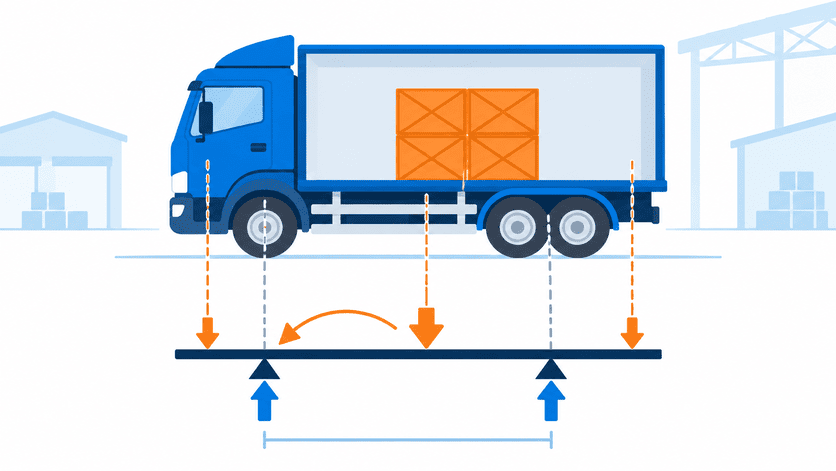
Step-by-Step Estimation Process
Let me walk through the full process using a common 3-axle-group tractor-semitrailer. This is the method I recommend to fleet operators who want a practical planning tool before investing in measurement equipment.
What you need before you start:
- Tractor empty weight distribution — steer axle weight and drive tandem weight when the tractor is unloaded (from the manufacturer's spec sheet or a scale ticket)
- Trailer empty weight — total empty trailer weight (spec sheet or scale ticket)
- Trailer empty weight distribution — how trailer empty weight splits between the kingpin (supported by tractor) and the trailer axle group
- Cargo weight — total payload weight
- Key dimensions:
- L₁ = distance from steer axle to drive tandem centerline
- L₂ = distance from drive tandem centerline to trailer tandem centerline
- d = distance from drive tandem centerline to the cargo's center of gravity
Step 1: Establish the Unloaded Baseline
Start with the tractor and trailer empty weights. Most OEMs provide axle-by-axle empty weight. If you only have total empty weight, you need a scale ticket — estimation on top of estimation stacks errors quickly.
| Component | Steer Axle | Drive Tandem | Trailer Tandem |
|---|---|---|---|
| Tractor empty | 4,800 kg | 3,200 kg | — |
| Trailer empty (via kingpin) | — | +1,400 kg | — |
| Trailer empty (on trailer axles) | — | — | 4,600 kg |
| Empty combined | 4,800 kg | 4,600 kg | 4,600 kg |
(All figures are illustrative. Your vehicle's empty weight distribution will differ.)
Step 2: Determine Cargo Center of Gravity Position
This is the hardest part and the biggest source of estimation error. For uniform-density cargo loaded evenly across the trailer floor, the center of gravity (CG) is roughly at the geometric center of the loaded area. For non-uniform cargo — machinery, mixed pallets, liquids — the CG can be significantly off-center.
Practical tips:
- For palletized goods of similar density, measure the front and rear edges of the loaded area and take the midpoint
- For a single heavy item, use the item's known CG or estimate it at the item's geometric center
- For mixed loads, this is where estimation accuracy degrades significantly — more on that below
Step 3: Apply Moment Balance
With the cargo weight (W) and its distance (d) from the drive tandem centerline, and the distance between the drive tandem and trailer tandem centerlines (L₂):
Cargo load on trailer tandem:
Cargo load on drive tandem:
Drive tandem cargo share = W − (W × d ÷ L₂) = W × (L₂ − d) ÷ L₂
Then add these cargo shares to the empty baseline:
[Total steer axle ≈ Empty steer axle weight](6">https://en.wikipedia.org/wiki/Wheelbase)6 (the steer axle change from cargo is secondary and handled through the fifth-wheel coupling — for a planning-level estimate, many operators hold this roughly constant or apply a small correction based on the fifth-wheel position relative to the steer axle)
Total drive tandem = Empty drive tandem + Drive tandem cargo share
Total trailer tandem = Empty trailer tandem + Trailer tandem cargo share
Step 4: Walk Through a Concrete Example
Let's say you have:
- Empty baseline: steer 4,800 kg, drive tandem 4,600 kg, trailer tandem 4,600 kg
- Cargo: 22,000 kg
- Cargo CG: 3.2 m behind the drive tandem centerline
- L₂ (drive tandem to trailer tandem): 7.5 m
Calculation:
| Formula | Result | |
|---|---|---|
| Trailer tandem cargo share | 22,000 × 3.2 ÷ 7.5 | 9,387 kg |
| Drive tandem cargo share | 22,000 − 9,387 | 12,613 kg |
| Total drive tandem | 4,600 + 12,613 | 17,213 kg |
| Total trailer tandem | 4,600 + 9,387 | 13,987 kg |
| Steer axle | ~4,800 kg (simplified) | ~4,800 kg |
| Gross total | 4,800 + 17,213 + 13,987 | ~36,000 kg |
Now compare these against your jurisdiction's axle limits. In many regions, a drive tandem limit might be around 18,000 kg and a trailer tandem limit around 20,000 kg (these are examples only — always verify against your local regulatory authority). In this scenario, the drive tandem at 17,213 kg looks compliant. But shift that cargo CG just 0.5 m forward, and the drive tandem picks up roughly another 1,500 kg — potentially pushing it over the limit.
This is the practical value of a truck axle weight calculator: it lets you test "what if" scenarios before the truck leaves the yard.
Where Does Axle Weight Estimation Break Down?
Even if you run the calculation perfectly, the result is still an estimate. This is not a matter of being more careful or using more decimal places. The errors are structural — they come from variables you simply cannot pin down precisely without measuring.
Every fleet operator who uses estimation should understand these limitations. In our experience supporting customers with weighing equipment selection, it is usually the gap between the estimated number and the actual measured number that drives the decision to invest in on-site weighing capability.
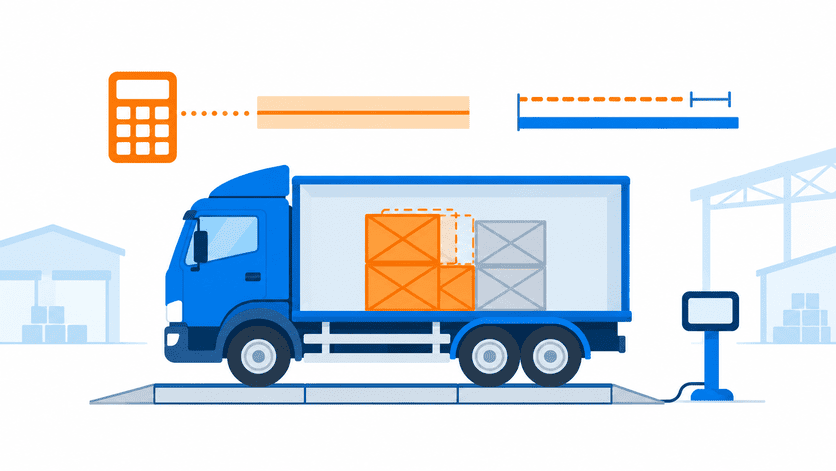
Error Sources You Cannot Calculate Away
- Unknown cargo CG: Unless you are loading a single item with a documented center of gravity, you are guessing. Mixed pallets, partial loads, and irregularly shaped cargo all introduce CG uncertainty.
- Uneven loading across the trailer width: The moment-balance method assumes everything is centered left-to-right. If cargo is heavier on one side, individual wheel loads become uneven even if the axle-group total looks acceptable.
- Fuel, water, and consumables: A full diesel tank can weigh 200–400 kg more than a near-empty one. DEF fluid, toolbox contents, and driver weight all shift the tractor's baseline.
- Suspension state: Air suspension at different ride heights, worn leaf springs, or uneven tire pressure change how load transfers between axles.7 A truck that sat overnight may settle differently than one that just rolled off the highway.
- Road gradient and surface: A truck parked on even a slight slope redistributes axle loads. This affects both estimation accuracy and field measurement with portable equipment.
- Fifth-wheel position: Sliding tandems or adjustable fifth wheels change the coupling point — and therefore the load split — significantly. A small adjustment here can move over a ton between axle groups.
What Does This Mean Practically?
It means your calculated axle weight should be treated as a planning range, not a precise figure. If your estimate puts a tandem at 17,500 kg and the legal limit is 18,000 kg, that 500 kg margin may or may not exist in reality. The structural error from unknown CG and suspension state alone can easily exceed 500 kg.
Rule of thumb from our field experience: If your estimated axle load is within roughly 5–8% of a legal limit, you should not assume compliance without a physical measurement.8
When Is Estimation Enough — and When Do You Need to Measure?
This is the question that really matters for fleet operations. A truck axle weight calculator is a legitimate tool. But it has a boundary, and knowing that boundary protects your fleet from fines, equipment damage, and liability.
The distinction maps cleanly to the decision being made and the consequence of being wrong.

Estimation Is Sufficient When:
- Pre-loading planning: You are deciding where to position cargo in the trailer before loading begins. The estimate tells you whether the planned arrangement is likely to distribute weight within limits.
- Quick "sanity check" on a known, repetitive load: You run the same cargo type on the same route regularly. The estimate confirms the standard loading pattern remains within expected ranges.
- Training drivers and loaders: The calculation teaches your team why load placement matters, building awareness that prevents casual overloading.
Measurement Is Necessary When:
| Situation | Why Estimation Falls Short | Appropriate Equipment |
|---|---|---|
| Departures from a loading yard with variable cargo | CG unknown; load composition changes daily | Portable axle weighing pads or on-site platform scale |
| Self-check before reaching enforcement stations | Must match what enforcement equipment will read | Portable axle weighing pads |
| Trade or settlement-based weighing | Legal liability; both parties need defensible data | Certified, calibrated truck scale (weighbridge) |
| Enforcement or regulatory compliance | Must meet legal metrology standards | Certified truck scale with valid calibration |
| Dispute resolution | Needs traceable, auditable measurement | Certified truck scale with legal-for-trade certification |
Where Portable Axle Weighing Pads Fit
Portable axle weighing pads sit squarely in the "self-check" category. They allow a fleet to measure axle loads on-site — at a loading yard, a mine gate, a farm, or a remote project location — without building a permanent weighbridge foundation.
However, based on our experience handling customer feedback on portable axle weighers, the most common complaints about "inaccuracy" trace back to site conditions, not the equipment itself. When a customer tells us their portable pads don't match the readings at a certified truck scale, the on-site investigation usually reveals one or more of these factors:
- Ground surface is uneven or soft — even a few millimeters of slope or a gravel surface introduces meaningful error
- The truck was not fully stationary — brakes not set, engine running, driver still in the cab shifting weight
- Suspension had not settled — the truck rolled onto the pads and was weighed immediately, before air suspension reached steady state
- Pads were not placed on a firm, level surface — asphalt patch, concrete slab, or compacted soil each behave differently
These are operational factors, not defects. A portable axle weigher is designed as a field self-check tool. It gives you actionable data for go/no-go decisions before the truck leaves. It is not designed to replace a full-length, foundation-mounted, calibrated truck scale for legal trade or enforcement purposes.
How Do Tandem and Tri-Axle Groups Affect the Calculation?
When your vehicle has tandem (dual) or tridem (triple) axle groups, the axle weight calculator must distribute the group's total load across the individual axles within that group. This matters because regulations typically set limits at both the group level and the individual axle level.
For a tandem axle group with equal suspension and even load, the group load divides roughly equally between the two axles. For a tridem, it divides roughly by three. But "roughly" does a lot of heavy lifting in that sentence.
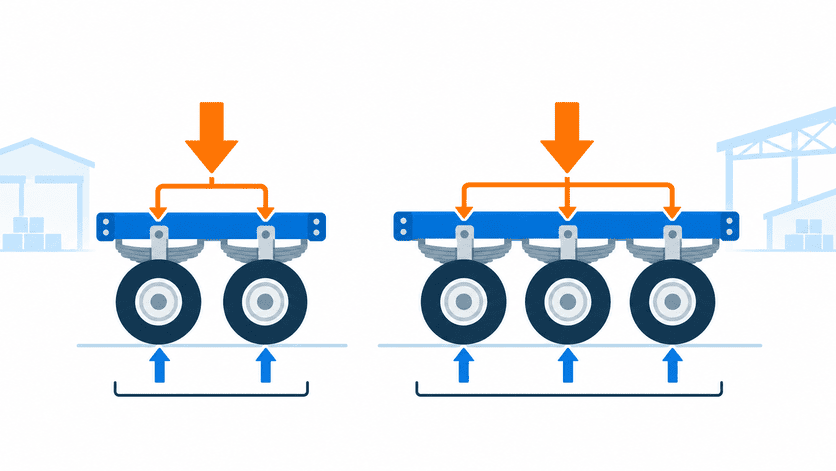
Factors That Affect Intra-Group Distribution
- Suspension type: Walking-beam, leaf spring, and air suspension distribute loads differently under static and dynamic conditions.
- Axle spacing within the group: Regulations in some jurisdictions adjust the allowable group limit based on the spacing between axles. Wider spacing generally permits higher group limits.9 (Verify specific values with your local transport authority.)
- Unequal tire pressure or worn components: If one axle in a tandem has lower tire pressure or a weaker spring, it carries less — and the other axle carries more.
- Dynamic effects: Under braking, the front axle of a tandem picks up load. Under acceleration, the rear one does. These are transient, but they matter at enforcement checkpoints if the truck has not fully settled.
Practical Calculation Approach
For planning purposes, most fleet operators use an equal-split assumption within a group:
Individual axle load ≈ Group total ÷ Number of axles in group
This is acceptable for pre-loading estimation. But if your group total is close to the legal limit, the equal-split assumption masks the risk that one axle might be individually over. This is another scenario where physical measurement provides the confidence that calculation cannot.
Frequently Asked Questions
Can a truck axle weight calculator replace weighing at a certified scale?
No. A calculator estimates axle loads based on assumed cargo position and vehicle geometry. It is a planning tool. Legal compliance, trade settlement, and dispute resolution require measurement on calibrated, certified weighing equipment. Estimation helps you load smarter; measurement confirms the result.
Why does my truck fail axle weight checks even though the total weight is legal?
Because axle weight depends on where the load sits, not just how much it weighs. Cargo positioned too far forward overloads the drive axles. Cargo too far back overloads the trailer axles. A truck axle weight calculator helps you visualize this before loading, but you need to actively manage cargo placement.
How accurate are portable axle weighing pads?
Accuracy depends heavily on site conditions — ground flatness, surface hardness, truck settling time, and proper pad placement. Under good conditions on a flat, hard surface, portable pads provide useful self-check data. Under poor conditions, errors increase significantly. They are field tools, not substitutes for permanently installed, calibrated truck scales.
What measurements do I need from my truck to estimate axle weights?
You need the empty weight per axle group (from a scale ticket or OEM spec), the wheelbase dimensions (steer axle to drive tandem center, drive tandem center to trailer tandem center), the fifth-wheel or coupling location, and the cargo weight and estimated center of gravity position.
Should I adjust my estimate for fuel level and driver weight?
For high-stakes loading near legal limits, yes. A full fuel tank versus near-empty can differ by 200–400 kg, most of which sits near the drive axles. Driver weight, toolboxes, and fluids all add up. These small variables matter when your margin to the legal limit is thin.
Conclusion
A truck axle weight calculator is a valuable planning tool that every fleet operation should understand and use. The moment-balance method gives you a practical way to estimate how cargo weight distributes across axle groups — and more importantly, it shows you how sensitive that distribution is to cargo position. But estimation has structural limits. Unknown cargo center of gravity, suspension behavior, fuel levels, and ground conditions mean calculated values are always approximate.
For pre-loading decisions and internal awareness, estimation works. For anything involving legal compliance, financial settlement, or third-party disputes, you need calibrated measurement equipment — portable axle weighing pads for on-site self-checks, or a certified truck scale for legal-for-trade accuracy.
At HENER, we manufacture both portable axle weighing pads for field use and full truck scales for permanent installations, backed by 23 years of industrial weighing experience. If you are evaluating whether your operation needs on-site weighing capability, contact our team for a straightforward conversation about what fits your actual workflow — no overselling, just the right tool for the decision you need to make.
References
- Beam Design F BEAM DESIGN FORMULAS WITH SHEAR ...
- Compilation of Existing State Truck Size and Weight Limit Laws
- Bridge Formula Weights - FHWA Operations
- 12.1 Conditions for Static Equilibrium - UCF Pressbooks
- Influence of a Trailer's Axle Arrangement and Loads on the ...
- Wheelbase
- Truck Tire Pavement Contact Pressure Distribution ...
- Uncertainty of Measurement Results from NIST
- Bridge Formula Weights - FHWA Operations