



On this page

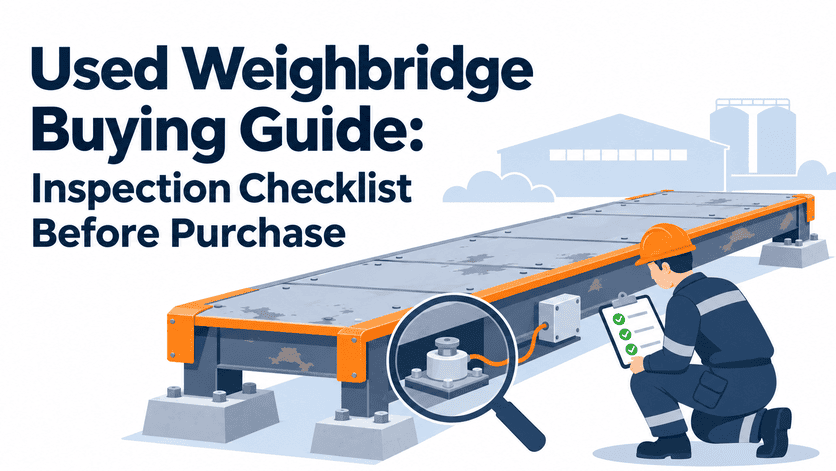
Finding a used weighbridge at half the price of a new one feels like a procurement win — until the scale drifts, the load cells fail, and the "savings" disappear into replacement parts, re-calibration fees, and operational downtime. The real question is not whether a used weighbridge looks good. The question is whether the components you are inheriting still have enough service life to justify the total cost of getting that scale installed, calibrated, and legally operational at your site.
A used weighbridge buying decision should be evaluated on landed-and-working cost — not purchase price. Before committing, buyers must verify the electrical chain (load cells, junction box, cabling, indicator), confirm why the scale was removed, and run measurable on-site tests. If the electrical components need replacement, the total investment often approaches new-scale cost for used steel and an unknown weld history.1
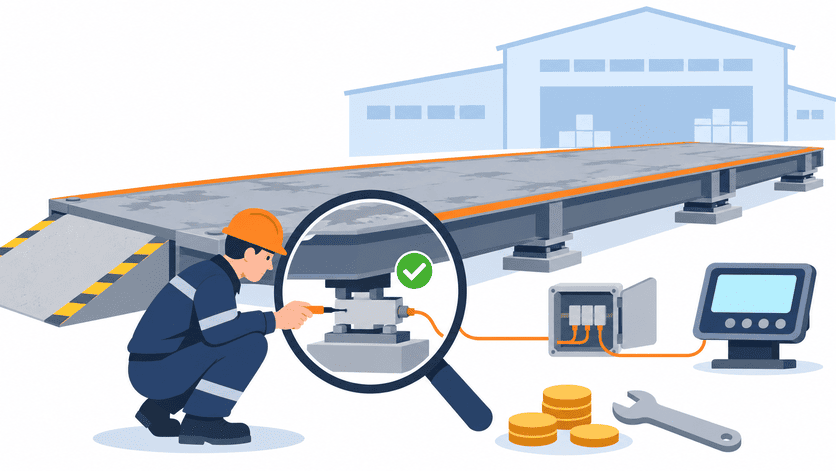
I have spent over two decades manufacturing weighbridges, load cells, indicators, and junction boxes at HENER. We do not sell or broker used weighbridges. But we see the aftermath constantly — buyers who purchased a used scale and then come to us for replacement load cells, junction boxes, and indicators because the originals failed within months. That experience, combined with the conversations we have when buyers use used-scale quotes to negotiate new-scale pricing, gives us a very specific view of what actually fails, what actually costs money, and where the real risk sits. Below is the framework we share with those buyers.
Why Is the Steel the Price Tag but the Electrical System the Lifespan?
Most buyers focus on the steel deck when evaluating a used weighbridge. It is the largest, most visible component. But here is the problem: the steel structure is the part that doesn't wear out first — while the electrical chain quietly degrades in ways you cannot see from the surface.2
A weighbridge's steel platform and substructure account for the majority of a new scale's manufacturing cost. Load cells, the junction box, cabling, and the indicator together represent a smaller share — from our manufacturing-side observation, roughly in the range of 15–25% of a new weighbridge's price, though the exact band varies by configuration and capacity (this is a supplier-side estimate from HENER's production cost structure, not an industry-standard figure; buyers should verify against quoted component prices for their specific scale).
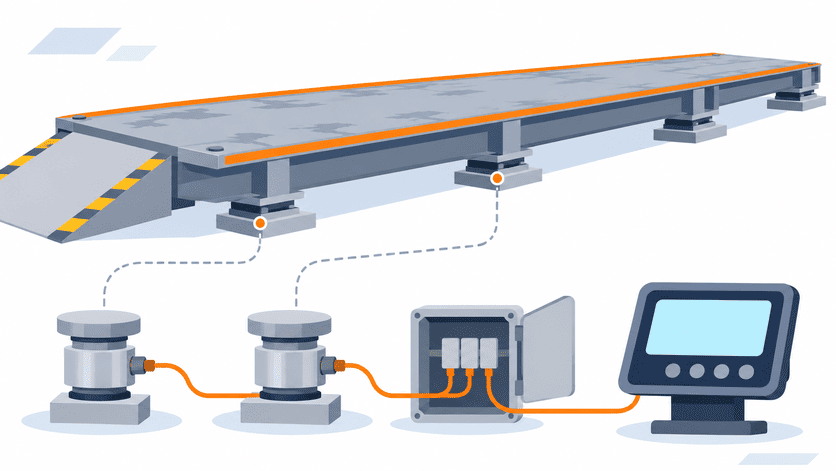
That cost split creates a dangerous illusion. A used scale priced at "50% of new" is being priced on the steel — the part with decades of potential service life. But the electrical chain, which actually determines whether the scale can hold calibration, pass inspection, and deliver repeatable readings, may already be near end-of-life.
What Does This Mean for the Buyer's Math?
When a buyer tells us they found a used 80-ton truck scale for half the price of a new one, I ask them to do a different calculation:
| Cost Element | New Weighbridge | Used Weighbridge |
|---|---|---|
| Steel structure | Included | Purchase price covers this |
| Load cells (6–12 units) | Included | Likely replacement needed |
| Junction box + cabling | Included | Likely replacement needed |
| Indicator / terminal | Included | May need replacement or upgrade |
| Foundation / civil work | New foundation | New foundation (used scale rarely fits existing pit) |
| Transport | Factory to site | Dismantling + heavy-haul from seller's site |
| Installation + calibration | Included or quoted | Buyer arranges separately |
| Total landed-and-working cost | Known, single quote | Unknown until electrical chain is assessed |
The steel you are buying is the part that holds value. The electrical components you are inheriting are the part that determines whether you actually save money. That is why every item on the inspection checklist below targets the electrical chain and structural integrity beneath the surface — not the deck you can see from the top.
What Are the Three Failure Modes HENER Sees in Replacement Parts Orders?
When buyers come to us after purchasing a used weighbridge, the replacement parts they need cluster into three predictable patterns. These are not theoretical risks. They are the actual failure modes driving real parts demand from our customer base.
The three most common failures in used weighbridges — based on HENER's experience supplying replacement components — are load cell water ingress causing calibration drift, corroded junction boxes producing unstable signals, and hidden structural damage masked by surface repainting. Each one is invisible from a casual visual inspection.
Failure Mode 1: Load Cell Water Ingress and Falling Insulation Resistance
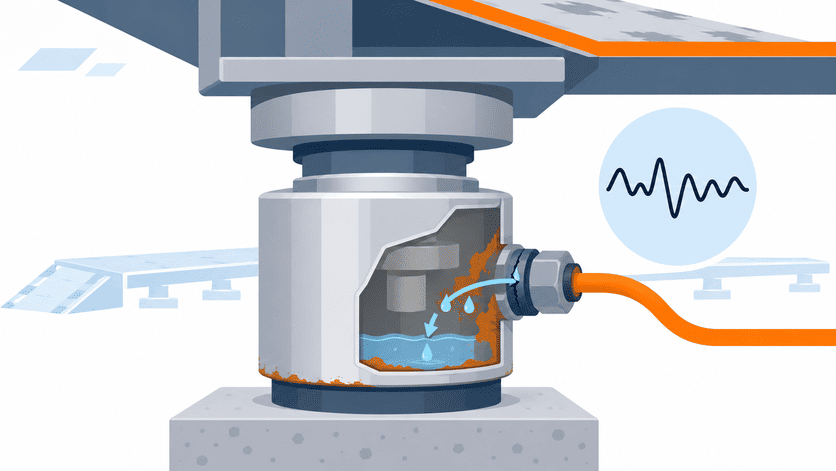
This is the single most common issue we see. Load cells in truck scales sit at ground level, exposed to water, mud, chemicals, and temperature cycling for years. Even IP67-rated cells eventually degrade — seals age, cable entry points crack, and moisture enters the cell body.3
The result is falling insulation resistance between the Wheatstone bridge circuit and the cell body (ground). When insulation resistance drops, the load cell's signal drifts.4 The practical symptom is:
- Corner errors that won't stay calibrated. You calibrate the scale, it passes. A week later, one corner reads differently. You re-calibrate. It drifts again.
- Temperature-dependent drift. The scale reads accurately in the morning but shifts as the deck heats up and moisture inside the cell expands.
- Intermittent zero instability. The empty-scale reading creeps, never settling.
A load cell with compromised insulation resistance cannot be repaired. It must be replaced.5 And because weighbridge load cells work as a matched system through the junction box, replacing one degraded cell often reveals that others are borderline — leading to cascading replacements.
On-site test: Measure insulation resistance to ground on each individual load cell using a megohmmeter (insulation tester) at 50V DC minimum. A healthy industrial load cell should read above 5,000 MΩ. Anything below 1,000 MΩ is a concern. Below 200 MΩ, the cell is failing and will not hold calibration.6 This measurement alone eliminates the single largest risk in a used weighbridge purchase.
Failure Mode 2: Corroded Junction Box and Oxidized Terminals
The junction box is where all load cell signals are trimmed, balanced, and summed before reaching the indicator. It sits under the deck or in a pit — exactly where water collects. In the units customers bring to our attention, we commonly see:
- Oxidized screw terminals that create variable contact resistance, producing readings that fluctuate or jump.7
- Corroded potentiometers (in analog junction boxes) that can no longer trim corner balance accurately.
- Degraded cable insulation inside the box, causing signal crosstalk between load cell channels.
The practical result: the indicator displays unstable, flickering, or non-repeatable weights. The buyer assumes the indicator is faulty, replaces it, and the problem persists — because the signal corruption originates in the junction box.
A quality stainless-steel junction box with proper IP rating and potted connections resists this for years. But a used scale's junction box may have been the lowest-spec component originally, and it has been aging in the worst possible location.
On-site check: Open the junction box. Photograph the terminals, potentiometers, and cable entries. Look for green or white corrosion on any metal surface. If you cannot open the junction box or the seller will not allow it, that is a walk-away signal.
Failure Mode 3: Hidden Structural Damage Beneath a Repainted Surface
This is the failure mode where the one surface a buyer can easily see is the one that lies most.
From a manufacturing standpoint, what we can judge at HENER is weld integrity and beam construction — we produce these structures daily with robotic welding and controlled processes. What we see when buyers send us photographs of used scales they are considering:
- Top deck repainted to look new, while the underside shows deep pitting corrosion on I-beams and cross-members.
- Cracked welds at beam-to-deck plate junctions, sometimes visible only from underneath.
- Section loss in main load-bearing beams from years of corrosive environments (salt, chemical runoff, acidic materials).8
A repainted top deck is cosmetically convincing. The underside — where structural fatigue and corrosion actually accumulate — is the surface most buyers never inspect, and the surface most sellers never clean.
On-site action: Inspect the underside of the deck. This may require lifting deck modules or using a mirror and flashlight. Look for weld cracks along main beam junctions, flaking or blistering paint (indicating corrosion beneath), and any evidence of thickness loss on beam flanges. If the underside has been freshly painted, ask why — and treat it with the same suspicion you would treat a freshly undercoated used vehicle.
What Four Questions Should You Ask Before Any Inspection?
Before you spend time and money traveling to inspect a used weighbridge, there are four qualifying questions that can eliminate unsuitable units remotely. At HENER, these are the questions we actually ask buyers first when they contact us about parts for a used scale they are considering.
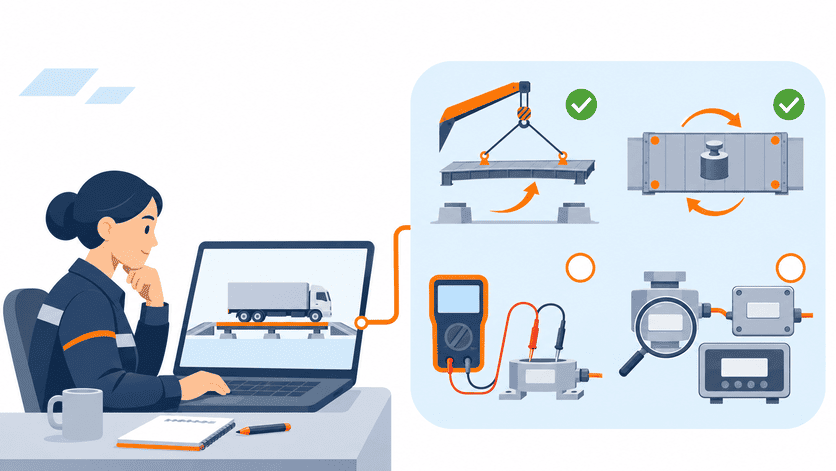
These four go/no-go questions should be asked before committing to a site visit: Why was the scale removed? Can you run a corner-load repeatability test? Can you measure each load cell's insulation resistance? Can you identify every electrical component by brand and model?
Question 1: Why Was This Scale Removed?
There are two acceptable answers: capacity upgrade (the site needed a higher-capacity scale) or site closure (operations moved or shut down). Both mean the scale was working when removed.
There is one unacceptable answer: vagueness. "It was surplus." "We upgraded our system." "It's been in storage." If the seller cannot or will not state clearly why a heavy, installed piece of infrastructure was ripped out of its foundation, assume it was removed because it stopped reading accurately — which points directly to electrical chain failure.
Question 2: Can You Run an On-Site Corner-Load Repeatability Test with a Known Reference Load?
This is not a full calibration. It is a basic functional test:
- Place a known reference weight (ideally certified test weights; a loaded vehicle of known weight is a pragmatic alternative) on each corner/section of the deck.
- Record the readings.
- Repeat three times.
- Compare.
You are checking two things: corner agreement (does each section read the same known load within acceptable tolerance?) and repeatability (does the same corner give the same reading three times?). If the seller refuses this test or says the scale "isn't set up for it," walk away. A functioning scale can always be tested.
Question 3: Can You Measure Insulation Resistance to Ground on Each Individual Load Cell?
This requires disconnecting each load cell from the junction box and testing with a megohmmeter. It takes 15–30 minutes for a technician who knows what they are doing.
If the seller says "the scale reads fine, you don't need to test individual cells," that is not reassurance — it is a refusal. A scale can display plausible-looking numbers while one or more cells are degrading. The insulation resistance test is the only way to know.
Question 4: Can You Photograph and Confirm the Brand and Model of Every Load Cell, the Junction Box, and the Indicator?
This question serves two purposes:
- Pricing replacement risk. If you can identify the components, you can price replacements before you buy. If you cannot, you are buying blind.
- Availability check. An older branded weighbridge is often worse than an unbranded one — discontinued indicator models, obsolete load cell mounting dimensions or output specifications, and no communication interface for modern ERP, PLC, or unmanned-weighing integration. If the components are unidentifiable or discontinued, you cannot repair the scale. That alone should kill the deal.
How Do You Calculate Landed-and-Working Cost for a Used Weighbridge?
"Half the price of new" is a comparison against the wrong number. The purchase price of a used weighbridge is only the first line item. The number that matters is what it costs to have that scale installed, calibrated, and producing legally defensible weight readings at your site.
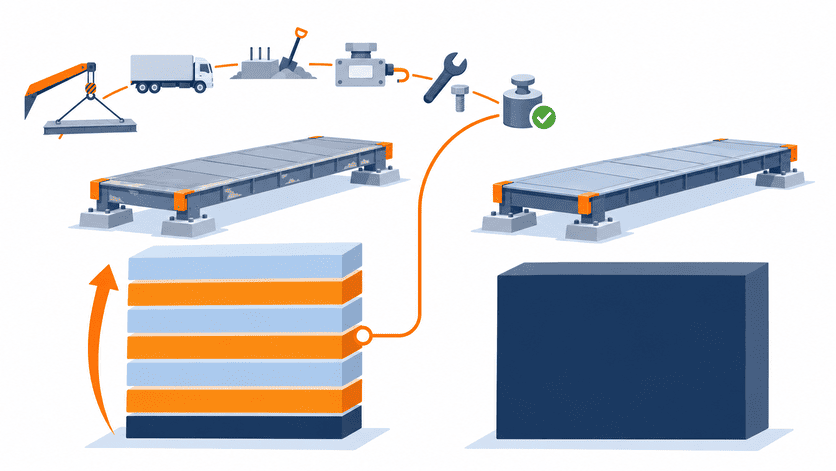
Landed-and-working cost includes dismantling, transport, civil work, electrical component replacement, installation, and calibration. When the electrical chain requires replacement — which the failure modes above make probable — the buyer has often paid new-scale money for used steel and an unknown weld history.
Breaking Down the Hidden Cost Items
Here is what buyers typically underestimate:
- Dismantling and transport. A 60-ton or 80-ton weighbridge is a massive steel structure. Dismantling a modular/bolted deck is manageable. Dismantling an integral welded deck often requires cutting, which damages the structure. Either way, heavy-haul transport of 18–24m steel sections is expensive and logistically complex.
- Foundation and civil work. A used scale almost never fits an existing foundation. Different manufacturers use different support-point geometries, module lengths, and pit dimensions. Budget for a new foundation — this alone can represent 15–30% of a new weighbridge project's total cost.9
- Electrical chain replacement. Based on the failure patterns we see at HENER, the probability of needing to replace at least some load cells and the junction box is high for any scale that has been in service for several years and then sat idle during removal and storage. Budget for a full load cell set, new junction box, and new cabling as a contingency. If testing proves they are good, that is a bonus — but do not build your business case on the assumption they are fine.
- Indicator upgrade or replacement. Even if the original indicator works, does it support the communication protocols your operation needs? RS232/RS485, Modbus, 4–20mA, Bluetooth, WiFi, ERP/PLC integration? An older indicator without these interfaces limits future automation and unmanned-weighing capability.
- Calibration and certification. A used scale must be fully re-calibrated at its new location. If your operation requires legal-for-trade certification, the scale must meet the applicable standards in your country — and certification requirements vary by jurisdiction. This is the buyer's responsibility to verify, and it is not guaranteed for a used unit.
The Honest Math
When I sit across from a buyer who quotes a used-scale price to negotiate down our new-scale pricing, the gap I have to explain is this: the used scale's purchase price buys steel. Our new-scale price buys steel plus a matched, tested, warranted electrical chain plus a foundation design matched to the platform plus factory calibration plus documentation for certification plus technical support for installation and integration.
Once you add replacement load cells, a new junction box, new cabling, re-calibration, civil work, and transport to the used-scale price, the numbers often converge. Sometimes the used scale still wins on cost — particularly if the electrical chain genuinely tests healthy. But the buyer must do that math before committing, not after.
When Should You Buy and When Should You Walk Away?
Not every used weighbridge is a bad deal. And not every new weighbridge is the right answer for every budget. The framework below is the buy/don't-buy decision gate we share with buyers who ask us honestly whether a specific used unit is worth pursuing.
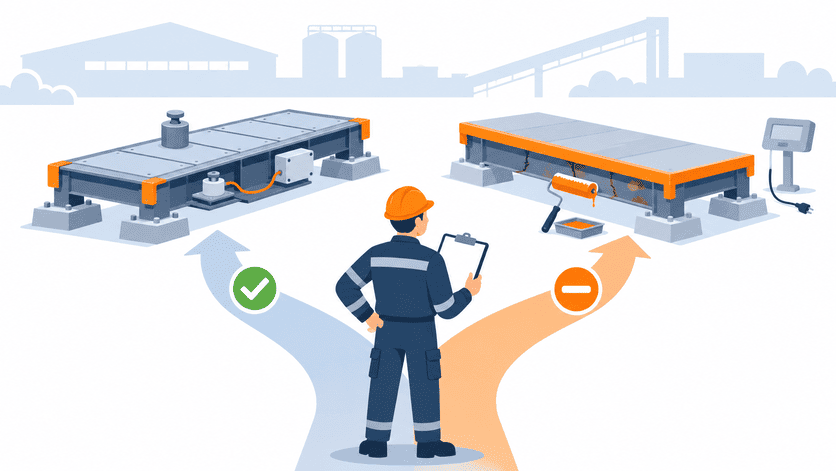
A used weighbridge is a reasonable buy when the deck is modular, the components are identifiable and still supported, the removal reason is clear, and the seller allows on-site testing. Walk away when components are unidentifiable, testing is refused, the underside is freshly repainted, or legal-for-trade certification is required.
Reasonable Buy Conditions
All of the following should be true simultaneously:
- Modular/bolted deck design — can be dismantled and transported without cutting, and reassembled at the new site without compromising structural integrity.
- Known-brand, still-supported load cells and indicator — replacement parts, calibration software, and technical documentation are currently available from the original manufacturer or compatible aftermarket suppliers.
- Clear removal reason — capacity upgrade or site closure, verifiable through the seller's operational context.
- Seller allows corner-load repeatability and insulation resistance testing on site, with the buyer's own technician or an independent third party.
- Buyer has already budgeted for full re-calibration and contingency replacement of the junction box and at least 2–3 load cells.
- The operation does not require legal-for-trade certification, or the buyer has confirmed with local metrology authorities that a used, re-calibrated unit can be certified.
Walk-Away Conditions
Any single one of these should stop the deal:
- Unidentifiable load cells, junction box, or indicator — you cannot price repair, source parts, or assess compatibility.
- Seller refuses on-site testing or will not allow the buyer to disconnect and test individual load cells.
- Freshly repainted underside with no documented reason — this is the structural equivalent of clearing a used car's fault codes before sale.
- No clear or credible removal reason provided.
- Integral welded deck that cannot be transported in manageable sections without structural cutting.
- The site requires statutory legal-for-trade certification and the buyer has not independently confirmed that a used, re-installed unit can achieve it.
- The indicator lacks communication interfaces needed for the buyer's operational systems (ERP, PLC, automated weighing), and no compatible upgrade path exists.
Frequently Asked Questions
Can I replace just the load cells and keep the rest of a used weighbridge?
You can, and many buyers do. But load cells work as a matched system through the junction box. If the junction box is also corroded or the cabling insulation has degraded, replacing only the load cells will not resolve signal instability. Test the entire electrical chain before deciding which components to keep.
How do I know if a used weighbridge can be certified for legal trade at my site?
Certification requirements vary by country and sometimes by region within a country. HENER cannot make this determination — it is the buyer's responsibility. Contact your local weights and measures authority or metrology office before purchasing. Ask specifically whether a used, re-installed, re-calibrated weighbridge can receive legal-for-trade approval in your jurisdiction.
Is a used branded weighbridge safer than an unbranded one?
Not necessarily. An older branded unit often comes with discontinued indicator models, obsolete load cell specifications, and no path to modern communication interfaces. Brand recognition does not guarantee parts availability. Confirm that the specific model's components are still manufactured and supported before treating brand as a safety factor.
What is the minimum testing I should do before buying a used weighbridge?
At minimum: (1) insulation resistance measurement on every individual load cell, (2) corner-load repeatability test with a known reference weight, (3) visual inspection of the junction box internals for corrosion, and (4) physical inspection of the deck underside for weld cracks, beam corrosion, and evidence of undisclosed repainting. If any of these four cannot be performed, the risk is not quantifiable.
Can HENER supply replacement load cells and indicators for a used weighbridge from another manufacturer?
In many cases, yes. HENER manufactures load cells in common industrial capacities and output specifications, as well as weighing indicators and junction boxes with standard communication interfaces. Compatibility depends on the specific mounting configuration, output specification (mV/V), and capacity of the original components. Send us photographs and specifications of the existing components, and we can confirm whether our products are suitable replacements.
Conclusion
A used weighbridge buying decision is not about whether the scale looks good — it is about whether the components you are inheriting have enough remaining life to justify the total landed-and-working cost. The inspection checklist above focuses on what actually fails: load cells with compromised insulation resistance, corroded junction boxes, and structural damage hidden beneath repainted surfaces. Before any site visit, ask the four qualifying questions. On site, measure and verify — do not rely on visual impressions. Run the honest cost calculation including dismantling, transport, civil work, electrical chain replacement, and re-calibration. A used weighbridge can be a sound procurement decision when the conditions are right. But the conditions must be tested, not assumed.
If you are evaluating a used weighbridge and need to price replacement load cells, junction boxes, indicators, or cabling, contact HENER with photographs and specifications of the existing components. We can help you assess compatibility, quote replacement parts, and give you the information you need to make the total-cost comparison before you commit.
References
- Lifecycle Costing (LCC): What It Is and How to Apply It in ...
- Common Weighbridge Problems and Maintenance Tips
- IP67 Testing: Dust Test and Temporary Immersion IEC 60529
- characteristics and applications of resistance strain gages
- How to Test for Faults in Load Cells
- OIML R60-1 WD
- spacecraft electrical connector selection and application ...
- FHWA-HRT-24-127: Best Practices for Corrosion Control and Mitigation
- Project Management for Construction: Cost Estimation