













On this page

A wrong livestock scale wastes time, stresses animals, and gives unstable readings. I see this when farms buy capacity first and workflow second.
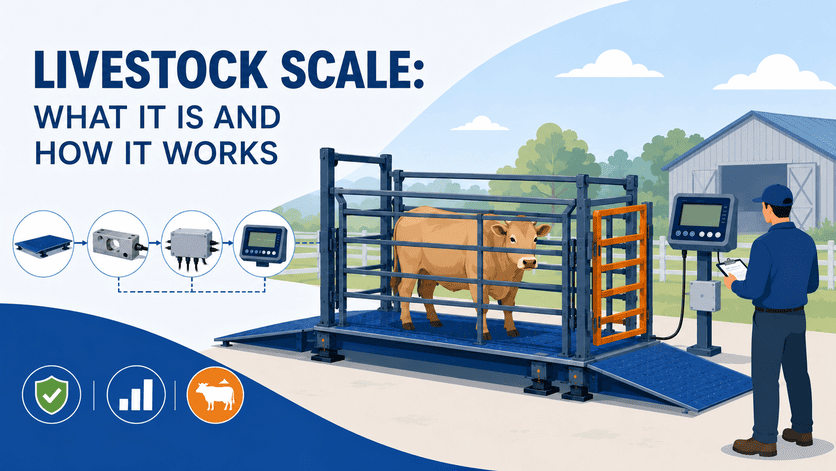
A livestock scale is a weighing system made for live animals. It uses a platform, load cells, junction box, indicator, gates, anti-slip surface, and calibration to give stable weight readings even when animals move.
I often answer the same early question from farmers: “What capacity do I need?” That question matters, but it is not the full question. I usually ask about the animal type, body size, platform length, entry direction, washing method, and how often the scale will be used. A livestock scale must fit the animal and the operator at the same time. If the animal cannot stand safely and calmly, the display may show numbers, but the data may not be useful. So I will explain what a livestock scale is, how it works, and how I think about selection in real farm use.
What Is a Livestock Scale?
A basic animal scale can look simple, but a poor setup creates jumpy readings, unsafe movement, and slow work. I see this problem often.
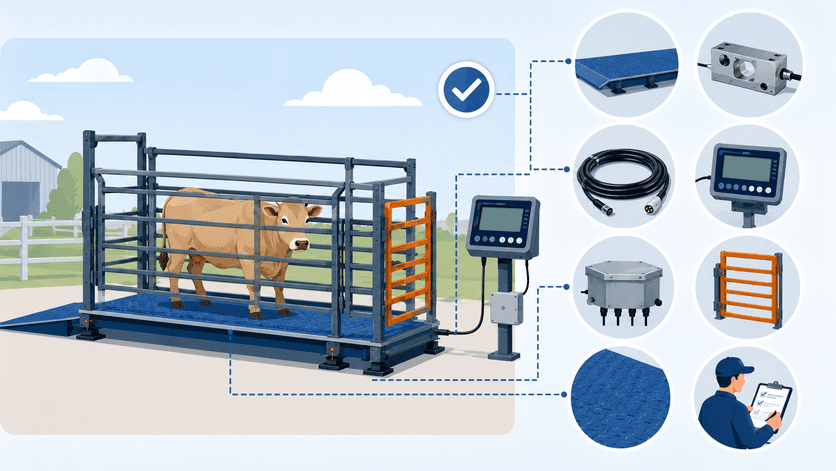
A livestock scale is a complete weighing system designed for live animals.1 It includes the weighing deck, load cells, signal wiring, indicator, enclosure, gates, anti-slip floor, and calibration work2. Each part helps turn animal weight into usable data.
I define the scale as a system
I do not define a livestock scale as just a platform scale with a fence. That view misses the main point. The animal is alive. It moves, shifts weight, steps sideways, and may resist entering. The scale must manage that movement and still produce a readable weight.
In livestock scale selection conversations, farmers often ask first about capacity. I understand why. Capacity is easy to compare. But the better question is, “Can this scale weigh my animals in my daily process without making the job harder?” That question leads to a better design.
| Part of the system | What it does | Why I care in real farm use |
|---|---|---|
| Platform deck | Holds the animal | It must match body size and hoof contact |
| Load cells | Convert weight into signal | They affect accuracy and stability |
| Junction box | Combines load cell signals | It helps with corner adjustment and service |
| Indicator | Displays the weight | It needs filtering for animal movement |
| Gates and enclosure | Guide and contain the animal | They reduce stress and improve safety |
| Anti-slip surface | Helps animals stand | It reduces slipping and sudden movement |
| Calibration | Sets correct readings | It keeps the system useful after installation |
I look at the animal before I look at the catalog
A cattle scale, sheep scale, pig scale, and goat scale may all use the same weighing idea. But they do not always need the same platform, railing, height, or gate design. A cow needs enough length to stand fully on the deck. A pig may need side panels that guide it forward. Sheep may move as a group, so the operator may want faster handling and clear entry control.
I also ask about the working place. Some scales sit in barns. Some sit outside near yards or loading lanes. Some farms wash the scale every day. Some sites have mud, manure, moisture, and rough handling. These details affect the structure, surface finish, indicator protection, cable routing, and long-term maintenance.
How Does a Livestock Scale Work?
Animal weighing feels difficult when the animal moves. I explain the process step by step so the owner knows what the scale is really doing.
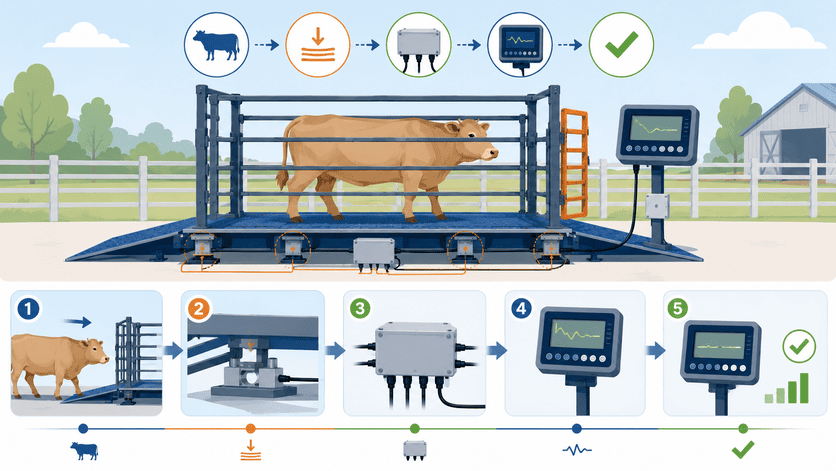
A livestock scale works by letting the animal stand on a weighing platform. The load cells sense the force, the junction box combines the signals, and the indicator processes the data. Stabilization and filtering help show a readable weight.3
I see the weighing process as a simple flow
The animal enters the platform first. The platform structure receives the full body weight. The structure then transfers that force to the load cells. The load cells create small electrical signals.4 The junction box combines those signals. The indicator reads the signal and converts it into a weight value.
That is the basic flow. But livestock weighing has one extra challenge. The animal rarely stands like a static steel part.5 It shifts, steps, lowers its head, pushes the rail, or leans against the side. So the indicator must process changing signals. The goal is not to freeze a perfect laboratory reading. The goal is to show a stable and practical weight that the operator can use.
| Step | What happens | Common issue |
|---|---|---|
| Animal enters | The operator guides it onto the deck | The animal may stop or turn |
| Weight transfers | The deck carries the animal load | Uneven standing can affect signal balance |
| Load cells sense force | Load cells output signals | Movement creates changing values |
| Indicator processes signal | The display calculates weight | Poor filtering creates jumpy readings |
| Operator records weight | The stable value is read or saved | Slow stabilization reduces work speed |
I pay attention to stabilization, not only accuracy class
Many buyers look at accuracy numbers first. I respect that. A scale must be accurate. But with livestock, stability is just as important in daily use. A technically accurate scale can still be frustrating if the weight keeps jumping while the animal moves.
The indicator setting matters here. Many livestock indicators use animal weighing modes, digital filtering, or hold functions. These functions help the operator capture a stable value. I do not present these functions as magic. They cannot fix a bad structure, a shaky floor, or a platform that is too small. But they help when the mechanical design and installation are already suitable.
I also check installation and level support
A livestock scale needs a stable base. If the base is uneven, soft, or shifting, the load cells may not receive force in a clean way. I usually ask whether the scale will sit on concrete, inside a chute, near a gate, or in a mobile setting. A fixed farm scale often benefits from a firm and level foundation.6 A portable livestock scale needs a design that handles movement and setup without constant trouble.
How Should I Choose the Right Livestock Scale?
A scale with enough capacity can still be the wrong scale. I have seen farms struggle because the size, gate flow, or surface did not match the animals.
I choose a livestock scale by matching it to animal type, body size, platform dimensions, entry and exit flow, weighing frequency, site conditions, and operator habits. Capacity is important, but it is only one part of correct selection.
I start with the animal and the job
I first ask what animals will be weighed. Cattle, calves, pigs, sheep, goats, and other livestock have different behavior. I also ask whether the farm weighs one animal at a time or several smaller animals together. The answer changes the platform size, capacity, and enclosure style.
Capacity should cover the heaviest expected load with a safe margin. But I do not want the buyer to treat capacity as the only feature. A 2-ton scale may weigh cattle by capacity, but a short deck may not let the animal stand fully. A strong scale may also perform poorly if the gate design slows handling.
| Selection factor | Question I ask | Why it matters |
|---|---|---|
| Animal type | What animals will you weigh? | Body shape and behavior affect design |
| Body size | How long and wide are the animals? | The animal must stand fully on the deck |
| Capacity | What is the heaviest expected load? | The scale must not overload |
| Platform size | Is the deck large enough? | A cramped animal moves more |
| Gate flow | How does the animal enter and leave? | Smooth flow saves labor |
| Frequency | How many times per day or week? | Heavy use needs stronger build |
| Site | Indoor, outdoor, wet, muddy, or washed? | Environment affects materials and protection |
I match the scale to the operator workflow
The scale is part of a work process. It is not only a machine. I ask where the operator stands. I ask how the animal is brought in. I ask whether the operator needs to read the display from a distance. I ask whether weight needs to be written by hand, sent to a printer, or connected to a computer system.
Not every livestock scale needs software, ear-tag reading, or tracking functions. These are optional. Some farms only need a clear display and a stable hold function. Some larger farms may want data output through RS232, RS485, Bluetooth, WiFi, or other systems. I always separate the basic weighing need from the optional data need. This keeps the purchase practical.
I think about calm standing before fast weighing
A calm animal gives better data.7 So the platform should not feel unsafe. The surface should reduce slipping. The entry should be clear. The side panels or railings should guide the animal without creating panic. If the animal jumps or twists, the weighing time becomes longer. The operator also faces more risk.
For that reason, I often see the best selection as a balance. The scale needs enough strength. It needs enough space. It needs a suitable gate layout. It needs an indicator that handles movement. When these parts work together, the farm gets weight data with less effort.
Why Does Durability Affect Livestock Scale Accuracy?
Many farms think durability only means the scale lasts longer. I see it differently. Durability also protects stable readings over time.
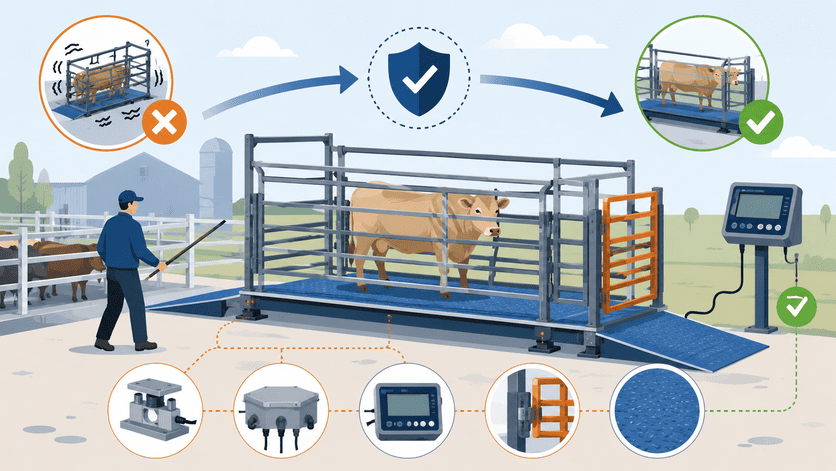
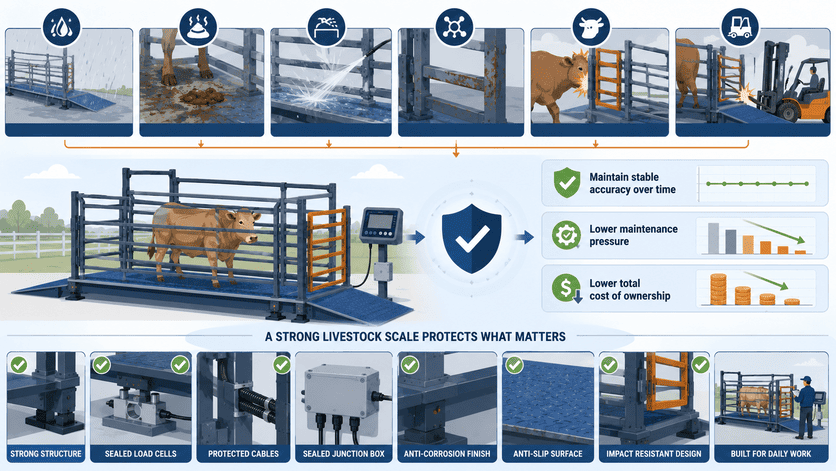
Durability affects accuracy because moisture, manure, washing, corrosion, impact, and rough handling can damage structure, cables, load cells, and junction boxes. A strong livestock scale helps maintain stable weighing performance and lowers maintenance pressure.
I treat the farm environment as part of the specification
A livestock scale often works in a rough place. It may face outdoor rain, dust, manure, mud, and daily washing. The deck may receive hoof impact. Gates may be pushed. Cables may be pulled or bitten. The indicator may sit in a wet or dusty area. These things do not sound like accuracy issues at first. But they become accuracy issues when they change the force transfer or damage signal parts.
A clean signal starts with sound mechanical support. If the steel structure bends too much, if the platform rocks, or if a load cell mount is not stable, readings can become inconsistent. If water enters the junction box, the signal can drift.8 If cables are damaged, the display may become unstable. So I see durability as a direct part of weighing quality.
| Farm challenge | Possible effect | Design point I check |
|---|---|---|
| Rain and washing | Moisture can enter electrical parts | Protected load cells and junction box |
| Manure and mud | Dirt can block movement or damage parts | Easy cleaning and protected gaps |
| Hoof impact | Structure can loosen over time | Strong deck and frame |
| Corrosion | Steel parts weaken and look poor | Surface treatment or stainless options |
| Rough gates | Animals can push or strike panels | Solid enclosure and hinges |
| Cable damage | Signal can become unstable | Protected cable routing |
I look at protection level and service access
I pay attention to the load cell and indicator protection. In many industrial weighing projects, IP protection matters because water and dust are common.9 For livestock use, this is also important. A higher protection level can help in wet and dirty conditions. But I still remind buyers that protection does not replace good cleaning habits, correct installation, and careful cable management.
Service access also matters. A scale should allow inspection of the junction box, cable paths, feet, and load cell mounts. If service is hard, small problems may stay hidden until the scale becomes unreliable. I prefer designs that make basic checking simple.
I connect maintenance cost with the first purchase decision
A cheaper scale can become expensive if it is hard to clean, easy to damage, or unstable after short use. I do not say every farm needs the heaviest model. That would be wasteful. I do say the farm should choose a scale that fits its real environment. A dry indoor barn and a wet outdoor yard may need different materials, finishes, and protection choices.
When I support selection, I ask about washing method, daily use, animal weight range, and site layout. These questions help prevent a common mistake. The mistake is buying a scale that can technically weigh the animal but cannot stay stable and easy to maintain in farm conditions.
What Optional Data Functions Can a Livestock Scale Use?
Some farms only need a number on the display. Other farms want records, reports, or system links. I try to keep this choice clear.
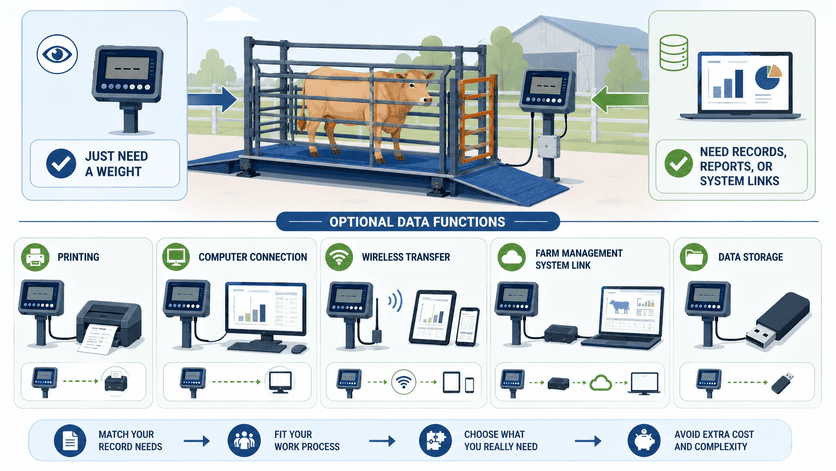
A livestock scale can use optional data functions such as printing, computer connection, wireless transfer, or farm management system links. These functions are not always included by default. They should match the farm’s record needs and work process.
I separate weighing from data management
The core job of the scale is to measure weight. Data functions come after that. I make this clear because some buyers see advanced functions and forget the base scale. A smart system still needs a stable platform, good load cells, correct installation, and proper calibration10.
For smaller farms, the operator may read the display and write the result by hand. This can be enough. For larger farms, manual recording may create errors or slow work. In that case, the farm may want printer output, computer connection, or wireless data transfer. Some farms may also connect weight data with animal ID systems. But I do not treat this as a standard feature for every livestock scale.
| Data need | Possible configuration | When it makes sense |
|---|---|---|
| Simple reading | Indicator display | Small farms or low weighing frequency |
| Paper record | Printer output | Sites that need printed tickets |
| Computer record | RS232 or RS485 output | Farms that enter data into software |
| Wireless transfer | Bluetooth or WiFi | Sites that need flexible data movement |
| System link | Custom integration | Larger operations with record systems |
I ask how the record will be used
I ask whether the farm needs weight for sale, health tracking, feed planning, shipping, or inventory. Each purpose may need a different record style. If the weight is only used for quick sorting, a clear display may be enough. If the weight supports business records, the farm may need better data capture.
I also ask who uses the system. A simple setup may work better when many workers share the scale. A more advanced setup may work well when one trained operator manages the records. The best choice is not always the most complex one. The best choice is the one that the team will use correctly every day.
Conclusion
I see the best livestock scale as a farm tool, not just a weighing machine. It must fit animals, workflow, environment, and data needs.
References
- Utilizing Livestock Scales to Increase Profitability - YouTube
- [PDF] USDA =a - Instructions for Testing Livestock and Animal Scales
- [PDF] NIST Handbook 44: Specifications, Tolerances, and Other Technical ...
- Design and Shape Optimization of Strain Gauge Load Cell for Axial ...
- Research on a Lightweight Recognition Model for Daily Cattle ...
- [PDF] NIST Handbook 44: Specifications, Tolerances, and Other Technical ...
- How Farm Animals React and Perceive Stressful Situations Such As ...
- Design and Shape Optimization of Strain Gauge Load Cell for Axial ...
- IP code - Wikipedia
- Calibrating Industrial Scales | Gram Group