













On this page

Weighbridge cost can become difficult to control when buyers compare equipment prices without checking the weighing task or project scope. A low quotation may exclude freight, foundations, lifting, commissioning, or essential accessories. I use this guide to explain how buyers can build a realistic budget and compare proposals on a like-for-like basis.
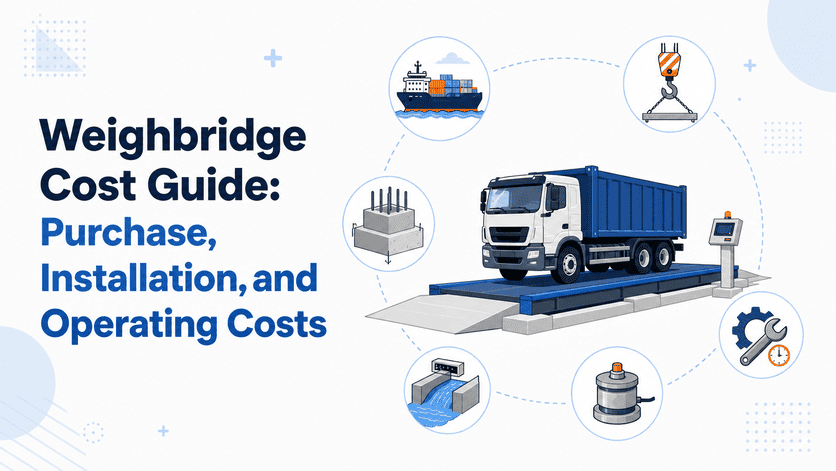
Weighbridge cost includes more than the scale itself. Buyers should budget for the weighbridge structure, load cells, indicator, freight, duties, civil works, drainage, lifting, installation, calibration, commissioning, maintenance, and downtime risk. The final amount depends on dimensions, capacity, axle loads, site conditions, usage frequency, delivery terms, and local requirements.

In the inquiries I handle, the fastest way to improve price accuracy is to define the application before asking for a final quotation. I normally separate the budget into equipment, logistics, site preparation, installation, compliance, and long-term ownership costs.
What Determines Weighbridge Cost?
Buyers sometimes receive two quotations with a large price difference and assume that one supplier is expensive. However, the quoted systems may have different dimensions, steel structures, load-cell quantities, or duty requirements. I first check whether both proposals can perform the same weighing task.
The main factors affecting weighbridge cost are platform length and width, maximum capacity, axle-load distribution, structural design, installation type, weighing frequency, environmental conditions, component specifications, data functions, and project scope. Buyers should compare prices only after confirming that these technical and commercial assumptions are equivalent.

I Start With the Weighing Task
I do not start a weighbridge discussion with price alone. I start with the vehicles, loads, traffic pattern, and required records. These details determine the physical configuration and often explain most of the difference between competing quotations.
I usually ask the buyer to confirm:
- The shortest and longest vehicle
- The maximum gross vehicle weight
- The expected single-axle and axle-group loads
- The required platform length and width
- The number of vehicles weighed per day
- Whether vehicles will stop fully on the platform
- Whether the system will be used for internal control or regulated trade
- The required data outputs and software functions
- The available installation space
- The soil, drainage, temperature, dust, moisture, and corrosion conditions
A longer platform normally needs more steel, additional modules, more transport space, and potentially more load cells. However, platform length alone does not define structural performance. I also review concentrated wheel loads, axle spacing, beam design, deck thickness, welding quality, and load transfer through the modules.1
How Do Core Specifications Affect Price?
The following table shows how I evaluate common cost drivers. It does not represent a universal price formula because every project requires its own engineering and commercial review.
| Specification | Why It Affects Cost | What I Ask Buyers to Verify |
|---|---|---|
| Platform dimensions | Larger decks use more steel and occupy more shipping space | Confirm usable weighing length and width |
| Rated capacity | Capacity affects load cells, structure, and calibration planning | Confirm gross weight and overload risk |
| Axle loads | Concentrated loads influence beam and deck design | Provide vehicle and axle configuration |
| Pit or pitless installation | Each option changes civil works, access, and drainage | Review site space and maintenance access |
| Weighing frequency | Heavy daily traffic may require a stronger duty design | Estimate vehicles per day and peak flow |
| Deck material | Painted carbon steel, concrete-filled decks, and other designs have different cost mechanisms | Compare corrosion, transport, and local construction needs |
| Environmental protection | Water, dust, chemicals, and salt may require upgraded components and coatings | Define actual exposure rather than relying on a general label |
| Automation | Cameras, barriers, RFID, software, and networking add hardware and integration work | Prepare a clear functional specification |
Why Does Usage Frequency Matter?
A farm that weighs a few seasonal grain trucks has a different operating profile from a mine or logistics terminal that processes vehicles continuously. Both sites may request the same nominal capacity, but they may not need the same fatigue resistance, traffic-control design, or support arrangement.
In our inquiries, I commonly see buyers provide capacity while omitting daily traffic volume. I ask for both. A nominal 100-tonne requirement tells me the maximum intended gross load, but it does not tell me whether the scale will receive 20 or 800 vehicle movements per day.
I treat capacity as one design input, not as a complete description of duty.
Buyers should ask a qualified structural or civil engineer to evaluate foundations, soil conditions, approaches, drainage, and local loading requirements.2 A weighbridge manufacturer can provide equipment drawings and reaction information, but local professionals should verify application-specific civil design.
How Should I Calculate Purchase, Landed, and Installed Weighbridge Cost?
A supplier’s equipment quotation may represent only one part of the project. If buyers treat an ex-factory price as the complete budget, freight and site expenses can produce an unpleasant gap. I therefore divide every project into clearly defined commercial layers.
I calculate total installed weighbridge cost by adding equipment price, export packing, inland transport, international freight, insurance, duties and taxes, unloading, civil works, drainage, crane hire, mechanical installation, electrical work, calibration, inspection, training, and commissioning. I also record which party is responsible for each item.

1. Equipment Purchase Price
The base equipment package may include:
- Modular steel weighbridge platforms
- Load cells
- Junction boxes
- Weighing indicator
- Cables and standard connectors
- Mounting hardware
- Basic terminal software
- Standard technical documents
However, suppliers do not always use the same definition of “complete weighbridge.” One quotation may include ramps, guide rails, a remote display, lightning protection, a printer, and installation tools. Another may list these items separately.
I recommend creating an inclusion and exclusion schedule instead of relying on the headline price. I also ask suppliers to identify the manufacturer and model of critical components where commercially possible.
2. Landed Cost
Landed cost starts with the product price and adds the expenses required to deliver the equipment to the agreed destination. Depending on the Incoterm, these expenses can include:
- Factory-to-port transport
- Export packing and container loading
- Port and documentation charges
- Ocean or road freight
- Cargo insurance
- Destination handling
- Import duty
- Sales tax or value-added tax
- Customs brokerage
- Inland transport to the project site
Freight can change materially with platform dimensions and module design. A modular structure that fits efficiently into containers may reduce logistics complexity. However, buyers should not assume that the system with the lowest shipping volume is automatically the best technical choice.
I ask buyers to compare quotations under the same Incoterm and destination. An EXW Changzhou price cannot be compared directly with a CIF destination-port price or a DDP site price.3 Buyers should also confirm the quotation currency, validity date, exchange-rate exposure, container assumptions, and demurrage responsibility.
3. Installed Project Cost
The civil and installation scope can be significant. It varies by country, soil condition, labor market, site access, and local design rules. I do not present a universal civil-work percentage because that approach can mislead buyers.
A typical site budget may include:
| Cost Category | Possible Items | Recommended Verification |
|---|---|---|
| Site survey | Levels, access, underground services, drainage | Verify with a local site professional |
| Civil works | Excavation, concrete, reinforcement, approaches, ramps | Obtain drawings and local quotations |
| Drainage | Channels, pumps, sumps, grading | Review rainfall and pit conditions |
| Unloading | Crane, forklift, rigging, traffic control | Confirm module weights and lifting points |
| Mechanical work | Assembly, alignment, load-cell installation | Define supplier and contractor roles |
| Electrical work | Power, earthing, conduits, network cables | Follow local electrical requirements |
| Metrology services | Calibration, testing, sealing, inspection | Verify local legal requirements |
| Commissioning | Corner adjustment, testing, software setup, training | Agree on acceptance criteria |
I once reviewed an inquiry in which the buyer focused heavily on reducing the equipment price but had not included crane access or foundation drainage in the initial budget. That discussion reminded me why a responsibility matrix is more useful than a single total.
How Should a Quotation State Its Assumptions?
I prefer quotations that clearly identify:
- Configuration: dimensions, capacity, modules, deck type, and accessories
- Currency: such as USD or EUR
- Quotation date and validity
- Trade term: such as EXW, FOB, or CIF
- Named port or destination
- Packing and container assumptions
- Installation and civil-work exclusions
- Calibration and certification responsibility
- Warranty scope
- Expected production lead time
An anonymized quotation can illustrate how scope changes cost, but it should never be presented as a universal market average. Prices also change with steel, freight, currency, component supply, and destination conditions. Buyers should request a current project-specific offer.
Why Can a Low Initial Weighbridge Cost Lead to Higher Lifetime Expenses?
The lowest purchase price can be appropriate when the equipment matches the application and the supplier has defined the scope honestly. The problem begins when buyers infer quality from price alone. Neither a low nor a high figure proves durability, accuracy, or supplier competence.
A low initial weighbridge cost can create higher lifetime expenses if the system suffers from structural fatigue, corrosion, unstable load cells, water-damaged connections, unavailable spare parts, frequent recalibration, or long downtime. Buyers should evaluate expected maintenance, repair response, component compatibility, and operational consequences alongside the purchase price.

I Use a Total Cost of Ownership Model
I recommend evaluating total cost of ownership over a defined planning period, such as five or ten years. The selected period should match the buyer’s asset policy and operating conditions.
A simple framework is:
Total ownership cost = acquisition + logistics + installation + planned maintenance + repairs + verification + software support + downtime + disposal or replacement
This calculation does not need false precision. Its purpose is to expose costs that the purchasing team might otherwise overlook.
For example, a logistics center may assign a high cost to one hour of scale downtime because every delayed truck affects dispatch operations. A seasonal agricultural site may have less traffic overall, but failure during a short harvest window can still create serious disruption. I therefore ask buyers to estimate the operational consequence of failure rather than using one generic downtime value.
Which Components Influence Long-Term Cost?
I pay particular attention to the following areas:
Steel Structure and Fabrication
Buyers should review beam layout, deck construction, welding consistency, access for inspection, surface preparation, and coating specifications. A heavier structure is not automatically better, but the supplier should be able to explain how the design addresses capacity, axle loads, and expected duty.
HENER’s manufacturing scope includes CNC processing, robotic welding, shot blasting, surface coating, assembly, and full-scale calibration. I present these capabilities as supplier-evaluation evidence, not as a substitute for project engineering or independent inspection.
Load Cells and Junction Boxes
Load cells operate under repeated load cycles and environmental exposure.4 Buyers should ask about:
- Rated capacity and safe overload
- Accuracy class
- Temperature compensation
- Creep and long-term stability testing
- Cable protection
- Sealing and ingress protection
- Surge or lightning protection strategy
- Replacement availability
- Compatibility with the indicator
HENER states that selected core components and indicators can be supplied with protection ratings up to IP67. Buyers should verify the exact model’s datasheet and certificate rather than applying that rating to every component or complete installation.
Calibration and Verification
A scale can require adjustment because of foundation movement, debris accumulation, mechanical interference, load-cell replacement, or environmental effects. Buyers should budget for routine inspection and locally required verification.
HENER reports system accuracy up to 1/10,000 of full scale and static weighing error controlled to no more than 0.02% for applicable configurations and test conditions. These values should be confirmed against the exact specification, test method, installation, and local metrology rules. I recommend qualified professional evaluation for each application.
How Can I Estimate Downtime Risk?
I use a practical risk table rather than assuming that every failure has the same impact.
| Risk Factor | Lower-Risk Condition | Higher-Risk Condition |
|---|---|---|
| Spare parts | Local stock or agreed spare kit | Long international replenishment time |
| Component compatibility | Documented standard models | Proprietary parts with unclear availability |
| Service capability | Trained local technician | No identified service provider |
| Scale redundancy | Alternative scale or process | One scale controls all traffic |
| Site drainage | Well-designed and maintained | Standing water or inaccessible pit |
| Documentation | Drawings, wiring diagrams, manuals | Incomplete technical records |
| Data system | Manual fallback available | Operations stop when software fails |
I often recommend buying a small critical-spares package with the original order. The package can include a matched load cell, junction-box parts, connectors, cables, fuses, and other agreed items. The right list depends on system design and local service capacity.
How Can I Compare Weighbridge Cost Quotations Fairly?
Quotation comparison becomes unreliable when suppliers interpret the project differently. One supplier may design for frequent mine traffic, while another may assume occasional farm use. I prevent this problem by issuing the same technical request and asking every bidder to identify deviations.
I compare weighbridge cost quotations by normalizing dimensions, capacity, axle loads, duty cycle, structural design, load cells, indicators, accessories, automation, trade terms, freight, installation scope, warranty, documentation, and after-sales support. I then evaluate exclusions, technical deviations, and lifetime risks before comparing the final commercial totals.

Build a Like-for-Like Comparison Sheet
I recommend placing the key requirements in the first column and each supplier’s response in a separate column. This method makes hidden exclusions visible.
| Comparison Item | Supplier A | Supplier B | Supplier C |
|---|---|---|---|
| Platform dimensions | Confirm | Confirm | Clarify |
| Rated capacity | 100 t | 100 t | 100 t |
| Axle-load design basis | Stated | Not stated | Stated |
| Expected vehicles per day | Accepted | Not stated | Accepted |
| Number and type of load cells | Listed | Listed | Clarify model |
| Indicator and communication | RS485 included | Basic indicator | Modbus included |
| Freight term | FOB named port | EXW factory | CIF named port |
| Civil works | Excluded | Excluded | Partial scope |
| Installation | Remote guidance | On-site option | Excluded |
| Calibration | Factory calibration | Factory setup | Clarify |
| Local verification | Excluded | Excluded | Excluded |
| Warranty | Defined | Defined | Clarify |
| Spare parts | Optional kit | Not listed | Included |
| Technical documents | Listed | General statement | Listed |
I do not score a “clarify” item as automatically bad. It means the buyer needs more information before making a decision. A responsive supplier should be willing to state assumptions and revise the proposal when the application changes.
Check the Technical Evidence
Buyers can request documents such as:
- General arrangement drawings
- Foundation guidance drawings
- Module and lifting information
- Load-cell datasheets
- Indicator manuals
- Wiring diagrams
- Calibration or factory test records
- Welding and coating process descriptions
- Quality-inspection checklists
- Packing plans
- Warranty terms
- Spare-parts lists
- Relevant certificates or declarations
HENER operates its production system according to ISO 9001 and supplies products designed around relevant OIML and CE requirements.5 I advise buyers to verify the scope, issuer, model coverage, validity, and target-market acceptance of every document. A logo on a brochure does not establish project compliance.
For North American projects, HENER can coordinate supply-chain support through qualified partners for configurations intended to meet relevant NTEP needs. Buyers still need to verify the exact device, certificate status, installation, local inspection, and jurisdictional requirements.
Evaluate the Supplier, Not Just the Product List
I ask several commercial and manufacturing questions:
- Can the supplier explain its design assumptions?
- Can it customize dimensions, communications, or installation arrangements?
- Can it provide stable replacement parts?
- Can it support remote troubleshooting and local technicians?
- Can it show how the scale is tested before shipment?
- Can it define responsibility for software and system integration?
- Can it maintain consistent specifications across repeat orders?
At HENER, we have 23 years of weighing-industry experience, ten automated production lines, annual capacity above 50,000 sets, and exports to more than 50 countries. These facts help buyers assess production scale and export experience. However, I still encourage customers to evaluate the exact factory capability, project team, quality records, and configuration they intend to purchase.
Match Integration Scope Before Comparing Prices
An automated vehicle weighing system can include much more than the deck and indicator. The scope may involve:
- License-plate recognition
- RFID identification
- Traffic lights
- Automatic barriers
- Cameras
- Remote displays
- Driver terminals
- Ticket printers
- Weighing software
- ERP or database connections
- PLC control
- RS232 or RS485 communications
- Modbus
- 4–20 mA signals
- Wi-Fi or Bluetooth functions
I ask the buyer to prepare a functional description. The description should explain the vehicle sequence, user roles, required records, exception handling, and interface ownership. An EPC contractor or system integrator should also define acceptance testing and cybersecurity requirements where relevant.
Frequently Asked Questions About Weighbridge Cost
How Much Does a Weighbridge Cost?
I cannot give a reliable total without the dimensions, capacity, axle loads, duty cycle, destination, currency, quotation date, trade term, and supply scope. I recommend requesting a configured equipment quotation and separate estimates for freight, civil works, installation, calibration, and local compliance.
Is a Pit Weighbridge More Expensive Than a Pitless Weighbridge?
A pit design can require more excavation, drainage, confined-space planning, and maintenance access.6 A pitless design can require ramps and more site length. I ask a local civil engineer to compare both options because soil, traffic flow, groundwater, and available space can change the result.
How Often Should I Budget for Weighbridge Maintenance?
I base the maintenance plan on traffic, environment, manufacturer guidance, legal verification rules, and site risk. Routine work may include cleaning, visual inspection, cable checks, mechanical-clearance checks, corner testing, and calibration. A qualified local service provider should determine the final schedule.
Do I Need to Include Calibration in the Initial Budget?
Yes. I separate factory calibration, installation adjustment, commissioning tests, and legally required local verification because they are not always the same service.7 Buyers should confirm who provides test weights or certified loading equipment and who pays for inspectors, seals, travel, and repeat visits.
Can I Reduce Weighbridge Cost Without Sacrificing Reliability?
I usually reduce cost by matching the platform to actual vehicle dimensions, selecting an efficient modular shipping design, removing unnecessary accessories, defining local installation responsibilities, and standardizing spare parts. I do not recommend reducing structural or component specifications without reviewing axle loads, duty, environment, and operational risk.
Conclusion: How Should I Control Weighbridge Cost?
I control weighbridge cost by defining the weighing task first and separating equipment price from landed, installed, and lifetime expenses. I compare dimensions, capacity, axle loads, structure, frequency, components, integration, delivery terms, and supplier responsibilities before I compare totals. I also verify certificates and obtain local professional advice for foundations, metrology, duties, and regulations.
If you are planning a vehicle weighing project, contact HENER with your vehicle details, site conditions, destination, and required functions. Our team can help you prepare a configuration-based quotation and a clearer scope comparison.
References
- Truck Scale Weighbridge Design and Capacity | ricelake.com
- HIGHWAY DESIGN MANUAL Chapter 9 Soils, Walls ... - nysdot
- Know Your Incoterms: An Overview | BETA
- OIML R60-1 WD
- Quality Certifications & Industry Compliance | HENER
- Choosing the Right Pit Mounted Scale for Your Business Needs
- What is the true meaning of a “scale division” (d) versus a “ ...