















On this page

Weighbridge useful life is hard to budget when the platform still looks sound but repair bills keep arriving. A depreciation schedule does not tell me whether the next failure will interrupt dispatch or trigger a weight dispute. I find a better answer by separating structural condition, electronics support, site conditions, and annual ownership cost.
Weighbridge useful life depends on continued structural safety, reliable measurement, supportable electronics, and economic operation—not simply the age of the steel. I assess repair, retrofit, and replacement by comparing their forward-looking costs over a common planning period, while treating local metrology requirements and application-specific engineering assessments as essential decision constraints.
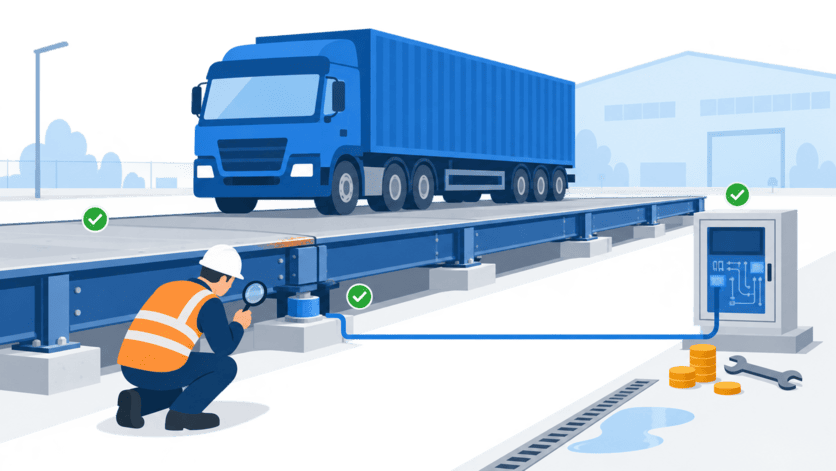
I write from HENER’s manufacturer-side aftersales experience, including repair requests, spare-part replacements, and refurbishment discussions. That perspective helps explain what buyers face after installation. I am not an independent asset-management consultant or metrology authority, so I separate practical procurement guidance from decisions that require qualified local evaluation.
What Usually Limits Weighbridge Useful Life First?
I understand why buyers focus on deck thickness: steel is visible, and a substantial platform feels reassuring. The problem is that an apparently sound deck can sit above deteriorating electrical components. When those components become unreliable or unavailable, usable service can end before structural life does.
Based on the repair and spare-part requests we handle, I investigate load cells, junction boxes, cable connections, and indicator support early in an aging weighbridge assessment. Moisture, unstable signals, and discontinued electronics can limit service before the deck does. Structural condition still requires separate evaluation, especially where overload or corrosion is suspected.
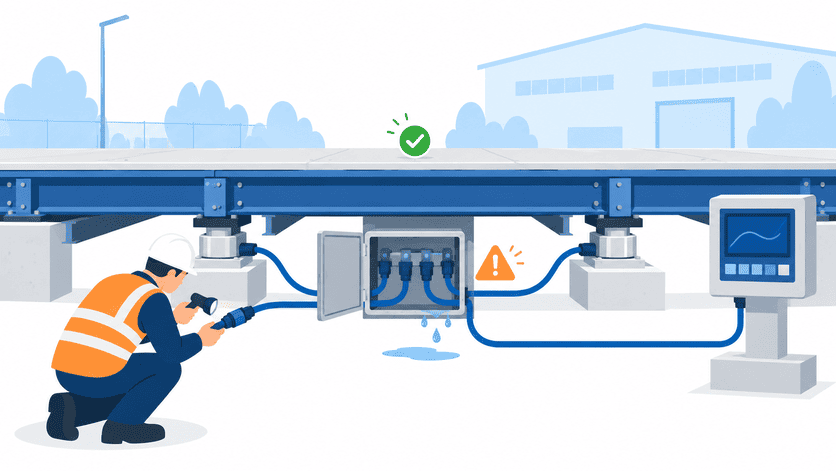
I separate physical survival from dependable weighing
A truck scale has several overlapping service lives. I find that buyers make better decisions when they assess those lives separately.
| System element | What I ask buyers to investigate | Evidence I would request |
|---|---|---|
| Deck and supporting structure | Corrosion, cracking, permanent deformation, and load suitability | Inspection findings, drawings, and relevant repair history |
| Load cells and mounts | Signal stability, moisture exposure, mechanical damage, and compatibility | Diagnostic results, component identification, and service records |
| Junction boxes and cables | Water ingress, damaged seals, deteriorated connections, and cable-entry condition | Inspection records and enclosure specifications |
| Indicator and software | Spare availability, firmware support, communication compatibility, and approval implications | Written support information and model-specific documentation |
| Foundation and approaches | Settlement, drainage problems, and unintended contact or loading | Site inspection and qualified engineering assessment |
In the aftersales discussions described in our business context, electrical replacement requests are a recurring reason to revisit an otherwise serviceable platform. I treat that as practical observation, not a fleet-wide failure statistic.
I ask about the whole sealing arrangement
An ingress-protection rating is useful evidence, but it does not describe the entire installed system. I also ask how the supplier specifies cable glands, connectors, junction-box placement, and access for inspection.
A protected load cell cannot compensate for an unsuitable cable connection elsewhere. Likewise, a correctly rated enclosure may perform poorly if its seal is damaged or its cable entry is assembled incorrectly.
I therefore include these questions in a supplier review:
- The supplier should identify the protection rating of each relevant component, rather than describe the entire weighbridge with one unexplained rating.
- The supplier should explain the installed sealing arrangement, including cable entries and connections.
- The supplier should document replacement compatibility, including what happens if the original indicator or cell model is discontinued.
- The supplier should state its support policy, while distinguishing stocked spares from items available only by special order.
For an eight-year planning horizon, I would ask whether the proposed electronics have a documented migration path. I would not treat a verbal promise of future availability as evidence.
This is why I see weighbridge useful life partly as a supportability question. A sound deck retains value only if the complete system can remain serviceable, accurate, and compliant for its intended use.
How Do Foundation and Drainage Affect Weighbridge Useful Life?
I would not judge an aging weighbridge from its equipment specification alone. Settlement, standing water, and installation problems can undermine a well-manufactured system. If a buyer replaces damaged components without addressing the site condition behind the damage, the same repair expense may return.
I treat foundation, drainage, and installation as shared design-and-execution responsibilities. The supplier should provide clear equipment loads, foundation interfaces, installation tolerances, and environmental requirements. Qualified project professionals should evaluate the site and execute the appropriate design. Commissioning should confirm that the installed system operates under its intended loading conditions.
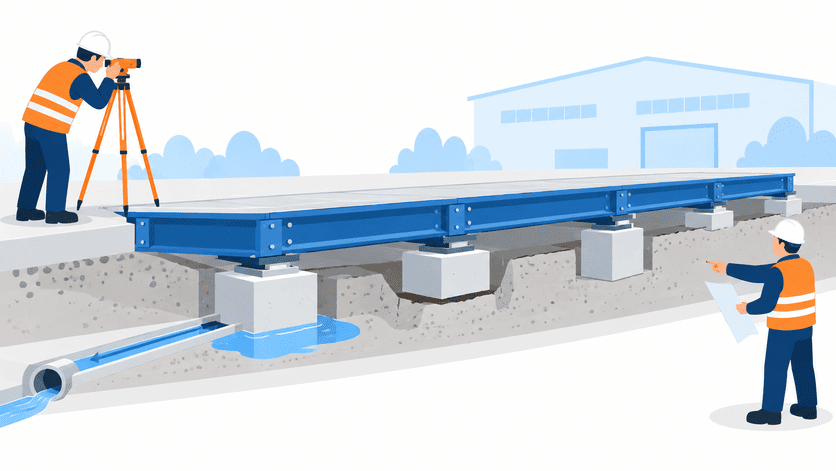
I look for the cause behind repeated component replacement
A failed load cell is a component problem, but repeated cell replacement may indicate a broader system problem. I want the service assessment to consider whether the weighbridge is being loaded as designed.
Possible contributors include:
- Foundation movement that changes the support conditions.
- Debris or unintended contact that restricts platform movement.
- Persistent water exposure around electrical components.
- Incorrect installation of mounts or related hardware.
- Vehicle loading that exceeds the specified operating assumptions.
These possibilities need qualified investigation. I would not diagnose foundation failure from an unstable display alone, because several electrical and mechanical faults can produce similar symptoms.
The procurement lesson is straightforward: a replacement part quotation is not necessarily a root-cause assessment. I ask suppliers to distinguish the immediate corrective work from the investigation needed to prevent recurrence.
I define responsibility before the equipment arrives
A foundation drawing is valuable only when its assumptions match the project. Soil conditions, groundwater, flood exposure, traffic movement, and local construction requirements may need site-specific review.
I use the following responsibility split as a starting point, not a substitute for the project contract:
| Project issue | Supplier contribution I expect | Site-team contribution I expect |
|---|---|---|
| Equipment support | Defined reactions, interfaces, and installation requirements | Site-specific foundation design and construction verification |
| Drainage | Clear equipment limitations and access requirements | Drainage design suited to rainfall, groundwater, and maintenance conditions |
| Installation | Instructions, tolerances, and agreed technical support | Competent execution and documented checks |
| Commissioning | Agreed equipment tests and technical documentation | Site readiness and qualified local verification where required |
This approach avoids blaming the operator for information the supplier never provided. It also avoids assuming that factory quality can overcome unsuitable civil works.
I treat overload history as a separate warning
For mines, quarries, and ports, I give vehicle profiles, axle loading, impact exposure, and overload history particular attention. A nominal capacity figure alone does not establish suitability for every traffic pattern.1
Permanent main-beam deformation cannot be corrected by corner adjustment.2 Corner adjustment addresses weighing response under specified conditions; it does not restore damaged structural geometry or load-bearing integrity.
If an inspection identifies cracking, deformation, or a potential safety issue, I would seek qualified structural evaluation before further use. Weighbridge useful life must never become an argument for keeping unsafe equipment operating.
How Should I Budget for Weighbridge Useful Life Beyond Depreciation?
I often see lifespan discussions become confused when a buyer asks for a ten-year cost figure and receives only a purchase price plus depreciation. That leaves the most disruptive expenses outside the comparison. A cheaper quotation can become the more expensive operating choice without ever looking expensive on the original bid sheet.
I budget for weighbridge useful life by separating book depreciation from future cash costs. My ownership model includes equipment, civil works, installation, maintenance, calibration, downtime, disputes, and spares support. I compare repair, retrofit, and replacement over the same period and use documented site assumptions rather than a generic lifespan promise.

I keep accounting life in its proper place
Straight-line depreciation generally allocates depreciable cost—cost less estimated residual value—over an estimated accounting useful life.3 A ten-year schedule does not prove that a weighbridge will remain reliable for ten years or need replacement afterward. Applicable accounting policy and tax treatment require advice from the buyer’s accountant. I use book life for financial reporting, not as the maintenance calendar.
I build the cost comparison around the same service requirement
My starting framework is:
Planning-period ownership cost = initial project costs + operating and support costs + intervention costs + end-of-period removal costs − residual value.
Initial project costs may include purchase, freight, civil works, installation, commissioning, and integration. Operating costs include inspection, servicing, calibration or verification, and the business consequences of interruptions.
I ask the finance team to apply its chosen discounting method when cash flows occur at different times.4 A common planning period matters because a repair that buys limited additional service should not be compared with a complete replacement as though both deliver the same remaining life.
For an existing weighbridge, I focus on future avoidable costs. Its original purchase price is generally a sunk cost for the operational decision, although disposal and accounting consequences still need financial review.5
I make four commonly missed costs visible
| Cost category | Inputs I ask the buyer to supply | Why it changes the decision |
|---|---|---|
| Recalibration and verification | Required frequency, service charges, test-load logistics, and shutdown time | Repeated interventions can make apparently inexpensive repairs costly |
| Downtime and vehicle queueing | Outage duration, traffic affected, alternative weighing arrangements, and incremental operating costs | A small component failure can interrupt a much larger workflow |
| Weight disputes | Investigation time, reweighing costs, documented claims, and reconciliation effort | Unreliable measurements create costs outside the maintenance budget |
| Spare-part availability | Stock location, lead time, interchangeability, expedited freight, and obsolescence exposure | Repairability depends on obtaining a suitable replacement in time |
I avoid double-counting these items. For example, queueing costs should not also appear in a broad downtime allowance if that allowance already includes them. I also distinguish lost revenue from lost contribution or other actual economic impact; they are not interchangeable measures.
Calibration frequency deserves careful treatment. More frequent adjustment may signal an unresolved fault rather than sensible preventive maintenance. I would ask a qualified weighing-service provider to investigate the cause.
To verify locally: Legal-for-trade status, verification intervals, permitted modifications, resealing requirements, and applicable approval documentation must be confirmed with the relevant local authority or qualified provider.6
I use scenarios instead of invented cost curves
An EPC defending a ten-year TCO estimate needs transparent assumptions, not a smooth-looking graph. I would model a base case and adverse cases using the buyer’s own records and supplier quotations.
Those cases could vary:
- The expected duration of an electronics-related outage.
- The availability of temporary weighing arrangements.
- The extent of foundation remediation.
- The cost and scope of a future controls upgrade.
- The remaining support period for critical components.
I then ask which assumption changes the preferred option. This makes uncertainty visible without pretending that a manufacturer can predict every year of weighbridge useful life.
When Should Weighbridge Useful Life Be Extended by Repair, Retrofit, or Replacement?
I do not assume that an old weighbridge needs a new platform. That decision can discard usable infrastructure. I also do not assume that another repair is economical simply because its invoice is small. The right intervention depends on the fault, the remaining condition, and the complete cost of keeping the system working.
I favor targeted repair for an isolated fault and evaluate retrofit when the structure remains suitable but electronics are aging or unsupported. Replacement becomes appropriate when structural condition, unresolved measurement performance, changed traffic requirements, or forward-looking ownership costs make continued investment unreasonable. Qualified assessment and local compliance checks should determine which options remain acceptable.
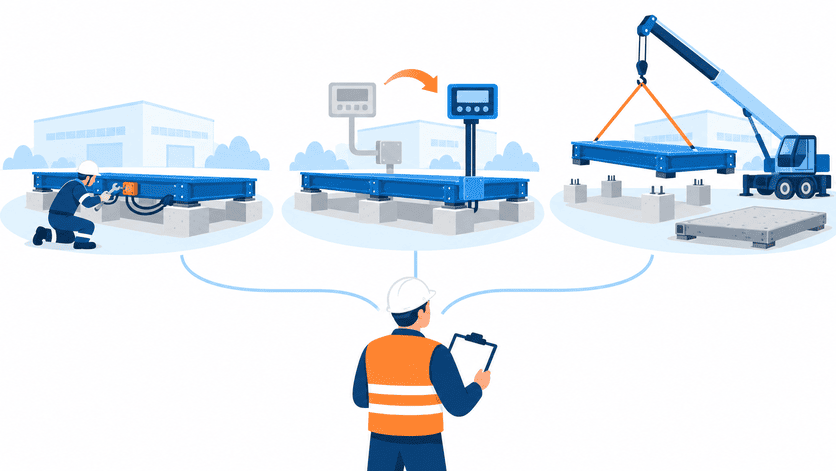
I compare acceptable options before comparing prices
Safety and required measurement performance are decision gates. An option that cannot meet them does not become acceptable because it costs less.
I use this framework to organize the discussion:
| Option | Conditions that make me consider it | Evidence I need before approval |
|---|---|---|
| Repair | A fault is isolated, compatible parts exist, and the wider system remains suitable | Diagnosis, root-cause review, and satisfactory post-repair testing |
| Retrofit | The deck and foundation are suitable, but the electrical system needs renewal | Condition assessment, compatibility review, approval implications, and an acceptance plan |
| Replace | The structure is unsuitable, the duty has changed, support is impractical, or economics favor new equipment | Engineering findings and a complete installed-cost comparison |
If repeatability or linearity fails the applicable acceptance criteria, I first ask whether a correctable cause exists.7 A failed test does not automatically condemn the platform. However, persistent unacceptable performance after competent investigation is a serious reason to reconsider continued investment.
I define a retrofit as a system project
Where the structure is sound, I normally evaluate electrical refurbishment before recommending complete platform replacement. Depending on the diagnosis, the scope may include load cells, junction boxes, cabling, and the indicator.
I would not assume that every component must be replaced together. The assessment should identify what can remain and what would create a compatibility or support problem.
My retrofit review covers:
- The technical team should confirm compatibility. Capacity, mounting arrangements, signal characteristics, excitation requirements, and communication interfaces all matter.
- The project team should review operational integration. Printing, traffic controls, ERP links, and stored weighing records may depend on the existing indicator or software.
- The local specialist should review compliance implications. Component substitutions may affect the approved configuration or require additional verification.
- The contract should define acceptance evidence. The parties should agree on commissioning tests, documentation, and responsibilities before work begins.
Any ISO 9001, CE-related, OIML-related, or other approval claim should be checked against the actual documents and their scope. A company-level quality certificate does not establish approval of every modified weighing system.8
I use an economic trigger, not an age trigger
The warning point comes when expected annual maintenance, calibration, downtime, and dispute costs approach or exceed the equivalent annual cost of a suitable intervention.
However, I do not compare those running costs only with a new platform’s purchase price divided by an assumed lifespan. The replacement side also needs installation, civil works, transition downtime, future operating costs, and residual value. A retrofit deserves the same complete treatment.
The cheapest correct intervention may therefore be a repair today, a planned electronics upgrade during a shutdown, or full replacement with a differently sized system. Spare-part obsolescence can force that decision even when the deck remains sound.
I find this condition-based approach more useful than asking for a retirement birthday. Weighbridge useful life ends when continued operation is no longer acceptable or economical—not when a depreciation spreadsheet reaches zero.
Frequently Asked Questions
How many years does a weighbridge last?
I would not give one number without knowing the installation, loading, environment, maintenance history, and electronics support. A sound, well-supported structure may remain usable after electrical refurbishment, while poor drainage or unsuitable loading can shorten service considerably. I recommend a condition assessment rather than an age-only replacement rule.
Does a fully depreciated weighbridge need replacement?
No. I treat full depreciation as an accounting position, not evidence of physical failure. Continued use depends on structural condition, measurement performance, supportability, and operating economics. Conversely, a weighbridge with remaining book value may already need substantial intervention if it cannot meet its intended duty or applicable requirements.
Can new load cells extend an old weighbridge’s useful life?
They can, if the existing cells are the relevant problem and the deck, foundation, mounts, and remaining electronics are suitable. I would require compatibility checks and post-work testing. New cells will not correct foundation movement, permanent structural deformation, or an unresolved installation problem.
What should a distributor request about spare-part support?
I would request component model numbers, current availability, indicative lead times, warranty terms, and the supplier’s process for discontinuation notices. I would also ask about compatible alternatives and migration costs. A support plan should explain how an obsolete component can be replaced without creating an unapproved or impractical system configuration.
Which records help an operator decide between retrofit and replacement?
I start with service invoices, calibration or verification results, fault reports, outage logs, component identities, and structural inspection findings. Vehicle profiles and changes in throughput also matter. These records help a qualified assessor distinguish an isolated repair from recurring system deterioration and give procurement a defensible basis for comparing proposals.
Conclusion
I assess weighbridge useful life through condition, supportability, compliance, and future cost—not steel age or depreciation alone. The practical choice is the least-cost acceptable repair, retrofit, or replacement, with site problems addressed rather than carried forward. HENER’s stated 23 years in industrial weighing and its equipment-and-component manufacturing scope provide context for these aftersales observations, not a lifespan guarantee. You can share your weighbridge specification, service history, site conditions, and local requirements with HENER to discuss a documented assessment scope and the evidence needed for an intervention quotation.
References
- [PDF] EPO No. 13 – Vehicle and Axle-Load Scales and Weigh-in-Motion ...
- Steel Bridges - Steel - Structures - Federal Highway Administration
- IAS 16 Property, Plant and Equipment - IFRS Foundation
- [PDF] Life Cycle Cost Manual for the Federal Energy Management Program
- Understanding Sunk Costs Can Help Everyday Decision-Making
- 49 CFR 180.213 -- Requalification markings. - eCFR
- [PDF] NIST Handbook 44: Specifications, Tolerances, and Other Technical ...
- International Organization of Legal Metrology - Wikipedia