













On this page

Choosing a weighbridge supplier looks simple until I ask who owns the problems after delivery. At HENER in Changzhou, my pre-sales and after-sales work exposes the gap between an attractive quotation and a supportable installation. I use that gap to evaluate configuration decisions, hidden costs, and accountability—not just factory status.
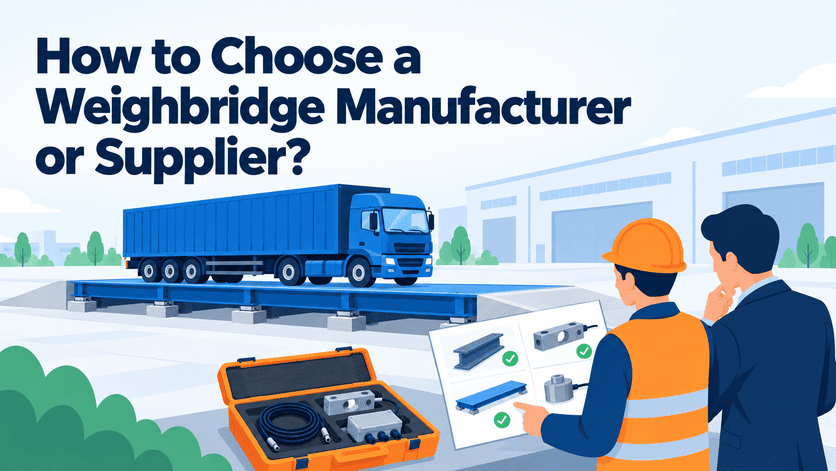
I recommend choosing a weighbridge manufacturer or supplier by checking who controls fabrication, component sourcing, testing, and after-sales support. I compare documented specifications rather than nominal capacity alone, require site-specific configuration explanations, and agree on delivery scope, acceptance criteria, and spare-parts responsibilities before placing an order.

The question I find most useful is not “Are you a real factory?” I ask, “Why have you proposed this configuration, and who will remain answerable three years after commissioning?” That question changes what I request in the next supplier call.
Does a Weighbridge Manufacturer Actually Control the Work?
I understand why buyers prefer to deal directly with a factory. They want fewer markups and clearer accountability. However, I have also seen how a factory label can hide outsourced work, unclear inspection responsibilities, and a sales team that cannot explain the quoted model.
I judge manufacturing control by traceable evidence, not company descriptions. I ask who fabricates the structure, selects the load cells, performs calibration and corner adjustment, and releases the equipment for shipment. A reseller with documented control can offer a stronger procurement proposition than a factory that cannot answer those questions.
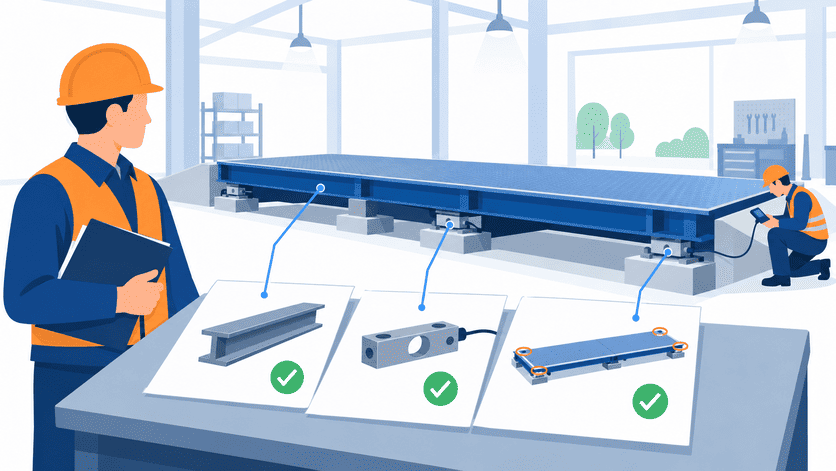
I follow the responsibility chain
My perspective comes from answering RFQs, handling technical objections, and working around steel fabrication, welding, calibration, and pre-shipment inspection. HENER’s supplied company background describes 23 years in industrial weighing. I treat that history as context, not as proof that any particular quotation deserves acceptance.
For each weighbridge offer, I want a clear chain from the proposed design to the equipment being shipped.
| I ask the seller | I request this evidence | I watch for this warning sign |
|---|---|---|
| “Which steel grade and plate thickness apply to this model?” | I request a model-specific drawing and material specification. | I question generic claims such as “heavy-duty steel.” |
| “Which welding procedure applies to the main connections?” | I request the relevant procedure reference and inspection requirements. | I question answers that describe equipment but not the joints being inspected. |
| “Who selects and approves the load cells?” | I request the manufacturer, exact model, and substitution policy. | I question descriptions such as “international-quality sensor.” |
| “Who performs final calibration and corner adjustment?” | I request the responsible party, test method, and available records. | I question a promise of “full testing” without defined conditions. |
| “Can I trace the inspection report to the shipped unit?” | I request serial-number-linked records and component identification. | I question sample reports presented as shipment-specific evidence. |
I distinguish ownership from control
I do not require every process to happen under one roof. Outsourcing is not automatically a weakness. I do require the seller to explain how outsourced work is specified, inspected, and accepted.
A trading company may have a disciplined relationship with a fabricator and a capable local service team. A manufacturer may subcontract critical work while leaving quality decisions poorly defined. Neither business label resolves the buyer’s risk.
When dealers carry several brands, I find their comparisons especially useful. I ask how each supplier handles a replacement component, a disputed reading, or an incomplete shipment. Those answers reveal more than a showroom photograph.
My qualification test is whether the seller can produce evidence and accept responsibility. If an answer requires a technical colleague, I consider that reasonable. If no one can answer before the purchase order, I do not assume the answer will improve afterward.
Why Can Two Weighbridge Quotes Hide Different Products?
I regularly see RFQs reduced to capacity and length. A request for “100t, 18m” gives suppliers a headline, but it does not define equivalent equipment. When I compare only those two figures, I leave room for major structural, component, and finishing differences.
I treat a low weighbridge quotation as a specification question before treating it as a bargain. I compare the steel structure, welding requirements, surface preparation, load cells, junction box, indicator, and cabling. A price gap may reflect efficiency or margin, but it may also conceal a scope or specification gap.
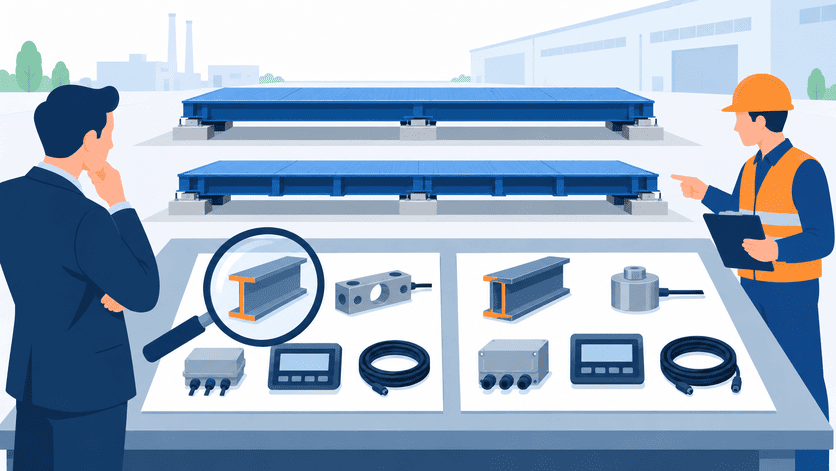
I locate the missing specification before negotiating price
I cannot honestly say that every cheaper offer removes quality. Production efficiency, purchasing volume, freight terms, and commercial strategy all affect price. However, I also cannot call two offers equivalent until the specifications support that conclusion.
I use the following comparison to expose what the headline price leaves out.
| Cost variable | What I compare | Why I need the information |
|---|---|---|
| Steel structure | I compare the specified grade, deck plate thickness, girder arrangement, and web details. | I need the proposed structure reviewed against the actual loading conditions. |
| Welding | I compare joint requirements, weld coverage, inspection scope, and repair records. | I need evidence that fabrication follows the approved design. |
| Surface treatment | I compare preparation method, coating system, specified thickness, and inspection records. | I need to distinguish controlled surface preparation from cosmetic painting. |
| Load cells | I compare the exact model, protection rating, and creep and temperature-performance documentation. | I need a defined component rather than a changeable brand description. |
| Junction box | I compare enclosure protection, cable entries, sealing details, and supporting test evidence. | I need to assess moisture exposure and future serviceability. |
| Indicator and cables | I compare model numbers, interface options, cable specifications, and included lengths. | I need to avoid installation surprises and integration substitutions. |
I avoid simplistic construction rules
I do not assume that more girders automatically mean a better weighbridge. I also do not assume that every joint requires full-penetration welding or that intermittent welding is always unacceptable. Those decisions depend on the structural design and service conditions.1
Instead, I ask why the proposed construction is appropriate and require qualified engineering review where the application demands it. My role in procurement is to expose the design assumptions, not to replace the structural engineer.
Surface finishing deserves the same discipline. “Painted steel” tells me little. I ask whether the quotation includes shot blasting or another specified preparation method, what coating system follows, and what inspection confirms the result. Paint applied over inadequately prepared mill scale is not equivalent to a documented preparation-and-coating process.2
I close the substitution loophole
Even a detailed offer loses value if the seller can change components without approval. I therefore include an approved bill of materials and a written substitution process in the purchase documents.
If a supplier proposes an alternative load cell or indicator, I want the technical differences, compatibility implications, and price effect disclosed before shipment. Otherwise, the comparison I approved may no longer describe the equipment I receive.
What Should a Weighbridge Supplier Ask Before Quoting?
I become cautious when a seller offers a final configuration after asking only about capacity and platform length. The missing questions do not disappear. They return later as civil rework, access problems, unsuitable components, or arguments about whether the buyer supplied enough information.
I expect a weighbridge supplier to ask about vehicle loading, traffic volume, installation layout, drainage, environment, measurement use, data connections, and civil-work responsibility. I use those questions as a qualification test because a supplier cannot explain a suitable configuration without understanding the site and operating requirements.

I evaluate the questions, not just the proposed answer
A budgetary quotation based on limited information can be useful. I simply want it marked as preliminary, with its assumptions listed. A final technical offer deserves a more complete discussion.
These are the questions I expect to appear before configuration approval:
- Vehicle loading: I expect questions about vehicle types, maximum axle loads, axle arrangements, and maximum gross loads.
- Traffic intensity: I expect questions about daily vehicle movements, busy periods, and operating hours.
- Installation arrangement: I expect questions about pit or pitless installation, approach space, maintenance access, and available civil space.
- Water conditions: I expect questions about drainage, groundwater, flooding exposure, and cleaning practices.
- Environment: I expect questions about ambient temperature, dust, humidity, salt exposure, and corrosive materials.
- Measurement purpose: I expect questions about commercial billing, internal inventory control, or another defined use.
- Data requirements: I expect questions about RS232/485, Modbus, ERP or PLC connections, and the required records.
- Project ownership: I expect questions about who designs the foundation, who builds it, and who checks it before installation.
I ask the seller to connect each answer to a decision
A completed questionnaire is only useful if it changes or confirms the proposal. I ask the supplier to explain the configuration logic in plain language.
For example, I want to know how the available approach space affects the proposed layout. I want the supplier to explain which environmental conditions informed component protection and coating choices. I also want to know which loading assumptions require a qualified engineer’s review.
For data integration, I separate a physical interface from a working connection. An RS485 port does not, by itself, prove compatibility with my software.3 I request the protocol documentation, message format, required software or licenses, and integration responsibilities.
I keep site accountability visible
When accuracy complaints reach after-sales, I first separate equipment condition, installation conditions, and calibration or operating practice. I do not assume that every disputed reading proves a defective load cell—or that every complaint is the installer’s fault.
I ask for the evidence needed to distinguish those possibilities. That becomes easier when the original quotation records the site conditions and acceptance assumptions.
A supplier who asks useful questions is making configuration risk visible. A seller who accepts only capacity and length may leave the buyer carrying that risk without saying so.
How Do I Define Delivery, Acceptance, and Year-Three Support?
I find that disputes often begin where a quotation stops being specific. “Complete system,” “installation support,” and “two-year warranty” sound reassuring, but each can mean something different to the buyer and seller. I turn those phrases into assigned tasks before the purchase order.
I put the delivery list, civil-work boundaries, factory testing, site calibration, acceptance criteria, and warranty process in writing. I also check spare-parts compatibility and technical response arrangements. A weighbridge warranty has practical value only when I know how the supplier will diagnose problems and provide a workable remedy.

I make “complete supply” an itemized commitment
I request a line-by-line delivery schedule that identifies quantities, models, and exclusions. I check deck modules, load cells, mounting hardware, junction boxes, indicators, cables, accessories, documentation, and agreed spare parts.
For foundation documents, I distinguish a supplier’s general arrangement or loading information from a site-specific civil design.4 I want the contract to identify the qualified party responsible for reviewing local ground conditions and completing the foundation design. I also assign responsibility for construction, inspection, and correction of nonconforming work.
I do not accept “buyer handles civil works” as a substitute for defining the interface between the equipment and the foundation.
I separate factory inspection from site acceptance
Factory inspection provides evidence of manufacturing quality under stated test conditions. It does not automatically prove that the installed weighbridge meets every contractual or local metrology requirement.
Before ordering, I agree on:
- The factory test scope: I specify the available test loads, methods, records, and witness arrangements where required.
- The site commissioning scope: I identify who checks installation, performs corner adjustment, and completes calibration.
- The acceptance basis: I define the applicable tolerance, load points, operating conditions, and required records.
- The correction process: I assign responsibility for investigation, remedial work, retesting, and associated costs.
I avoid an acceptance clause that says only “accuracy: 0.02%.” I need to know whether that percentage refers to full scale, applied load, or another defined basis.5 I also need the test method and its relationship to any required legal verification.
I test what the warranty means operationally
My year-three question is simple: Can I obtain a compatible replacement without rebuilding the system?
I ask about the expected availability of load cells, mounting assemblies, junction boxes, and indicators. I also request the rules for component changes and access to configuration information needed for service.
For warranty support, I want a named technical contact, a response commitment, diagnostic requirements, and a clear allocation of parts, freight, travel, and labor costs. I also ask what happens while a claim is being assessed.
Local inventory can shorten downtime, but I verify who holds it and which models it covers. A long warranty with no service route may offer less practical protection than a shorter warranty supported by common parts and capable local technicians.
Which Weighbridge Certificates Must I Verify Locally?
I understand why procurement teams ask for certificates early. They want evidence that the proposed equipment can meet the destination market’s requirements. Problems begin when I treat a familiar logo or a supplier’s general certificate as permission to use a particular installation for commercial transactions.
I verify weighbridge documents against the exact model, configuration, capacity range, intended use, and destination requirements. I distinguish quality-system certification, conformity declarations, type evaluation, and local verification. I confirm commercial-use requirements with the relevant local authority or qualified specialist before committing to the compliance scope.

I distinguish documents that answer different questions
I do not treat ISO 9001, CE marking, OIML documentation, and NTEP certification as interchangeable evidence.
| Document or reference | How I use it during procurement | What I do not assume |
|---|---|---|
| ISO 9001 certificate | I check the named organization, scope, validity, and issuing body. | I do not assume it certifies the accuracy of the quoted scale.6 |
| CE marking and supporting declaration | I examine the applicable legislation, identified product, and conformity-assessment basis. | I do not assume CE marking alone proves a universal type evaluation or worldwide trade approval.7 |
| OIML-related certificate | I check the recommendation, issuing body, model coverage, and listed limitations. | I do not assume it authorizes commercial use in every market.8 |
| NTEP Certificate of Conformance, where relevant | I check the certificate number, covered equipment, and configuration restrictions. | I do not assume a component certificate covers every complete installation.9 |
| Local approval or verification records | I confirm their necessity and scope with the responsible local party. | I do not assume the exporter can determine every local obligation without verification. |
I match the recommendation to the weighing method
I distinguish OIML R76, which concerns non-automatic weighing instruments, from OIML R134, which concerns automatic instruments for weighing road vehicles in motion and measuring axle loads.10
I would therefore question an offer that lists both references without explaining which applies to the proposed operating method. A static truck scale and an in-motion vehicle-weighing system should not be treated as the same approval exercise.
I also check whether the document covers the proposed indicator, load-cell arrangement, capacity, verification interval, and other relevant restrictions. If the shipment differs from the evaluated configuration, I request a documented explanation rather than accepting “same series” as sufficient.
I verify destination requirements before the order
For commercial billing, I ask a qualified local metrology professional or the relevant authority which approvals, initial verification, installation checks, and ongoing obligations apply. These requirements vary by jurisdiction and intended use, so I treat the local approval route as something to verify, not something to infer from an export certificate.
I then assign responsibility for the required documents, applications, testing, fees, and site access. That prevents a compliance gap from becoming an unexpected cost after the equipment has already arrived.
Frequently Asked Questions
Is buying directly from a weighbridge manufacturer always cheaper?
I compare total delivered and supported cost, not only the factory price. Direct purchasing may reduce an intermediary’s margin, but I may need to arrange import handling, installation, calibration, and service separately. A distributor can justify its margin when those responsibilities are clearly included and competently delivered.
What should I request when comparing three supplier quotations?
I send all three suppliers the same site brief and comparison template. I request model-specific structural details, component lists, finishing specifications, test records, delivery inclusions, and service terms. I then ask each seller to explain every exception instead of accepting a general statement of equivalence.
Can factory calibration replace on-site calibration?
I do not treat factory calibration as a substitute for commissioning checks. Transport, assembly, foundation conditions, and installation can affect performance. I specify the required site adjustment, calibration, and acceptance process separately, and I verify whether local legal-for-trade rules require additional examination or verification.
Which spare parts should I include with my first order?
I ask the supplier and local service technician to recommend spares based on component compatibility, lead times, and downtime consequences. I commonly review load cells, junction boxes, cable accessories, and indicator availability. I avoid buying unverified alternatives merely because their capacity labels match.
What is the strongest warning sign during supplier qualification?
I become most concerned when a seller refuses to document responsibilities. Missing information can sometimes be resolved through technical review. Repeatedly vague answers about substitutions, testing, foundation interfaces, acceptance, or warranty costs suggest that I may inherit unresolved risks after paying the deposit.
Conclusion
I choose a weighbridge supplier by tracing responsibility from the quotation to the third year of operation. I want configuration decisions supported by site information, price differences explained through specifications, and inspection records linked to the shipment. I also want written acceptance rules, a locally verified compliance route, and a realistic spare-parts plan. For your next RFQ, I recommend sending this checklist with your site brief and requiring written answers before the purchase order. That gives you a stronger basis for comparing factories, traders, and local distributors fairly.
References
- [PDF] Bridge Welding Reference Manual - Federal Highway Administration
- FHWA Bridge Coatings Technical Note: Overcoating (Maintenance ...
- RS-485 - Wikipedia
- [PDF] Geotechnical Engineering Circular No. 6 - Shallow Foundations
- [PDF] NIST Handbook 44: Specifications, Tolerances, and Other Technical ...
- ISO 9000 family - Wikipedia
- CE marking - Wikipedia
- International Legal Metrology FAQs - NIST
- [PDF] National Type Evaluation Technical Committee (NTETC) - NIST
- [PDF] OIML R 76-1 Edition 2006