













On this page

Weigh-in-motion systems vs static truck scales can look like a simple technology comparison, but choosing by specifications alone creates risk. A fast system may produce data that cannot support its intended official use, while a controlled scale may create avoidable queues. I start instead with the purpose and authority of the weight record.
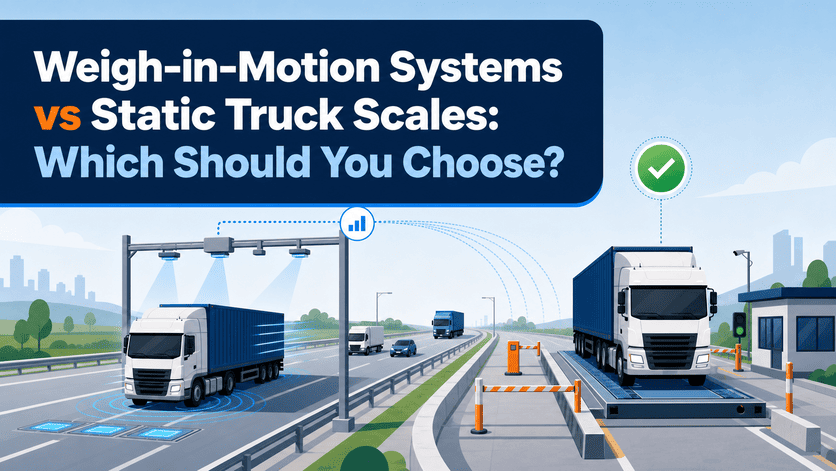
Weigh-in-motion systems measure vehicles while they travel, making them suitable for traffic monitoring and pre-screening.1 Static truck scales weigh stopped vehicles under controlled conditions, which can better support highly trusted or official records. The right choice depends on data use, traffic volume, stopping constraints, site conditions, and local legal requirements.

I have participated in requirement clarification for customers considering both technologies. The most useful conversations never begin with “Which system is more advanced?” They begin with four practical questions about purpose, traffic, stopping, and confirmation.
How Does Data Purpose Affect Weigh-in-Motion Systems vs Static Truck Scales?
A procurement team can compare accuracy classes and prices for weeks yet still select the wrong system. The problem occurs when the team has not defined what the resulting weight data must prove. That uncertainty can become an operational, contractual, or legal risk.
Buyers should first determine whether weight data will support traffic analysis, overload screening, process control, enforcement, billing, or another official record. Each purpose requires a different level of measurement control and legal authority.2 Local agencies must verify metrology approvals, certification, admissibility, and enforcement rules before procurement.

I Begin with the Intended Decision
In my requirement discussions, I ask: “What action will someone take because of this weight?” That question is more useful than asking only for the highest possible accuracy.
A highway authority may need data for several purposes:
- Estimating axle-load patterns
- Monitoring traffic composition
- Identifying potentially overloaded vehicles
- Directing selected vehicles to an inspection area
- Recording an official vehicle weight
- Supporting enforcement or a legal proceeding
- Controlling access to a bridge, port, or industrial site
These uses do not necessarily have the same evidence requirements. A system that supports network planning may not automatically satisfy an enforcement program.3 Likewise, a solution used for screening does not always need the same controlled conditions as a scale producing a legally recognized record.
| Intended use | Typical measurement priority | Procurement question |
|---|---|---|
| Traffic monitoring | Continuous data collection | Can the system classify and count vehicles reliably? |
| Overload screening | Fast identification of exceptions | What thresholds and false-selection risks are acceptable? |
| Process control | Repeatable operational decisions | How will data connect with barriers, cameras, or software? |
| Official record | Controlled and traceable measurement | Which local approvals and procedures apply? |
| Enforcement | Legally supportable evidence | Is the complete system authorized for this use locally? |
I advise buyers to treat certificates as documents for verification, not as broad promises. A supplier should identify the precise model, configuration, accuracy class, issuing body, validity, and intended jurisdiction. The buyer’s legal, metrology, and engineering specialists should then confirm whether those documents cover the planned application.
A technically accurate reading and a legally authoritative record are not always the same thing.
This distinction protects procurement teams from buying capable hardware that cannot deliver the required institutional outcome.
How Should Throughput and Data Authority Be Compared?
Public infrastructure teams often face pressure to avoid traffic delays. WIM appears attractive because vehicles can remain in motion, but speed alone does not determine suitability. If selected readings require stronger confirmation, the site still needs a practical way to manage exceptions.
WIM generally offers higher uninterrupted throughput because vehicles do not need to stop for every measurement.4 Static weighing provides more controlled measurement conditions but requires vehicle positioning and dwell time. Buyers should evaluate peak flow, queue tolerance, available space, required confidence, and the proportion of vehicles needing confirmation separately.

I Separate Capacity from Authority
I often see “efficiency” used as if it were a single specification. In practice, a weighing system has at least two different forms of efficiency:
- Traffic efficiency: How many vehicles can pass without unacceptable disruption?
- Decision efficiency: How quickly can the authority obtain data suitable for the intended action?
A WIM installation can preserve traffic flow, but its operational value depends on the road and workflow around it. The procurement team should document:
- Peak and average traffic volume
- Vehicle mix and axle configurations
- Normal and abnormal driving behavior
- Permitted speed range through the measurement zone
- Available deceleration and inspection space
- Maximum acceptable queue length
- Number of vehicles expected to require further checks
- Required integration with cameras, barriers, or central databases
Static truck scales create a different workflow. Vehicles must approach, stop in the correct position, complete the weighing process, and leave. However, the controlled condition can be valuable when the record requires a higher degree of confidence or traceability.

When Can a Combined Workflow Make Sense?
I consider WIM pre-screening plus static confirmation only when the requirements justify both layers. A possible workflow is:
- The WIM system measures passing vehicles.5
- Software applies defined screening rules.
- The system directs abnormal or selected vehicles to a controlled area.
- A static truck scale performs confirmation.
- Authorized personnel follow the applicable inspection or enforcement procedure.
This architecture can help a busy site avoid stopping every vehicle while still providing a path for confirmation. However, it is not a universal best practice. A low-volume site may gain little from WIM. A monitoring project may not need a static scale. A constrained site may also lack safe diversion space.
I recommend modeling actual peak traffic and expected selection rates before specifying two systems. That analysis prevents buyers from overspending for throughput they do not need.
Which Site Conditions Affect Weigh-in-Motion Systems vs Static Truck Scales?
Nominal performance can create false confidence when a procurement document ignores the site. WIM readings depend on the interaction between sensors, pavement, vehicles, speed, calibration, and environment.6 Static scales also require suitable foundations, drainage, approaches, and controlled operation.
Buyers should assess pavement quality, road geometry, vehicle behavior, speed consistency, drainage, temperature, power, communications, calibration access, and maintenance capability. WIM performance is conditional on these factors. Static truck scales also require proper civil works, level approaches, load-cell protection, and verified calibration procedures.7

I Ask for Site Facts Before Recommending Equipment
A product specification describes performance under stated conditions. It cannot guarantee that every highway or inspection site will reproduce those conditions. Dynamic vehicle forces can change when drivers brake, accelerate, change lanes, or pass over uneven pavement.
For a WIM project, I ask buyers to evaluate:
- Pavement condition: Cracks, rutting, settlement, and surface irregularities can affect vehicle dynamics.
- Road alignment: Curves, slopes, lane changes, and nearby intersections may disturb stable passage.
- Speed behavior: The operating speed range should match the selected technology and project design.
- Vehicle behavior: Braking and acceleration can alter dynamic axle loads.
- Environment: Temperature, water, dust, snow, and debris may affect components and maintenance.
- Calibration plan: The authority should define reference vehicles, procedures, frequency, responsibility, and records.
- System integration: Sensors, controllers, cameras, communications, and software must exchange reliable data.
Static truck scales need an equally disciplined assessment. The civil design should address foundation capacity, drainage, approach alignment, deck dimensions, traffic controls, and service access. Procurement teams should also confirm the required load capacity, axle configuration, overload allowance, load-cell protection, indicator functions, and data interfaces.
At HENER, our supplied business context includes truck scales, load cells, indicators, junction boxes, remote displays, and unattended weighing integration. Our production process includes robotic welding, surface treatment, assembly, corner adjustment, multipoint calibration, overload checks, and final inspection. Buyers should still verify the exact project specification, inspection records, and applicable certificates before acceptance.
For public or enforcement applications, I recommend that qualified civil, metrology, traffic, and legal professionals review the design. Country-specific rules may govern equipment approval, calibration, sealing, operator procedures, data retention, and evidentiary use.
Frequently Asked Questions
Is WIM more accurate than a static truck scale?
No universal answer applies. WIM accuracy depends heavily on pavement, speed, vehicle dynamics, sensor technology, calibration, and environmental conditions. Static scales measure stopped vehicles under more controlled conditions. Buyers should compare verified performance under the proposed operating conditions rather than rely on a general ranking.
Can WIM data be used directly for enforcement?
WIM data may support direct enforcement in some jurisdictions and configurations, but that authority is not automatic.8 The agency should verify local legislation, metrology approval, equipment certification, installation requirements, calibration procedures, and evidentiary rules with qualified local professionals.
When is a static truck scale the better choice?
A static truck scale can be the better choice when traffic volume permits stopping, the site needs controlled measurement, or the weight record supports an official transaction or decision. The procurement team should also confirm local legal requirements and the operational cost of vehicle queues.
Does every WIM site need a static confirmation scale?
No. A confirmation scale is justified when the site must screen high traffic volumes and verify selected vehicles under controlled conditions. Monitoring-only projects may not need one, while low-volume inspection sites may use static weighing alone.
What should a WIM supplier provide during evaluation?
I recommend requesting applicable certificates, technical specifications, site-condition limits, calibration requirements, civil-work drawings, integration protocols, maintenance plans, reference projects, acceptance criteria, and warranty terms. Buyers should verify that each document applies to the exact proposed model and jurisdiction.
Conclusion
The choice between weigh-in-motion systems vs static truck scales should begin with the required use of the weight record. WIM can preserve traffic flow, while static weighing offers more controlled measurement conditions. Neither advantage makes one technology the universal winner. I recommend defining data authority, peak traffic, stopping limits, site conditions, and confirmation needs before requesting quotations. Contact HENER to discuss your vehicle weighing requirements and develop a project-specific equipment and integration proposal for professional review.
References
- 2.0 Summary of Benefits and Challenges - FHWA Operations
- 2.0 Summary of Benefits and Challenges - FHWA Operations
- Demonstration of Weigh-in-Motion Systems for Data ...
- Effective Use of Weigh-in-Motion Data: The Netherlands Case ...
- Weigh-In-Motion Pocket Guide, Part 2
- LTBP Program's Literature Review on Weigh-In-Motion Systems , June 2016
- Vehicle Scale Construction/Relocation Approval Application
- Weigh in motion