













On this page

Quarry weighbridge solutions fail not because the scale is inaccurate, but because hardware, software, and daily vehicle workflow were specified in isolation. An operator buys a perfectly calibrated deck, then discovers six months later that hundreds of daily load tickets cannot be reconciled without manual labor. The real problem is a design approach that treats the weighbridge as a standalone instrument rather than the nerve center of quarry logistics.
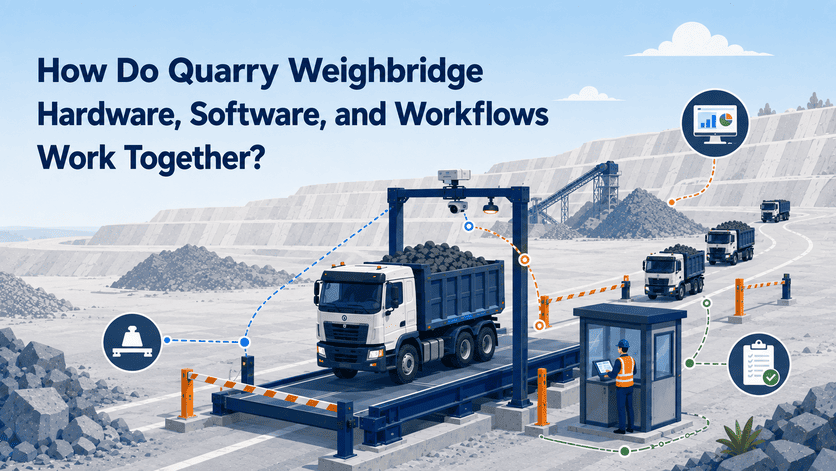
A quarry weighbridge solution is a tightly integrated system where platform structure, weighing software, and vehicle-flow management are designed as a single unit. The hardware must withstand impact loads and abrasive dust unique to quarry environments, the software must automate vehicle identification and material settlement, and the workflow design must match your peak daily truck count. Specifying any layer in isolation leads to accurate scales surrounded by chaotic data.
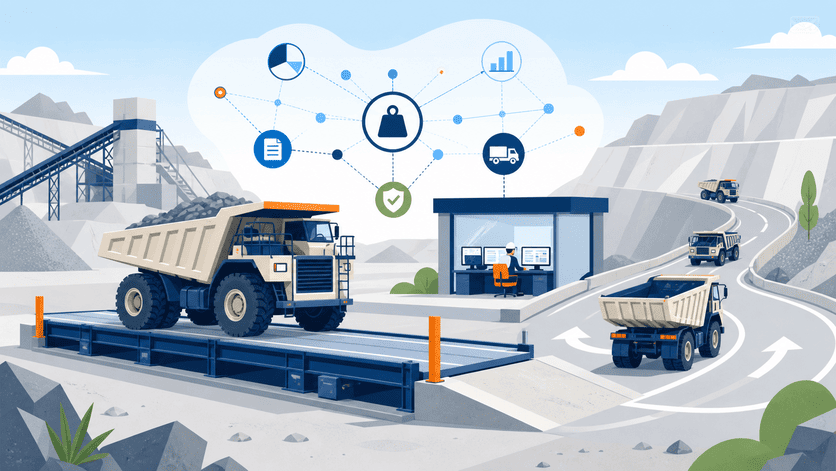
Understanding why these three layers must be co-designed starts with one question most buyers skip: how many trucks cross your scale at peak hour, and what do their axles weigh? That single data point cascades into every specification decision. Let me walk you through that cascade.
Why Does Peak Daily Truck Count Drive Every Specification Decision?
Most quarry operators begin their weighbridge search by asking "What tonnage capacity do I need?" That question matters, but it is not the first one. The variable that actually shapes your entire system—from structural steel thickness to whether you need unattended automation—is peak daily vehicle count combined with maximum single-axle impact load.
When a quarry client asks us for a quote, our first questions are about peak daily truck count and maximum axle load—not total tonnage. A 60-tonne scale serving 40 trucks per day is a fundamentally different specification from a 60-tonne scale serving 300 trucks per day, even though the capacity number on the data sheet looks identical.
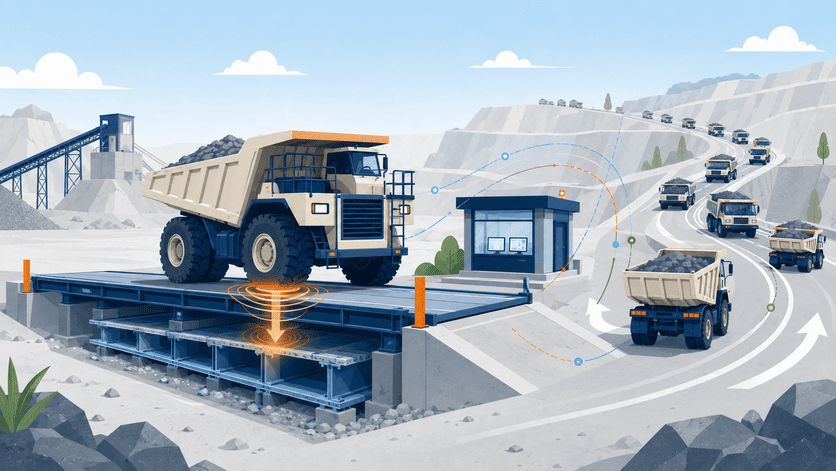
The Specification Cascade
Here is how peak traffic volume cascades into every layer of your quarry weighbridge solution:
| Peak Daily Trucks | Hardware Impact | Software Impact | Workflow Impact |
|---|---|---|---|
| < 80 trucks/day | Standard heavy-duty deck may suffice; single-scale layout | Basic ticketing software with manual entry is tolerable | Attended operation with one operator per shift |
| 80–200 trucks/day | Higher fatigue-rated steel; consider dual-direction weighing | Automated LPR and material classification become necessary to avoid ticket backlogs | Semi-attended operation; queue management becomes critical |
| > 200 trucks/day | Maximum structural reinforcement; dual scales (inbound/outbound) | Full unattended system with multi-scale networking, real-time settlement | Fully automated traffic flow with barriers, LPR, and driver self-service terminals |
Why Axle Load Matters More Than Total Capacity
A quarry is not a logistics yard. The vehicles crossing your scale are not evenly-loaded highway trucks. They are dump trucks—often overloaded—with extreme single-axle concentrations. A 40-tonne loaded dump truck can deliver 15+ tonnes of impact force on a single rear axle1 when it rolls onto the platform at speed, especially if the approach road is uneven.
This means:
- Platform structural design must be rated for single-axle impact, not just static distributed load
- Load cell selection must account for dynamic overload events, not just maximum capacity
- Foundation specifications must handle repetitive shock loading without settlement cracks
A common pattern we see in quoting: the buyer specifies a "60-tonne truck scale" and receives a platform engineered for distributed highway loads. Within 18 months, load cell drift and deck fatigue appear2—not because the scale was defective, but because quarry impact conditions were never part of the specification.
What This Means for Your Decision
Before you evaluate any hardware or software, document two numbers:
- Peak-hour truck count (not daily average—your busiest hour determines queue length and system throughput)
- Maximum single-axle load of your heaviest vehicle class (measure it, do not estimate from GVW)
These two numbers determine whether you need a standard heavy-duty platform or a reinforced quarry-grade structure, whether attended operation is sustainable or automation is a necessity, and whether a single scale handles your flow or you need inbound/outbound separation.
What Makes Quarry Weighbridge Hardware Different From Standard Truck Scales?
Standard truck scales are designed for logistics yards where vehicles arrive at controlled speeds on paved roads, loads are evenly distributed, and environmental exposure is moderate. Quarry conditions violate every one of those assumptions. Specifying a standard platform for a quarry is like specifying office furniture for a construction site—it meets the dimensional requirement but not the duty cycle.
The hardware differences quarry operators must evaluate fall into three categories: structural fatigue resistance, environmental protection ratings, and sensor durability under dynamic loading.
Structural Requirements for Impact Loading
Quarry dump trucks do not roll gently onto a scale. They approach on unpaved roads, sometimes at speed, creating dynamic impact forces that exceed static weight by 1.5–2× on the leading axle3. The structural implications:
- Deck plate thickness: Quarry-grade platforms typically require 14–16mm checkered plate versus 10–12mm for standard highway scales
- Main beam design: I-beam or U-beam profiles must be rated for repetitive impact fatigue, not just bending moment under static load
- Modular joint design: Multi-section platforms must resist lateral shifting from off-center loading by vehicles that do not track straight
Decision point for buyers: Ask your supplier for the fatigue-rated cycle count at maximum single-axle overload—not just the static capacity certificate. A platform rated for 100,000 overload cycles will outlast one rated for 50,000 cycles by years in a busy quarry.
Environmental Protection: Where IP Ratings Actually Matter
Quarry environments produce abrasive mineral dust, water spray from wheel wash, and extreme temperature swings. But not all components face the same exposure. Here is where I see buyers make a critical mistake: they focus on the IP rating of the indicator (which sits in a cabin) and ignore the junction box (which sits under the platform in the dust plume).
Protection priority ranking for quarry sites:
- Junction box — IP67 minimum4. This component lives under the deck, directly exposed to dust infiltration and water pooling. A failed junction box seal causes signal drift across all load cells simultaneously—the hardest fault to diagnose.
- Load cells — IP67 or IP68. Hermetically sealed stainless-steel load cells resist moisture and dust ingress at the sensor element itself.
- Cable connections — sealed potted connectors. Standard screw terminals corrode within months in crushing-plant environments.
- Indicator — IP65 is usually sufficient if housed in a control cabin. If exposed outdoors, IP66 minimum.
Load Cell Selection Logic
For quarry applications, the load cell decision is not just about capacity. It involves:
- Material: Alloy steel is cost-effective but less corrosion-resistant; stainless steel costs more but survives acidic runoff from certain rock types
- Overload tolerance: Quarry cells should tolerate 150% of rated capacity without permanent zero shift
- Temperature compensation range: Quarries in desert or highland locations experience 60°C+ diurnal swings; cells must be compensated across the full range
| Parameter | Standard Truck Scale | Quarry-Grade Weighbridge |
|---|---|---|
| Deck plate | 10–12mm mild steel | 14–16mm high-strength checkered plate |
| Load cell overload | 120% safe, 150% ultimate | 150% safe, 200% ultimate |
| Junction box IP | IP65 | IP67 minimum |
| Fatigue cycle rating | 50,000–80,000 | 100,000–200,000 |
| Approach plate | Optional | Essential (prevents step-shock) |
Why Is Weighing Software the Invisible Half of Your Quarry Investment?
Most quarry buyers spend 90% of their evaluation time on the physical scale and discover software requirements only after commissioning—when the first monthly settlement cycle reveals chaos. The scale works. The tonnage numbers are correct. But matching 300 daily tickets to customers, materials, and haulage contracts by hand takes two full-time clerks and still produces errors.
Quarry weighing software is not a "nice-to-have dashboard." It is the layer that converts raw weight data into actionable business records. The three functions quarry clients frequently discover too late:
1. Automatic Vehicle/Customer/Material Classification
Every weigh event in a quarry must be tagged with at minimum:
- Vehicle identity (plate number or RFID)
- Customer account (who pays for this load)
- Material type (crusite, aggregate grade, sand, etc.)
- Pit or source (which loading area)
- Destination (if relevant to pricing)
Without automatic classification, an operator manually enters this data for every single truck. At 200 trucks per day, that is 200 manual entries—each one an error opportunity and a fraud vector.
2. LPR-Linked Records to Eliminate Manual Entry and Fraud
License Plate Recognition (LPR) linked to your weighing database creates an automatic audit trail. When a truck crosses the scale:
- The camera reads the plate
- The software matches it to a registered vehicle → customer → material order
- The weight record is auto-tagged without human intervention
- Any unregistered plate triggers an alert
This eliminates the two most common quarry fraud patterns: ticket duplication (same ticket used for multiple loads) and vehicle substitution (a different truck using another's account).
3. Multi-Scale Networking
Quarry sites with multiple pits, multiple entry/exit points, or separate inbound/outbound scales need their data unified in real time. Without multi-scale networking:
- A truck weighed at Scale A (entry) and Scale B (exit) cannot be automatically matched
- Discrepancies between pit-level production data and exit-scale totals remain invisible until end-of-month
- Management has no real-time view of site throughput
The software decision framework:
| Daily Truck Volume | Minimum Software Capability |
|---|---|
| < 80 | Basic ticketing with manual classification |
| 80–150 | LPR integration + auto-classification + daily reports |
| 150–300 | Full automation + multi-scale networking + real-time dashboard |
| > 300 | Enterprise integration (ERP/accounting) + queue management + driver self-service |
When Does an Unattended Weighbridge System Make Sense for Quarries?
Unattended weighing systems are powerful—but they are not a plug-and-play upgrade. Quarry vehicle fleets are mixed (customer trucks, hired haulers, internal loaders), drivers are transient, and queuing is dense. I have seen quarry operators invest in unattended systems that revert to manual operation within weeks because the prerequisites were not met.
An unattended quarry weighbridge system becomes justified—and sustainable—only when specific traffic, fleet, and infrastructure conditions are satisfied simultaneously.
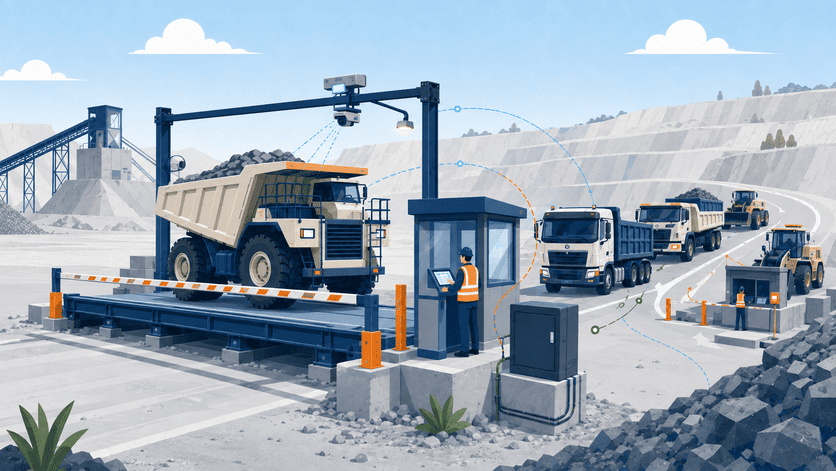
Prerequisites for Successful Unattended Operation
Before committing to an unattended system, quarry operators should verify:
1. Traffic volume threshold
- Below ~100 trucks/day, the cost of unattended infrastructure (LPR cameras, barriers, driver terminals, intercom, UPS) rarely pays back versus a single operator
- Above 150 trucks/day, the labor savings and error reduction make automation compelling
- The sweet spot for ROI is typically 150–300 trucks/day
2. Fleet registration and control
- All vehicles must be pre-registered in the system (plate number, tare weight, customer account)
- Casual or unregistered vehicles need a fallback process (manual lane, intercom to control room)
- If more than 20% of daily traffic is unregistered, the system spends more time in exception-handling than in automated mode
3. Driver behavior and literacy
- Drivers must follow lane discipline, stop at defined positions, and interact with terminals if required
- Multi-language interfaces may be necessary for sites with international or migrant driver pools
- Signage, traffic lights, and physical barriers must enforce correct positioning
4. IT infrastructure
- Reliable network connectivity between scales, cameras, barriers, and the central server
- Uninterruptible power supply (UPS) for all field devices—a power interruption during a weigh cycle corrupts the transaction
- Camera positioning must account for quarry dust on lenses; automated lens-wash or heated enclosures are often required
5. Exception management protocol
- No quarry operates 100% unattended. Overweight vehicles, unregistered plates, system faults, and driver errors all require human escalation
- The system must have a clear fallback: remote operator via intercom, or on-site attendant during peak hours
Risk flag for EPC contractors: Specifying an unattended system without confirming fleet registration discipline and network infrastructure is a common scope gap. Include these as prerequisites in your project documentation, not as post-commissioning assumptions.
What We Advise Installation Partners to Verify
Since HENER supplies complete hardware packages and weighing software but relies on local partners for on-site installation, we specifically advise them to verify:
- Foundation drainage prevents water pooling under the platform (corrodes junction boxes and load cells)
- Approach roads are graded smooth for at least 10 meters before the scale (reduces impact shock)
- Camera mounting height and angle account for local dust density and lighting conditions
- Network infrastructure is tested under load before go-live, not just during commissioning
How Should Quarry Operators Map Hardware and Software to Their Daily Workflow?
The ultimate test of a quarry weighbridge solution is not calibration accuracy on day one—it is whether the system supports every step of the daily vehicle cycle without creating bottlenecks or data gaps.
Here is the quarry vehicle workflow mapped against system requirements:
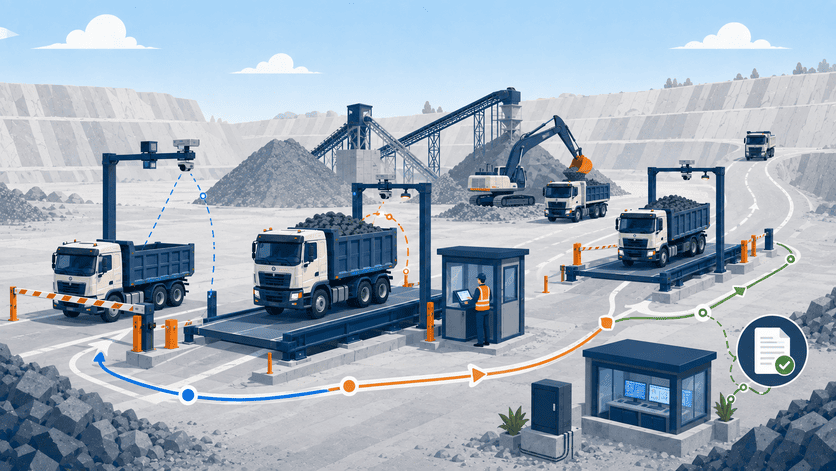
The Complete Vehicle Cycle
| Workflow Step | Hardware Involved | Software Function | Common Failure Point |
|---|---|---|---|
| 1. Truck arrives at gate | LPR camera, traffic light, barrier | Vehicle identification, queue management | Unregistered plate causes queue blockage |
| 2. First weighing (tare or gross) | Scale platform, load cells, indicator | Auto-capture weight + plate + timestamp | Truck not fully on platform; partial weight |
| 3. Loading at pit | (None at scale) | Material/pit assignment in transaction | Wrong material code assigned manually |
| 4. Return for second weighing | Scale platform, load cells, indicator | Net weight calculation, ticket generation | Tare/gross mismatch due to wrong vehicle ID |
| 5. Ticket issuance | Printer, driver display, SMS module | Auto-print or digital ticket delivery | Printer failure halts entire queue |
| 6. Exit and barrier release | Barrier, traffic light | Transaction closed, barrier opens | Barrier fails to open; manual override needed |
| 7. End-of-day settlement | (None) | Report generation per customer/material | Manual classification errors accumulate |
| 8. Monthly reconciliation | (None) | Multi-report cross-check, export to ERP | Data gaps from offline periods undetected |
Designing Around Bottlenecks
The most common bottleneck in quarry weighing is not the scale itself—it is the identification step. If vehicle recognition takes 15 seconds instead of 3 seconds, and you have 200 trucks per day crossing one scale, that extra 12 seconds per truck adds 40 minutes of total queue time daily.
Design principles to prevent bottlenecks:
- Separate identification from weighing where possible—use an RFID or LPR read point before the scale, so the vehicle is already identified when it rolls onto the platform
- Provide bypass lanes for vehicles that will not be weighed (internal loaders, service vehicles)
- Design for simultaneous inbound/outbound flow when daily count exceeds 200—one bidirectional scale creates conflicts
Integration Checkpoints for EPC Contractors
If you are specifying a quarry weighbridge system within a larger project scope, these integration points require explicit documentation:
- Data protocol compatibility: Confirm the weighing indicator supports your site's PLC or SCADA via Modbus, RS485, or analog 4–20mA5
- Software API availability: Verify the weighing software can export to your ERP or accounting system automatically
- Network topology: Define whether the weighbridge connects via Ethernet, Wi-Fi, or cellular backup
- Power supply redundancy: Specify UPS duration for each field component (camera, barrier, indicator, server)
- Maintenance access: Ensure platform design