













On this page

When you search for truck scales for sale, the first instinct is to compare prices. You pull up two or three quotations, line up the capacity and platform length, and pick the lowest number. But a year or two later, a deformed deck or a fried junction box tells you that the quotes were never truly comparable — because the real specifications were hidden inside the line items you never thought to question.
The most important comparison when evaluating truck scales for sale is not the unit price — it is the match between the scale's structural design, surface protection, and electrical specification and your actual vehicles, site environment, and data requirements. Two quotes listing "80 t, 18 m, OIML" can differ by several tons of structural steel, entirely different coating systems, and vastly different levels of electrical protection. Until you normalize those hidden variables, you are not comparing scales — you are comparing PDFs.
In my daily work as a pre-sales technical consultant at a truck scale manufacturer, I spend more time asking questions than answering them. When a buyer emails requesting a price, the first thing I send back is a list of counter-questions — about vehicles, site conditions, local regulations, and how they plan to use the weighing data. Those questions form the skeleton of this article. Let me walk you through them so you can build your own comparison framework before you sign anything.
What Vehicles Are You Actually Weighing — And Why Does That Determine Platform Length?
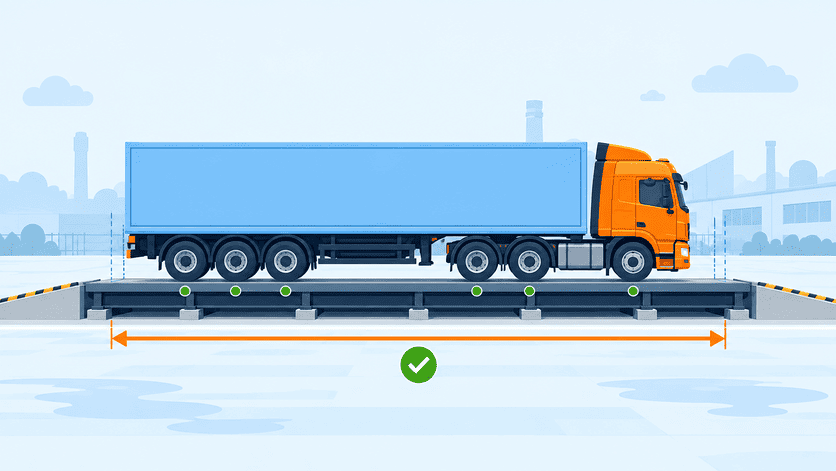
Most buyers start with capacity. "I need an 80-ton truck scale." But capacity alone tells you almost nothing about the platform you need. The critical starting point is the vehicle profile: body length, axle count, axle spacing, and loaded versus empty weight pattern.
A truck scale platform must be long enough to weigh the entire vehicle in a single pass without any axle hanging off the edge. The correct platform length is derived from the longest vehicle body that will cross the scale, not from a round number on a spec sheet. For most standard six-axle trucks in heavy-haul markets, an 18 m platform works. For shorter rigid-body trucks common in some regions, 12 m or even 9 m may suffice — and cost significantly less.
How to Define the Right Capacity and Division Size
Over-speccing capacity is one of the most common forms of self-inflicted waste I see. A buyer whose heaviest loaded truck tops out at 55 tonnes requests a 100-ton scale "just to be safe." The result? A heavier, more expensive structure, often paired with a finer division size that the buyer's operation does not need and that their local legal-for-trade rules may not even allow at that capacity.
Here is a more disciplined way to approach it:
- List every vehicle type that will cross the scale — loaded and empty.
- Identify the maximum gross vehicle weight (GVW) of the heaviest truck in regular operation.
- Add a reasonable overload margin — typically 20–30% above the maximum GVW, depending on your traffic pattern and whether occasional overloads are realistic.
- Check your local legal-for-trade division requirements. In many jurisdictions following OIML R76-based regulations, an 80 t scale typically uses a 20 kg or 50 kg division. Requesting a 10 kg division at 80 t may push the scale into a higher accuracy class that is harder and more expensive to certify — and may not be legally permitted in your market. Always verify division size and accuracy class requirements with your local metrology authority.
| Vehicle Type | Typical GVW Range | Suggested Min. Platform Length | Common Capacity Spec |
|---|---|---|---|
| Rigid 2-axle truck | 10–18 t | 6–9 m | 30–40 t |
| Rigid 3-axle truck | 20–30 t | 9–12 m | 40–60 t |
| Articulated 5-axle | 35–45 t | 15–18 m | 60–80 t |
| Articulated 6-axle (heavy haul) | 45–60 t | 18–21 m | 80–100 t |
| Road train / B-double | 60–80+ t | 21–24 m | 100–120 t |
Note: These are general planning ranges, not universal standards. Your actual vehicle fleet, local road regulations, and legal-for-trade requirements should drive the final specification.
The Cost Implication Buyers Miss
The difference between a 60 t / 16 m scale and an 80 t / 18 m scale is not just a line item on a quote — it cascades into foundation size, civil works cost, freight volume, and installation time. When a buyer over-specs by one capacity tier, they are often adding 15–25% to the total project cost before any negotiation begins.1 Start from the vehicle, not from the number.
How Much Steel Is Actually Inside That Deck — And Why Won't the Quote Tell You?
This is the single most important comparison point that almost no buyer asks about. Two quotations listing "80 t, 18 m, modular steel deck" can differ by several tons of structural steel — and that difference directly determines load-bearing integrity, long-term deflection resistance, and service life.2
The structural steel weight of a truck scale deck is the largest legitimate cost driver in the entire quotation. Yet it is almost never printed on a standard specification sheet. You have to ask for it.
What to Ask For — A Comparable Spec Sheet Built by the Buyer
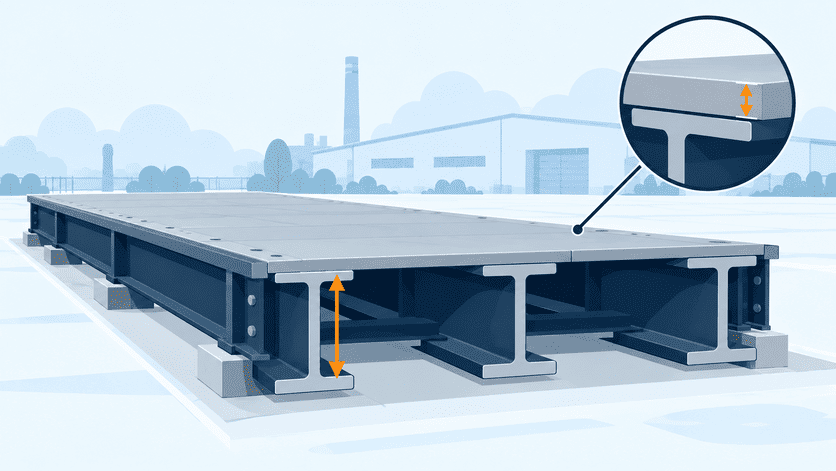
When I receive a request for quotation that includes a competitor's spec sheet, I can usually identify where cost has been trimmed within a few minutes. The giveaways are always the same: main girder height, top plate thickness, and total steel weight per module. Here is what you should request from every supplier quoting:
- Top plate thickness — typically ranges from 12 mm to 16 mm in standard-duty scales; heavy-duty or mining-grade may go to 18–20 mm. Thinner plates cost less but deflect more under concentrated axle loads.
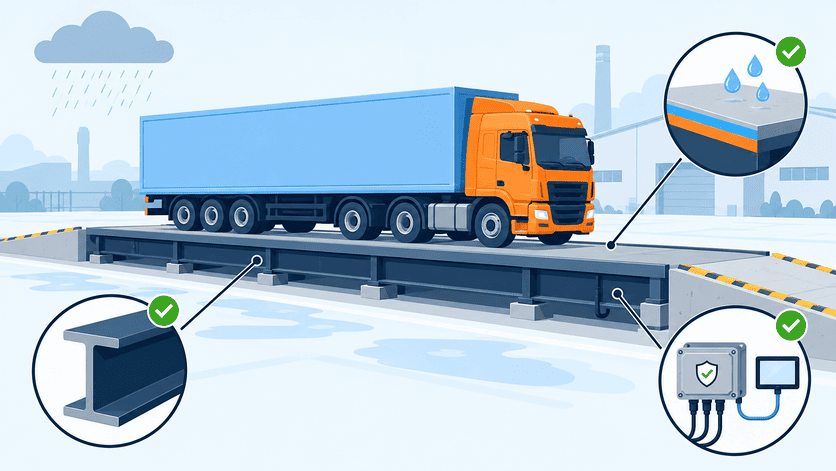
- Main girder (I-beam or U-channel) height — this is the primary structural member running the length of the deck. Typical ranges for 80 t scales run from around 300 mm to 450 mm. A shorter girder saves steel; it also bends more.
- Steel weight per module — ask each supplier to state the total structural steel weight per deck module, excluding load cells and accessories. This is the most direct apples-to-apples number you can compare.
- Number of main girders per module — some designs use fewer, heavier girders; others use more, lighter ones. The total section modulus matters more than the count, but knowing the layout helps you understand the design philosophy.
What Happens When Steel Is Too Light
I have seen cases — one involving a mining operation in Africa — where a deck purchased on price began showing visible deflection and top-plate deformation within the first operating season. The scale met its rated capacity on paper. But the structural safety margin was too thin for the real-world loading pattern: heavily loaded trucks with high axle concentrations, crossing the deck dozens of times per day, in extreme heat that softened the asphalt approach and shifted axle impact points.
Repairing a deformed deck in the field is rarely economical. In most cases, the modules must be replaced — and the buyer pays twice.
Practical tip: If two quotes for the same capacity and length differ by more than 15–20% in price, ask both suppliers for the steel weight per module. The answer will almost certainly explain the gap.
Is Surface Treatment Just a Cosmetic Choice — Or a Lifespan Decision?
Surface treatment is where I see the widest gap between what buyers assume and what actually happens to a truck scale after two or three years in the field. Most buyers glance at the paint finish in a factory photo and move on. But the process under the paint determines whether the deck will hold up or quietly corrode from the inside out.
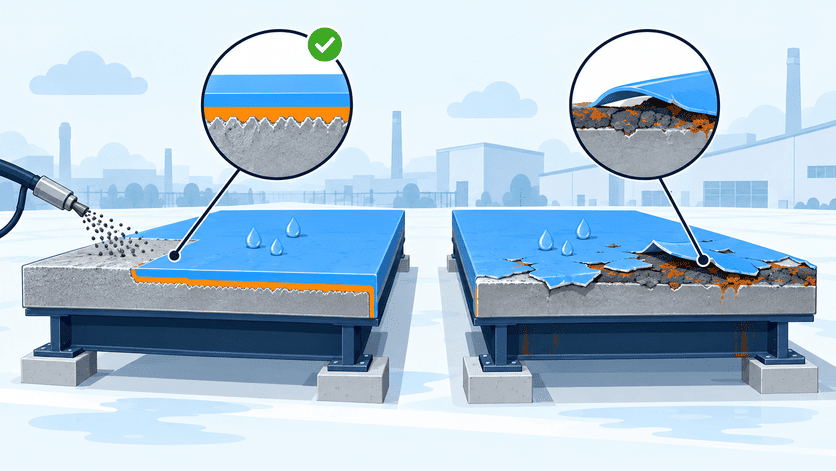
The critical distinction is between a properly shot-blasted and multi-coat painted deck versus a deck that is merely spray-painted over mill scale. Shot blasting removes mill scale and surface rust, creating a profile that paint can mechanically bond to.3 Without it, paint sits on a slippery oxide layer and begins delaminating within months of outdoor exposure — especially in humid, coastal, or chemically aggressive environments.
What a Proper Coating System Looks Like
A manufacturing-grade surface treatment process for a truck scale deck typically follows this sequence:
- Shot blasting to Sa 2.5 (near-white metal) — removes mill scale, rust, and contaminants; creates a surface profile of 40–75 μm for paint adhesion.
- Zinc-rich epoxy primer — applied within hours of blasting to prevent flash rust; provides cathodic protection.
- Epoxy intermediate coat — builds film thickness and corrosion barrier.
- Polyurethane or epoxy topcoat — provides UV resistance, abrasion resistance, and final appearance.4
- Total dry film thickness (DFT) — typically 200–300 μm for standard outdoor applications; heavy-duty or marine environments may require more.
What a Shortcut Looks Like
A low-cost producer may skip shot blasting entirely, applying paint directly over mill scale with a single-coat alkyd or low-grade epoxy. The surface looks acceptable in photos. In the field, this is what happens:
- Within 6–12 months: Paint begins blistering at weld seams and cut edges where moisture penetrates the mill scale layer.
- Within 1–2 years: Visible rust bleeding through the topcoat, especially on the deck underside and inside box-section girders where condensation collects.
- Within 2–3 years: Structural corrosion accelerates. The top plate thins. The foundation contact surfaces degrade.5 At this point, repainting in the field cannot restore the original protection — the corrosion is already inside the steel sections.
How to Verify Before Buying
This is one comparison point you can verify before signing a purchase order:
- Ask for the surface treatment process specification — shot blasting grade (Sa 2.5 is the standard reference), number of coats, paint type, and total DFT.
- Ask for factory process photos showing the blasting line, primer application, and final coating.
- If visiting the factory, look at the blasting equipment. A facility that shot-blasts truck scale decks needs large-format blasting chambers or automated roller-table blasting lines — these are not small or easy to fake.
At HENER, we run every deck module through roller-table shot blasting before entering the coating line. I mention this not as a sales point but because it is an example of a process that is directly visible and verifiable during a factory audit — unlike many other quality claims.
Does Site Environment Change What You Should Spec — Or Just How You Install It?
Site environment is a specification input, not an installation afterthought. Yet in the majority of inquiries I receive, the buyer provides capacity, length, and sometimes a foundation drawing — and nothing about climate, power grid conditions, lightning exposure, or chemical environment. These factors directly change the required IP rating, load cell material and protection, surge protection level, and junction box sealing.
If your truck scale will operate in a region with high humidity, coastal salt air, extreme temperatures, unstable power grids, or frequent lightning, the base electrical and structural specification must be upgraded at the quotation stage — not patched after installation failures.

Climate and Corrosion Exposure
The coating specification I described above applies to standard outdoor environments. If your site is near the coast, in a chemical processing zone, or in a tropical high-humidity region, standard coating may not be sufficient. Consider:
- Stainless steel load cells instead of alloy steel — especially for scales installed in pits where water accumulation is common.
- Higher IP ratings on load cells and junction boxes — IP67 or IP68 versus the baseline IP65 that some suppliers default to.6
- Sealed cable glands and potted connections — open terminal strips inside junction boxes are a common failure point in humid environments.
Power Grid and Lightning Protection
This is the factor I wish more buyers asked about. In many markets across Africa, Central Asia, South America, and parts of Southeast Asia, power grid instability and high lightning density are daily realities. An unprotected truck scale system in these environments is essentially waiting for a failure event.
I have worked on cases where a single lightning strike destroyed multiple load cells and the weighing indicator simultaneously — because the system had no dedicated surge protection on the signal lines or the power supply. The repair cost exceeded the price difference between a protected and unprotected system several times over, not counting the downtime.
What to specify for high-risk electrical environments:
| Protection Element | Purpose | When to Require |
|---|---|---|
| Load cell signal surge protectors | Divert transient voltage from lightning-induced surges away from load cells and indicator7 | Any site with moderate-to-high lightning exposure |
| Power supply surge protector / UPS | Protect indicator and peripherals from grid spikes and outages | Unstable grids, rural/industrial zones with frequent power fluctuations |
| Proper grounding system | Provide low-impedance path for fault currents and lightning energy | Every installation — but especially critical in high-lightning zones |
| IP67 load cells and junction boxes | Prevent moisture ingress that accelerates corrosion and electrical failure | Pit installations, coastal sites, tropical climates, wash-down environments |
Key takeaway: If your supplier's quotation does not ask about your power grid quality or lightning zone, they are quoting a standard system. That may be fine for a stable urban environment. It is a risk for anything else.
What Is the Real Comparison Unit — FOB Price or Landed, Commissioned Cost?
The final and most consequential framing mistake I see is treating the FOB price as the comparison number. Two suppliers quoting the same FOB price can deliver wildly different total project costs depending on freight mode, foundation requirements, installation complexity, and calibration support.
The correct comparison unit for truck scales for sale is the total landed and commissioned cost: FOB price + freight + customs and duties + foundation civil works + installation labor + calibration + initial spare parts. Only when all these elements sit in the same column can you make a legitimate comparison between suppliers.

A Cost Comparison Framework You Can Use
Here is the framework I recommend to buyers who are evaluating two or more quotations side by side:
| Cost Element | Supplier A | Supplier B | Notes |
|---|---|---|---|
| FOB / EXW price | $ _____ | $ _____ | Ensure same Incoterm |
| Structural steel weight (total) | _____ kg | _____ kg | Normalize for equivalent structure |
| Surface treatment spec | Shot blast + 3-coat | Direct spray | Affects replacement cycle |
| Load cell IP rating | IP67 | IP65 | Affects maintenance cost in wet environments |
| Surge protection included? | Yes / No | Yes / No | Critical for lightning-prone sites |
| Freight to site | $ _____ | $ _____ | Volume and weight affect shipping cost |
| Customs & import duties | $ _____ | $ _____ | Varies by HS code and country |
| Foundation civil works | $ _____ | $ _____ | Heavier scales may need different foundations |
| Installation & calibration | $ _____ | $ _____ | Local labor + any supplier support required |
| Spare parts (Year 1) | $ _____ | $ _____ | Load cells, junction box, indicator |
| TOTAL LANDED + COMMISSIONED | $ _____ | $ _____ | This is the real comparison number |
Why Foundation Cost Belongs in the Comparison
A truck scale's foundation is not standardized. A heavier, stiffer deck may actually require a simpler foundation because the load distribution is more uniform. A lighter deck might need a more over-engineered concrete base to compensate for structural flexibility. The foundation drawing should come from the scale manufacturer — and the civil works cost should be estimated before you finalize the scale selection, not after.
Pit-mounted and surface-mounted (pitless) installations have fundamentally different civil costs. If you have not yet decided on the installation type, get foundation estimates for both from each supplier. This single variable can shift the total project cost by 20–40%.
What "Technical Support" Actually Means at the Quotation Stage
A quotation that includes a foundation drawing, installation guide, wiring diagram, and calibration procedure is more valuable than one that is $500 cheaper but ships the scale with a one-page spec sheet. When you are thousands of kilometers from the manufacturer, documentation is your installation insurance.
Ask each supplier: What documents ship with the scale? At minimum, you should receive:
- Foundation drawing with rebar and drainage specifications
- Mechanical installation guide with dimensional tolerances
- Electrical wiring diagram for load cells, junction box, and indicator
- Calibration procedure with recommended test weights
- Spare parts list with part numbers for reordering
Frequently Asked Questions
How long does a truck scale typically last?
A well-manufactured truck scale with proper shot-blasted coating, appropriate load cells, and correct foundation can last 15–25 years with routine maintenance. Lifespan depends heavily on structural steel quality, surface treatment, environmental exposure, and whether the scale is operated within its rated capacity. Scales with poor coating or undersized structure may show serious degradation within 3–5 years.
Do I need OIML or CE certification for my truck scale?
That depends entirely on your local jurisdiction. OIML R76 and CE marking indicate that a product has been tested or assessed against certain technical requirements, but they do not automatically constitute legal-for-trade approval in your country.8 Always check with your national or regional metrology authority to confirm which certifications, type approvals, or verifications are required for commercial weighing in your market.
How many load cells does a truck scale need?
The number of load cells is determined by the platform length, number of modules, and the structural design. A typical 18 m modular truck scale uses 6 to 8 load cells, with each module supported at defined bearing points. More load cells does not automatically mean better accuracy — proper installation, corner adjustment, and calibration matter more than count alone.
Can I install a truck scale myself or do I need the manufacturer's team on site?
Many truck scales are designed for installation by local civil and electrical contractors using the manufacturer's documentation. The key requirement is accurate foundation work and proper electrical wiring. However, final calibration should be performed by a qualified weighing technician, often using certified test weights. Ask your supplier whether they provide remote calibration support or require on-site commissioning.
What spare parts should I keep on hand?
At minimum, keep one spare load cell, one spare junction box, and a set of signal cables on site. These are the components most vulnerable to damage from lightning, moisture, and mechanical impact. Having spares reduces downtime from days or weeks (waiting for international shipping) to hours.
Conclusion
When you compare truck scales for sale, the lowest price on a quotation rarely represents the lowest total cost. The real comparison begins when you ask what is inside the quote: how much structural steel, what surface treatment process, what level of electrical protection, and what documentation and support ship with the equipment. Match every specification back to your actual vehicles, your site environment, and your local regulatory requirements — not to a generic spec sheet.
Build your own comparison table. Ask for the numbers that suppliers do not volunteer: steel weight per module, coating DFT, load cell IP rating, and surge protection scope. Estimate your foundation, freight, and commissioning costs alongside the FOB price. That is how you avoid a scale that passes on paper and fails in year two.
If you are currently evaluating truck scale quotations and want help normalizing specs across suppliers — or if you need a detailed quotation with full structural and process documentation — feel free to reach out to our team at HENER. We are happy to walk through the comparison with you, whether or not we end up being the supplier you choose.
References
- Factors Influencing Weighbridge Pricing | PDF
- Section modulus
- FHWA Field Manual for Bridge Painting Inspection
- Polyurethane & UV Protective Coatings
- Sulfur | Definition, Element, Symbol, Uses, & Facts
- IP code
- Developing a Consumer-Oriented Guide on Surge Protection
- International Organization of Legal Metrology