













On this page

A pallet truck with digital scale and printer can address two warehouse problems at once: moving a pallet and documenting its weight. But a poor match can create handling difficulties, questionable readings, and unusable receipts. I recommend evaluating the actual receiving or shipping task before comparing capacity, advertised accuracy, or printer options.
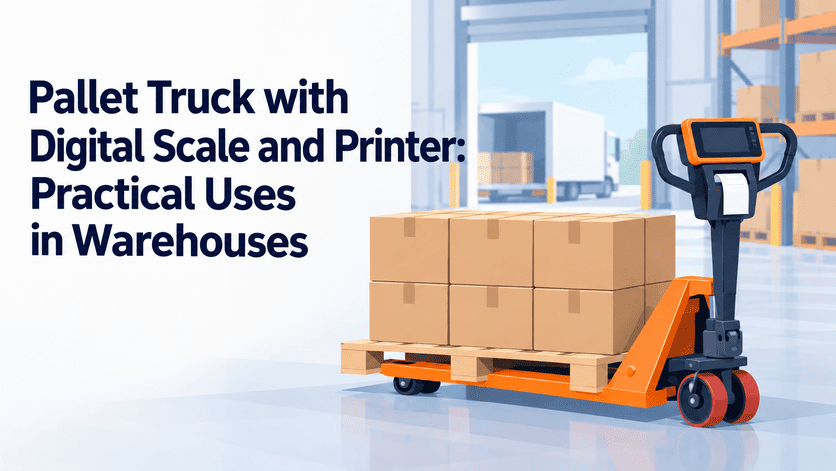
A pallet truck with digital scale and printer is useful when warehouse staff need to move pallets, weigh them, and immediately produce a paper weight record. I consider it most relevant to receiving, shipping, and offline handovers, provided its fork dimensions, working range, weighing conditions, and receipt format suit the task.

In my manufacturing and pre-sales discussions, I return to a simple question: what must happen between picking up the pallet and handing over its weight record? That question reveals requirements that a capacity figure or product photograph cannot answer.
Where Does a Pallet Truck with Digital Scale and Printer Fit Warehouse Workflows?
Warehouse teams may handle the same pallet several times before its weight reaches the shipping paperwork. Each transfer or handwritten entry creates another opportunity for confusion1. I start by checking whether integrated weighing and printing remove a specific handling or documentation step.
I see the strongest fit at receiving and dispatch points where operators already move palletized goods and need an immediate weight receipt. The equipment may reduce trips to a separate scale and manual copying, but I would confirm pallet suitability, operating conditions, and record requirements before recommending it.

I start with the task, not the equipment
For receiving, I ask whether the warehouse needs to record incoming pallet weights, compare them with delivery documents, or attach a receipt to an inspection record. A printed weight can support that process, but it does not establish product quantity or condition by itself.
For shipping, I ask whether staff need a final packed-pallet weight before completing dispatch paperwork. The useful measurement may be gross weight, net weight, or both. Those terms need agreement before the supplier configures the indicator and ticket.
| Warehouse task | Potential value | Question I ask before selection |
|---|---|---|
| Incoming pallet checks | Weight and receipt at the receiving point | What reference weight will staff compare against? |
| Outbound pallet preparation | Record of the packed load | Does the required figure include the pallet and packaging? |
| Internal department transfer | Paper evidence for handover | How will the receipt identify the transferred material? |
| Offline dispatch | Local record without a live network | Who will enter and reconcile the record later? |
I also check whether an existing floor scale already serves the workflow well. An integrated pallet weighing truck is not automatically the better choice. A separate weighing station may suit operations that require a controlled location, different platform dimensions, or another approval configuration.
A pallet truck with digital scale and printer becomes more relevant when weighing naturally belongs within the pallet movement task. I would not recommend adding a printer merely because it appears convenient on a specification sheet.
My evaluation includes the person receiving the ticket. If that person cannot connect the printed weight to the correct pallet or shipment, the equipment has produced a number rather than a useful business record.
How Should I Specify a Pallet Truck with Digital Scale and Printer for Pallet Fit and Load Range?
A truck can meet the stated capacity and still fail to enter the warehouse’s common pallets. It can also display fine increments without providing useful results at typical loads. I therefore separate mechanical compatibility from weighing performance before I compare suppliers.
I specify pallet dimensions, entry openings, fork geometry, and actual load distribution before selecting capacity. I then ask the supplier to explain the minimum useful weighing range, display division, and verified performance. A high maximum capacity does not, by itself, demonstrate suitability for lighter routine loads.

I verify the pallet interface first
I ask purchasing teams for drawings or measured dimensions of the pallets they actually use. A familiar pallet name is not always enough, especially when the operation handles several pallet designs or damaged returnable pallets.
My mechanical checklist includes:
- Fork length and outside width: These dimensions must suit the intended entry direction and load support.
- Lowered fork height: The forks must clear the available entry opening.
- Lift clearance: The truck must raise the pallet clear of the floor for weighing.
- Pallet construction: Bottom boards, entry geometry, and wheel paths can affect compatibility.
- Aisles and turning space: The operator needs room to position the load without contacting surrounding objects.
I request a drawing of the proposed weighing model rather than assuming it matches a standard non-weighing pallet truck.
I distinguish capacity from useful measurement
Consider an illustrative warehouse requirement with most loads between 150 and 600 kg, plus occasional loads near 1,500 kg. I would not select the system only around that occasional maximum. I would ask for performance evidence across the routine range as well.
If a proposed indicator has a 1 kg display division, that increment represents about 0.67% of a 150 kg load and 0.17% of a 600 kg load. These figures describe the size of the displayed increment relative to the load; they are not accuracy specifications.
I also distinguish display resolution, repeatability, measurement error, and legal-for-trade suitability. Those concepts answer different procurement questions.
For a pallet truck with digital scale and printer, I want the quotation to identify both the truck’s handling capacity and the weighing system’s rated range. I also want any minimum-load restrictions and performance claims stated clearly. A qualified weighing professional should review the final configuration when the measurement affects regulated transactions or application-specific acceptance decisions.
What Affects a Pallet Truck with Digital Scale and Printer’s Real-World Readings?
An impressive accuracy statement can create false confidence if nobody explains the conditions behind it. Warehouse floors, load placement, and operator habits can influence readings. I treat published performance as something to investigate through documented tests, not as a guarantee for every location.
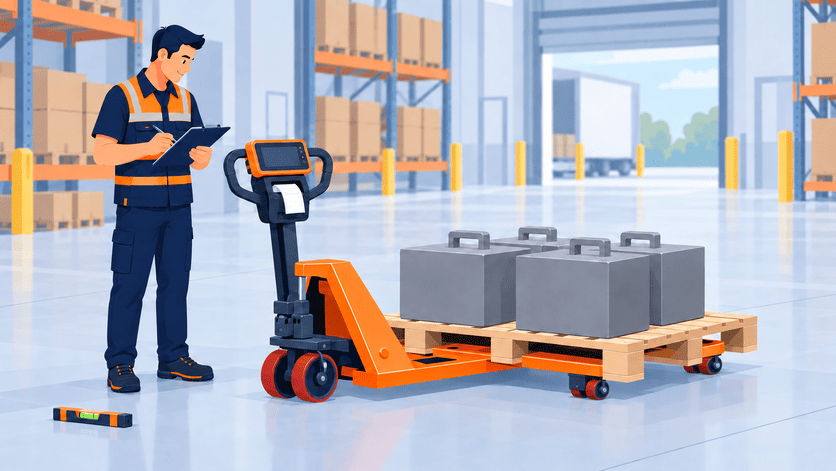
I assess calibration, repeatability, off-center loading, floor suitability, vibration, and the required weighing procedure. The pallet should be fully supported, clear of external contact, and stationary during measurement. I ask suppliers to define their test conditions and recommend qualified on-site evaluation before the readings support critical decisions.
I explain what the weighing system measures
An integrated pallet scale typically uses load cells to sense force through the weighing structure2. The indicator converts their signals into a displayed weight using its configured calibration.
That measurement depends on the intended load path. If part of the pallet remains supported by the floor, or the load touches a rack, the scale may not measure the complete load as intended. A stable-looking number does not prove that the setup is correct.
I ask buyers to include these conditions in their evaluation:
| Potential influence | Why I investigate it | Evidence or check I request |
|---|---|---|
| Off-center loading3 | Position can change the response of the weighing assembly | Documented eccentric-load testing |
| Uneven or sloping floor | Conditions may affect support and stability | Supplier limits and site assessment |
| Vibration or movement | The displayed value may fluctuate | Defined settling and stable-reading procedure |
| External contact | Another surface may support part of the load | Clear demonstration with the pallet fully supported |
| Temperature changes4 | Components can respond to environmental changes | Operating range and relevant test information |
| Mechanical wear or damage | The load path may change over time | Inspection and service requirements |
I distinguish factory testing from site acceptance
According to HENER’s supplied manufacturing information, its quality-control processes include individual load-cell testing, multi-point calibration, corner-error adjustment, repeatability testing, and final inspection. I use that information as a starting point for requesting model-specific records, not as proof that every configuration achieves identical performance.
For a pallet truck with digital scale and printer, I would agree an acceptance plan covering representative loads, repeated measurements, relevant load positions, and comparison with suitable traceable reference weights or equipment.
I also separate calibration from adjustment. Calibration establishes the relationship between indications and reference values under stated conditions; adjustment changes the instrument’s response. Local verification requirements may add another step.
My recommendation is to have a qualified weighing service provider define the installation checks and ongoing calibration schedule. The appropriate interval depends on use, risk, environment, and applicable requirements—not a universal calendar rule.
When Does a Pallet Truck with Digital Scale and Printer Produce Useful Records?
A receipt can look professional while omitting the information needed to resolve a shipment question. A weight without a pallet reference, tare basis, or timestamp may be difficult to use later. I evaluate the record’s purpose before I evaluate the printer hardware.
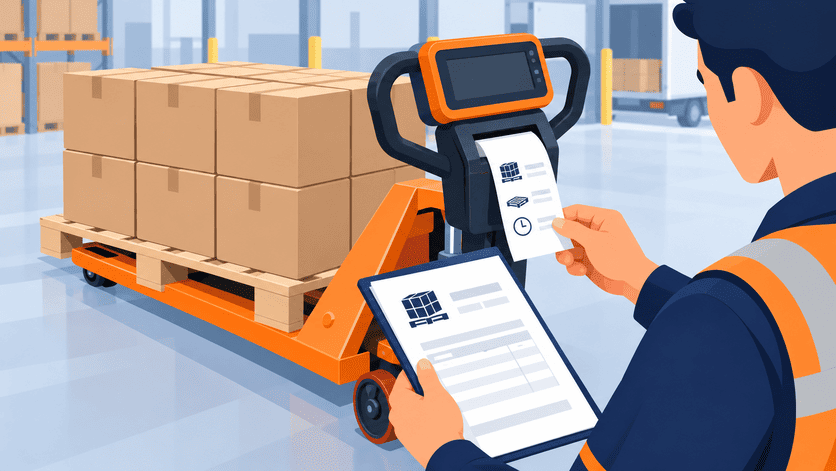
I consider printing valuable when staff need immediate evidence for receiving, dispatch, or an offline handover. The ticket should identify the load and explain the weight being reported. However, a printed receipt does not automatically update inventory, validate shipment data, or provide full WMS or ERP integration.
I ask for a sample ticket before approving the configuration
My first request is a sample receipt generated by the proposed indicator and printer combination. A list of available fields is helpful, but a physical or digital sample reveals whether the layout is readable and whether the required information appears together.
Depending on the task, I check for:
- Date and time.
- Weight unit, such as kilograms.
- Gross, tare, and net values where supported and required.
- Pallet, shipment, batch, or transaction reference.
- Operator or station identification where available.
- A sequence number or another way to distinguish records.
I do not assume that every indicator supports these fields. Some configurations may print only a weight and a timestamp. Others may require an additional input device or software connection to include shipment references.
I pay particular attention to tare
If the workflow requires net product weight, the tare value must represent the packaging and pallet being excluded. Variable pallet weights, damaged pallets, or additional wrapping can make a fixed tare unsuitable.
I ask whether the proposed unit supports the required tare method and whether the receipt clearly distinguishes measured gross weight from calculated net weight. The buyer should also confirm any restrictions that apply to approved trade-use configurations.
I treat paper records and digital integration separately
A pallet truck with digital scale and printer may provide a useful fallback when a network is unavailable. But someone still needs to file, enter, or reconcile that information afterward.
For digital connectivity, I request separate documentation covering the interface, data format, transaction identifiers, acknowledgments, and error handling. HENER’s business information lists several communication and integration options across its product range, but I would verify availability for the exact quoted model.
I also check printer power requirements, replacement paper availability, ticket readability, and storage conditions. If long-term retention matters, I ask the buyer to validate the proposed printing medium against its document-retention policy.
How Do I Compare Suppliers and Plan Acceptance Testing?
Two quotations can describe similar equipment while offering very different levels of documentation and support. Missing drawings, unclear test methods, or uncertain printer compatibility can transfer risk to the buyer. I compare the evidence behind the offer rather than relying on its headline specifications.
I ask each supplier for configuration drawings, a complete specification, sample receipts, relevant test records, and service arrangements. I then define factory and site acceptance criteria. Certification and approval documents should be checked for scope, validity, model coverage, and destination-market requirements before the purchase is finalized.

I make quotations comparable
For a pallet truck with digital scale and printer, my comparison starts with a shared requirements sheet. Without that sheet, one supplier may quote a basic indicator while another includes a different battery, printer, or communication option.
I want each quotation to state:
- The exact truck, indicator, and printer configuration.
- Fork dimensions, handling capacity, and weighing range.
- Display division and clearly defined performance claims.
- Operating limits and environmental protection ratings5.
- Receipt fields and any required input method.
- Battery, charger, and printer power arrangement.
- Supplied documents, spare parts, warranty terms, and service responsibilities.
I also ask who supports the equipment locally. A distributor may need replacement load cells, indicators, printers, wheels, and compatible firmware or configuration files. Availability matters, but so does the ability to restore and verify weighing performance after a repair.
I verify documents instead of relying on labels
HENER’s supplied business context states that its production system operates under ISO 9001 and that its products address relevant OIML and CE requirements. I would still ask for the documents applicable to the proposed product and market.
ISO 9001 certification concerns the quality management system. It does not establish the measurement accuracy of an individual scale.6 Likewise, an OIML-related statement needs an identifiable recommendation, certificate, or test scope. CE documentation should identify the applicable legislation and product configuration7.
If the application requires legal-for-trade weighing8, I recommend review by a qualified local specialist. For a North American project requiring NTEP-related support9, I would confirm the approved model, manufacturer, configuration, and certificate coverage; partner supply-chain support alone is not sufficient evidence.
I agree on acceptance before shipment
My preferred acceptance plan includes mechanical fit, representative weighing checks, repeatability, receipt content, and power operation. Any digital interface needs its own test.
I also define what happens when a test fails: who investigates, what evidence is required, and whether correction occurs before dispatch or during site commissioning. These agreements make supplier comparison more meaningful than a feature checklist.
Frequently Asked Questions
Do I need a printer if my warehouse already uses a WMS?
I would check whether the WMS already captures the required weight and provides sufficient handover evidence. A printer may still help with offline work or physical documentation, but it is not automatically necessary. I would compare the paper-record requirement with the actual digital workflow before specifying both.
Can I use the printed weight for commercial transactions?
I would not assume that a printed receipt makes the measurement legal for trade. The complete instrument configuration, intended use, and local rules determine suitability. I recommend checking applicable approvals and verification requirements with a qualified local weighing professional before using the result to calculate a commercial charge.
How often should I calibrate a pallet weighing truck?
I recommend a schedule based on usage, measurement risk, operating conditions, service history, and local requirements. A qualified provider should define the interval and interim checks. Impacts, repairs, relocation, or unexplained changes in readings may justify an earlier inspection or calibration rather than waiting for the next scheduled visit.
Can I use one model for every pallet in my warehouse?
I would verify each common pallet type rather than assume universal compatibility. Fork width, length, lowered height, entry direction, and bottom-board geometry can all matter. A mixed pallet population may require more than one handling arrangement, especially when some pallets cannot be fully supported for weighing.
Does a finer display division mean better accuracy?
I treat display division and accuracy as different characteristics10. Smaller increments can make readings more detailed, but they do not prove smaller measurement errors. I ask for repeatability, eccentric-load performance, and calibration evidence across the intended working range, with the supplier’s test conditions clearly stated.
Conclusion
I evaluate a pallet truck with digital scale and printer by the warehouse task it must support—not by capacity and advertised accuracy alone. Pallet compatibility, useful load range, stable weighing conditions, and meaningful receipts determine whether the configuration fits. I also verify supplier evidence and arrange qualified evaluation where the application demands it. To discuss a suitable HENER configuration, share your pallet dimensions, typical load range, operating environment, destination market, and required receipt fields. I can then help define a clearer basis for quotation and acceptance.
References
- Data Quality in Health Research: Integrative Literature Review
- Weighing scale
- Eccentricity Test for Weighing Devices | PDF
- What Is Load Cell Temperature Compensation Why It Matters
- IP code
- ISO 9001
- CE marking – obtaining the certificate, EU requirements
- Weighing equipment for legal use
- National Type Evaluation Program (NTEP)
- The Difference Between Accuracy, Precision, and Resolution