
Are you losing money due to weighing errors1? Guessing between OIML C32 and C6 load cells can cost you thousands. Let us find the right precision for your scale.
OIML C3 offers 3,000 verification intervals and works best for standard logistics like truck scales3. OIML C64 offers 6,000 intervals and provides hyper-precision for high-value chemical or pharmaceutical batching. Choosing the right class depends on your structural frame and exact business needs.
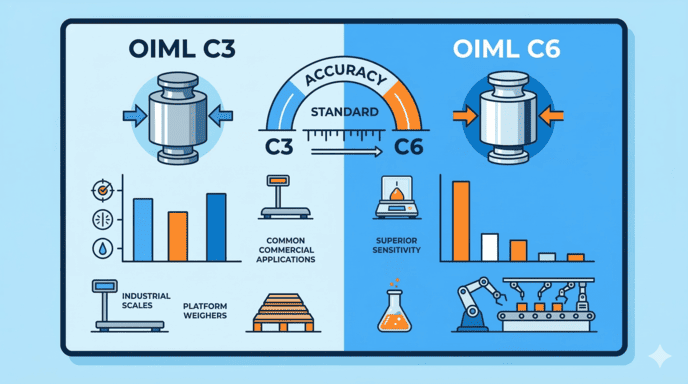
Many people think a higher number always means a better result. I often hear this from procurement teams looking to buy load cells. However, buying too much precision can ruin your weighing system. Keep reading to see how the wrong upgrade can actually hurt your daily operations.
What Is the True Difference Between C3 and C6 Metrology Baselines?
Do technical spec sheets confuse you? Choosing the wrong verification intervals leads to poor scale performance. Here is the exact difference between C3 and C6 load cells.
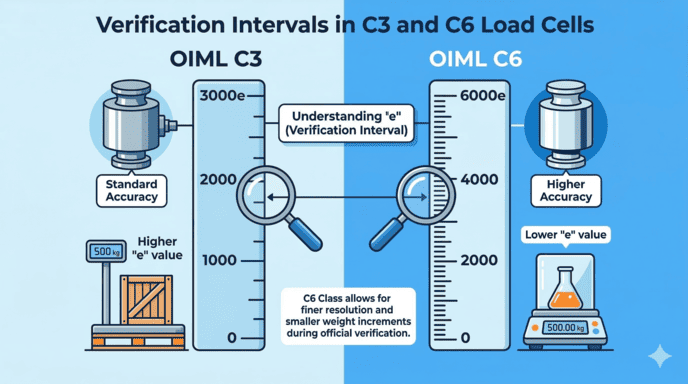
The main difference lies in verification intervals (v)5. A C3 load cell divides its maximum capacity into 3,000 steps. A C6 load cell divides the same capacity into 6,000 steps. This means a C6 load cell detects much smaller weight changes than a C3 load cell.
Breaking Down Verification Intervals
When I started fixing scales years ago, the math behind metrology often confused plant managers. Let us keep it simple. The letter C stands for Class C. The number after it tells you how many thousands of verification intervals the load cell has. An interval is the smallest unit of weight the scale can legally and accurately read.
If you have a 3,000 kg scale, the math is easy.
| Accuracy Class | Total Intervals | Smallest Readable Weight (v) | Target Use Case |
|---|---|---|---|
| OIML C32 | 3,000 | 1.0 kg (3000 kg / 3000) | Standard commercial weighing |
| OIML C64 | 6,000 | 0.5 kg (3000 kg / 6000) | Precision commercial weighing |
A C6 load cell gives you double the resolution of a C3 load cell. Getting a 0.5 kg resolution on a heavy scale sounds amazing. You might think this extra detail gives you better data to prevent waste. But higher resolution is not just about reading smaller numbers on a screen. It is about the sensor picking up every tiny physical force around it. A C3 scale ignores small bumps and wind. A C6 scale feels everything on the floor. You must match the interval to your exact environment to get a good reading.
Which Industrial Processes Actually Require C6 Precision Over Standard C3?
Are you overpaying for scale parts you do not need? Wasting budget on unneeded precision hurts your bottom line. Let us look at what your process really needs.
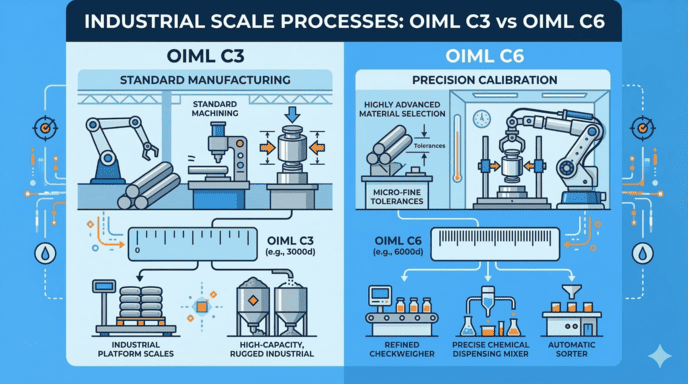
Standard operations like truck scales3, warehousing, and bulk grain shipments only need C3 precision. You only need C6 precision for high-value processes. These include pharmaceutical batching, expensive chemical mixing, and advanced automated packaging where tiny weight drops cost significant money.
Matching the Sensor to the Job
I work with operations managers all the time. They want good compliance and fewer errors. You might manage bulk shipments of grain and products. For these daily jobs, OIML C3 is the absolute best choice. It handles heavy trucks, vibrations, and harsh outdoor weather very well. In fact, standard C3 load cells successfully cover about 85 percent of all standard industrial weighing tasks today.
You only need to step up to C6 when the cost of a small mistake ruins your budget.
When to Choose C3 vs. C6
| Industry Need | Best Choice | Reason Why |
|---|---|---|
| Agricultural Truck Scales | C3 | Survives wind, dirt, and heavy impact |
| Warehouse Floor Scales | C3 | Good stability and lower equipment cost |
| Specialty Chemical Mixing | C6 | Prevents giving away expensive ingredients |
| Pharmaceutical Batching | C6 | Meets strict industry compliance rules |
When you export heavy agricultural products, standard C3 keeps your daily operations moving fast. It avoids bad readings from passing warehouse forklifts. C6 is very different. It is like a fine sports car. You do not drive a sports car through a muddy farm field. You use it on a smooth track. You should use C6 load cells only when your process handles costly materials in a very clean, tightly controlled indoor space.
Why Does Upgrading to C6 Fail Without Superior Mechanical Scale Frames?
Did your new high-precision scale fail shortly after installation? Buying a high-class sensor for a weak frame causes costly shutdowns. You must fix your mechanical structure first.
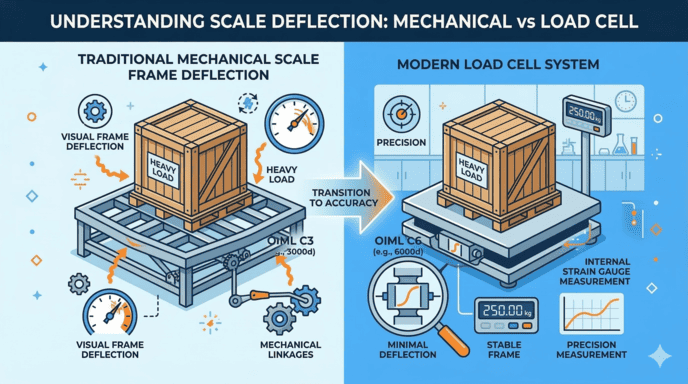
Upgrading to C6 fails because the hyper-sensitive sensor measures every micro-force. If your scale frame flexes under heavy loads, the C6 load cell will magnify those structural flaws. This causes erratic zero-drifting and worse readings than a standard C3 load cell.
The Trap of False Precision
I want to share a raw story from last quarter. I visited a specialty chemical client in Frankfurt. The plant manager demanded our premium C6 load cells for their aging mixing tanks. He wanted to stop giving away expensive raw ingredients. A few weeks later, he called me. He felt very angry. The scale readings would not stay at zero.
I walked the plant floor with my chief engineer to inspect the setup. The new load cells were perfect. The problem was the old structural steel.
The Impact of Mechanical Flaws
| Problem Factor | How it Affects C3 | How it Affects C6 |
|---|---|---|
| Scale Frame Flexing | Ignores minor flexing | Shows erratic weight jumps |
| Temperature Changes | Remains mostly stable | Drifts off the zero mark easily |
| Floor Vibrations | Absorbs basic shocks | Records vibration as real weight |
Because a C6 load cell has 6,000 intervals, it acts like a giant magnifying glass. The client had aging mounting brackets. These brackets bent slightly under heavy loads. The C6 cell measured that bending as extra weight. If your scale frame lacks stiffness, or if you ignore simple thermal expansion6, a C6 setup will fail. I always tell my clients at HENER SCALE that mechanical integrity must come before sensor precision. A strong metal frame is mandatory for good results.
How Do You Balance Cost and Precision for Smart Factory Algorithms?
Does bad data ruin your automated systems? Feeding messy weight numbers into smart systems breaks inventory tracking. You need the right load cell to get clean data.
To feed clean data into smart factory algorithms7, you must match your load cell class to your true operational noise. C3 filters out heavy vibrations naturally for steady logistics data. C6 provides exact micro-data for quiet, automated packaging systems where tight inventory control matters most.

Feeding Clean Data to Smart Systems
Today, we send huge amounts of weighing data into computer systems. Operations managers want real-time tracking from the factory floor to the gallery wall. Good data fidelity is critical for your success. If your scale sends bouncy, useless numbers, your inventory software will make bad choices.
You want to balance your budget while getting the best clean metrics. Upgrading to a C6 load cell costs more upfront. It also requires a high-end mechanical base, which adds to the final project bill.
Tracking the Return on Investment (ROI)8
| Data System | Load Cell Focus | ROI Driver |
|---|---|---|
| Basic Inventory Logging | OIML C3 | Low cost, high durability over time |
| Smart Farm Logistics | OIML C3 | Fast, stable weights despite wind |
| IoT Automated Packaging | OIML C6 | Exact material tracking, zero daily waste |
| AI Quality Control | OIML C6 | Perfect micro-data for algorithm learning |
You must look firmly at your daily needs. If you load bulk grains onto semi-trucks, a smart system needs the steady numbers a C3 gives. The system filters out the noise. If you run a modern, enclosed, automated plant, C6 gives your computers exactly what they need to stop tiny leaks. Make sure your system design completely supports the sensor. This simple planning ensures your money pays off well.
Conclusion
Choosing between C3 and C6 depends on your exact mechanical frame and daily operational needs. Smart engineering gives you reliable data, better compliance, and a true return on investment.
Quantifies financial impact so you can justify upgrades and prioritize fixes that pay back fast. ↩
Gives official definitions and typical applications to confirm C3 fits your operation. ↩
Helps you choose a robust setup that resists vibration, wind, and heavy impacts. ↩
Explains where C6 precision is truly needed so you avoid overspending or under-specifying. ↩
Helps you interpret specs correctly and connect “v” to real-world accuracy and compliance. ↩
Helps you design for temperature effects so high-resolution systems stay stable. ↩
Improves data quality for automation, analytics, and control systems—preventing bad decisions. ↩
Gives a framework to compare C3 vs C6 costs against savings from waste and errors. ↩