
Inaccurate scales cause massive inventory chaos. When load weights drift, your operations suffer and compliance risks rise fast. You can fix this easily by mastering corner load calibration for precise measurements.
Corner load calibration ensures a scale reads the exact same weight regardless of where the load is placed. It corrects microvolt signal differences between load cells1, enabling exact 1/10,000 Full Scale precision and preventing data errors during off-center pallet placements on industrial floor scales.

When I was in Seoul at a large battery plant, I saw firsthand how hidden scale errors ruin inventory data. Let me show you exactly how structural and digital upgrades eliminate these costly measurement problems once and for all.
The Physics of Eccentric Loading: Why Do Off-Center Pallet Placements Destroy Measurement Integrity?
Forklifts rarely place pallets perfectly in the center. This off-center loading stresses the scale plate unevenly. You must understand the physics of eccentric loading to stop bad weight records.
Off-center pallet placements destroy measurement integrity because they apply uneven mechanical forces across the scale. This shifts the weight distribution, causing uncalibrated load cells1 to output completely different microvolt signals. Proper corner calibration levels these signals so every corner reads the exact same weight.

I saw this exact problem early in my career. A few months ago, I was on-site at a tier-one lithium-ion battery plant in Seoul. Their automated guided vehicles dropped very heavy pallets of raw materials onto a competitor's floor scale. Their computer system constantly showed large inventory mistakes. The plant manager strongly believed the load cells1 were broken. I told the vehicle operator to put a test pallet right in the middle. Then, I told him to move the heavy pallet to the back-left corner. The digital indicator immediately showed a difference of almost three kilograms. The sensors were completely fine. The scale just had a terrible corner load error2. The technicians never corrected it. In industrial weighing, buyers only look at maximum load cell capacity. They rarely ask about eccentric loading testing. We call this a corner load error on the factory floor. Reaching standard 1/3,000 precision is very easy. Pushing a scale to an amazing 1/10,000 Full Scale accuracy is a very different challenge. You must aggressively fix the corner errors.
Breaking Down Eccentric Load Errors
| Load Condition | Scale Reaction | Measurement Result |
|---|---|---|
| Perfect Center Load | Even force on all cells | High accuracy |
| Off-Center Load | Uneven force distribution | High error risk |
| Corrected Corner Load | Adjusted signal balance | Perfect precision |
The Structural Prerequisite: How Does Micro-Deflection in the Scale Deck Sabotage High-Resolution Calibration?
Weak scale decks constantly bend under heavy loads. This tiny bending easily ruins your load cell alignment. You need complete structural rigidity to achieve high-resolution weight calibration today.
Micro-deflection sabotages high-resolution calibration by introducing lateral shear forces to the load cells. When the steel deck flexes even one millimeter under heavy load, it bends the sensors out of alignment. You cannot fix mechanical bending with electrical calibration; you need a rigid scale deck first.

You absolutely cannot solve a mechanical problem with an electrical fix. This is a strict rule I always follow. When a heavy pallet sits far off-center, it pushes the scale deck down hard. If the steel deck bends even one millimeter, it creates dangerous lateral shear forces. These sideways forces directly twist the load cells out of their proper place. The load cells then measure the twist instead of the actual weight. You cannot clear this active bending away with software patches. You must start with a very strong metal structure. Achieving true 1/10,000 Full Scale precision demands total structural strength. This is exactly why HENER uses thick, heavy-duty U-channel bracing under all our platforms. The U-channel design aggressively stops the metal plate from bending under extreme pressure. It keeps the fragile load cells completely flat. When the foundation is totally solid, the calibration will hold steady. A weak deck ruins all your hard work very quickly. You must build a tough scale first.
The Role of Heavy-Duty Bracing
| Deck Structure | Bending Risk | Calibration Stability |
|---|---|---|
| Thin Flat Steel | Very High | Constant Drift |
| Standard Beams | Medium | Occasional Errors |
| U-Channel Bracing | Zero | Perfect Stability |
Analog Guesswork vs Digital Precision: What Is the Evolution of Signal Trimming and Junction Box Technology?
Old analog scales use tiny dials that always vibrate loose. This causes constant weight drift and immense frustration. Smart digital junction boxes permanently lock in perfect corner compensation.
The evolution of junction boxes moves from analog guessing games to precise digital control. Historically, technicians manually turned potentiometers3 to trim microvolt signals, but these drifted with temperature and vibration. Today, digital junction boxes use smart software to perfectly balance corner signals without physical dials.

In a standard floor scale, you are mixing tiny microvolt signals together. Integrators often forget this highly important detail. Even the very best factory load cells have small differences. The metal cuts are never exactly identical. This means each corner sends a slightly different signal under the exact same weight. In the distant past, technicians used old junction boxes. They manually twisted small analog potentiometers3 to change these tiny signals. This was a very frustrating and painfully slow guessing game. Physical dials also drift heavily over time. Factory engine vibration and warehouse humidity make the analog dials move easily. Today, we use smart digital junction boxes. These modern devices use advanced software to manage the signals perfectly. They remove the human guessing game completely. You type the exact correction into the main computer. The software securely locks the number in place permanently. Heavy vibration and deep moisture cannot change a digital software code. This digital process easily guarantees perfect stability for many years.
Fixing Signal Variance with Digital Tools
| Technology Type | Adjustment Method | Risk of Drift |
|---|---|---|
| Analog Junction Box | Physical turning dial | Very High |
| Digital Junction Box | Software programming | Zero |
| Uncalibrated Box | No adjustment | Guarantee Error |
Securing the Data Supply Chain: Why Is Flawless Corner Accuracy Non-Negotiable for Automated AGV Warehousing?
Automated warehouses strongly rely on clean data to function perfectly. Bad weight readings confuse your smart factory software. Flawless corner accuracy ensures your automated systems never fail due to bad data.
Flawless corner accuracy is non-negotiable for automated warehousing because smart factory algorithms rely completely on raw weight data. If a scale gives bad readings during an off-center drop, the system flags false inventory errors. High-precision scales consistently guarantee perfect data fidelity for automated operations.
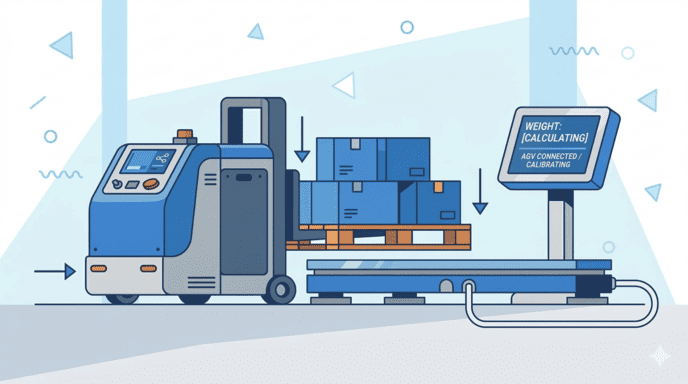
In our modern IoT era, your smart factory is only as good as your raw data. Automated warehousing systems depend completely on perfect data supply chains. In Mexico, busy operations managers move massive amounts of agricultural exports every day. They aggressively modernize their large facilities with automated data recording software. They want to eliminate human errors and rapidly speed up work. If an AGV drops a heavy grain pallet near the edge of a scale, the scale must still read the perfectly correct weight. A bad corner reading immediately sends wrong data directly to the main computer. The computer software will then halt the entire production line. A smart, high-precision scale always handles real-world off-center loading seamlessly. Flawless corner compensation guarantees pure data fidelity. It actively keeps the supply chain moving fast. You never have to worry about where the forklift drops the cargo. Exact data quickly builds complete trust in your digital warehouse system. You achieve pure operational efficiency.
Validating Data for Smart Factories
| Data Quality | System Reaction | Warehouse Operation |
|---|---|---|
| Raw Analog Error | Software flags bad inventory | Production line stops |
| Drifting Signal | Inconsistent tracking | Workers waste manual time |
| Flawless Digital Data | Perfect software integration | Full automated speed |
Conclusion
Mastering corner load calibration unlocks true scale precision. A rigid foundation and digital junction boxes guarantee exact measurements and clean data for your automated factory operations every single day.