














On this page

Weighbridge problems often begin with a drifting zero, jumping readings, or different weights for the same truck. I know these symptoms can quickly become shipment disputes and requests for replacement parts. My first response is a cost-ascending diagnosis: site and mechanics, wiring and power, indicator configuration, and only then load cells.
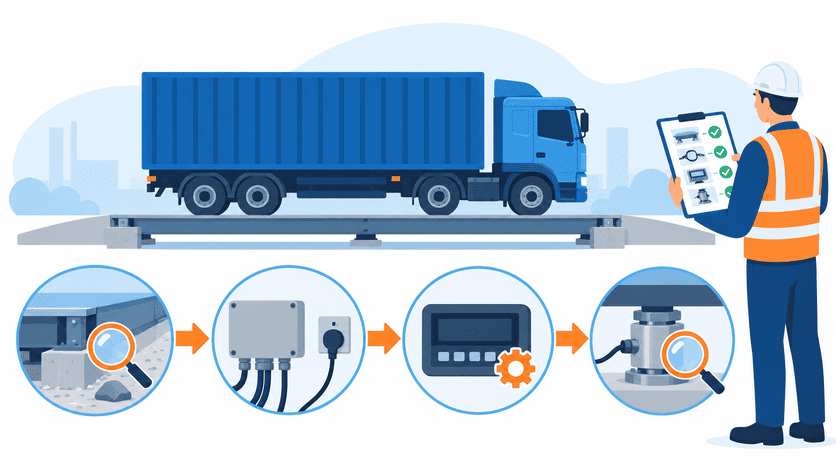
I troubleshoot common weighbridge problems in four stages: site and mechanical conditions first, wiring and power second, indicator settings third, and load cells last. I compare each symptom with documented observations before recommending action. This order helps buyers separate installation issues from equipment faults and avoid unnecessary component replacement.
I write from my manufacturer-side after-sales and selection role at HENER in Changzhou, drawing on the company’s stated 23 years in industrial weighing. I use the following framework to help dealers, maintenance teams, and project buyers decide what evidence they need before authorizing service or parts.
Why Do I Check Weighbridge Problems in Four Layers?
I understand why a customer suspects a load cell when a weighbridge becomes inaccurate. The sensor is the component most closely associated with weight measurement. However, I often see fault reports where environmental, electrical, or configuration problems imitate sensor failure and make early replacement an expensive distraction.
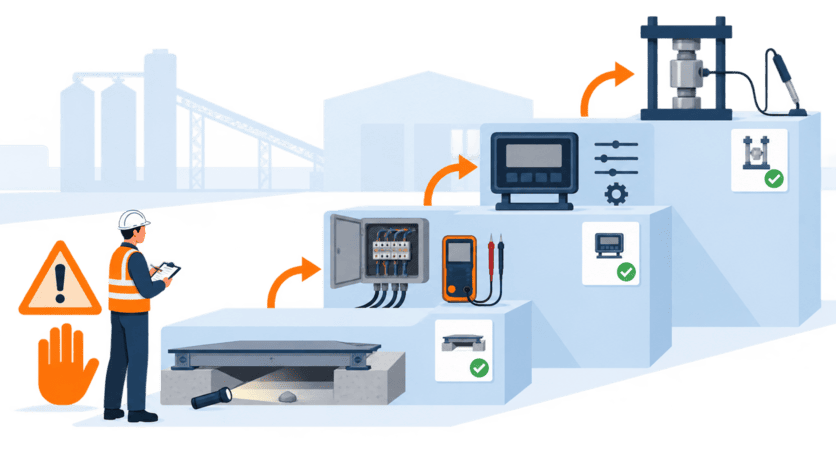
I investigate weighbridge problems from the least costly observations to the most specialized component tests. My sequence is site and mechanical conditions, wiring and power, indicator configuration, and load cells. Each stage must produce evidence before I move forward, although any immediate safety concern takes priority over this order.
Layer 1: I establish whether the deck can behave mechanically as intended
I first request photographs of the deck perimeter, approaches, accessible supports, pit condition, and check rods or stops. I look for debris bridging clearances, standing water, visible settlement, and signs that restraints remain in contact when they should not.
These observations change the next decision:
- Debris touching the deck: I request safe cleaning under the site’s isolation procedure, followed by a documented repeat test.
- Standing water: I request drainage assessment and inspection of potentially affected electrical components.
- Changed gaps or apparent settlement: I refer the foundation and support condition to a qualified local installer or civil professional.
- Binding restraints: I ask an authorized weighing technician to compare their condition with the installation drawings.
I do not recommend entering pits, reaching beneath a loaded deck, or adjusting restraints around vehicle traffic.
Layer 2: I investigate the signal path and its electrical environment
I next look for wet junction boxes, oxidized terminals, crushed cables, rodent damage, unstable supply conditions, and interference associated with nearby equipment.
A reading that jumps when a motor starts gives me a different investigation path from one that drifts after rain. Neither observation proves the cause, but both help a qualified technician choose meaningful electrical checks.
Layer 3: I compare settings with the approved configuration
I request the current indicator configuration and any earlier backup. I look for changed calibration values, capacity and division settings, zero-tracking settings, filtering, and communication or sensor configuration where applicable.
I preserve the existing record before anyone changes parameters. A factory reset can remove useful evidence and introduce additional errors.
Layer 4: I authorize targeted load cell evaluation
Only after the earlier layers are reasonably cleared do I request sensor-specific testing and consider replacement.
In the fault reports we handle, apparent sensor failures most often require investigation of the surrounding installation first. I regard jumping directly to layer four as the single most expensive troubleshooting mistake in the field. It adds parts, freight, labor, and downtime without establishing that the replacement will solve anything.
How Do I Map Common Weighbridge Problems to the Fastest Useful Checks?
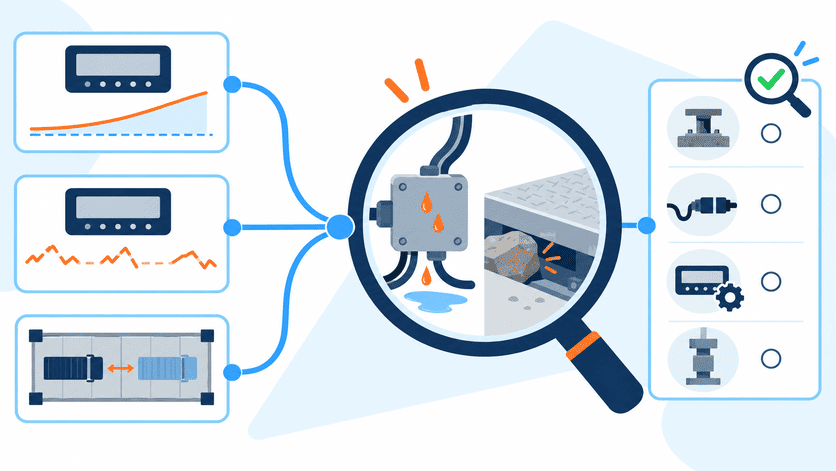
I often receive three descriptions: “the zero moves,” “the display jumps,” and “the truck weighs differently in another position.” These sound like separate failures. I treat them as different entry points into the same root-cause pool, because one wet connection or mechanical restriction can produce several symptoms.
I map weighbridge problems by ranking candidate causes within the four-layer sequence, then asking for observations that distinguish them. Drift directs my attention to binding, moisture, electrical stability, and zero settings. Missing or jumping readings emphasize connections and supply conditions. Position-dependent results emphasize supports, restraints, and channel consistency.
I use a symptom-to-evidence table
My rankings below describe the investigation order, not measured failure probabilities. I expect a qualified technician to perform electrical measurements and controlled loading tests.
| Symptom | Ranked candidate causes | Fastest useful observation | What I infer and request next |
|---|---|---|---|
| Drift or unstable return-to-zero | 1. Deck contact, debris, or changing support conditions | I request empty-deck readings before and after unloading, alongside photographs of accessible clearances. | A changed zero with visible contact supports a mechanical investigation before calibration. |
| Drift or unstable return-to-zero | 2. Moisture, damaged wiring, unstable supply, or interference | I compare the fault timeline with rain and nearby equipment operation. | A repeatable correlation directs a technician toward the relevant enclosure, cable, supply, or grounding checks. |
| Drift or unstable return-to-zero | 3. Altered zero tracking or calibration settings | I compare the current settings with the commissioning record. | A documented change supports controlled configuration review, not an arbitrary reset. |
| Drift or unstable return-to-zero | 4. Sensor instability | I request individual-channel stability tests after the earlier checks. | An isolated unstable channel needs cable, connection, mounting, and sensor separation tests before replacement. |
| No signal or jumping readings | 1. Mechanical interference or damage near supports | I request visible-condition photographs and the timing of any impact or site work. | Evidence of contact or damage requires local inspection before further weighing. |
| No signal or jumping readings | 2. Loose, wet, oxidized, or damaged connections; power disturbance | I request the exact display message and technician-recorded supply behavior during the fault. | A blank display, error code, and fluctuating weight require different investigations. |
| No signal or jumping readings | 3. Incorrect indicator or sensor configuration | I ask whether the symptom began after indicator replacement, servicing, or parameter changes. | A clear timing link makes configuration verification a priority after physical and electrical checks. |
| No signal or jumping readings | 4. Sensor or channel failure | I request controlled channel comparison using the manufacturer’s procedure. | A repeatable channel-specific anomaly justifies targeted component evaluation. |
| Different readings at different deck positions | 1. Settlement, binding restraints, debris, or uneven load transfer | I request a technician-led position test with a controlled reference load. | A repeatable position effect supports inspection of the associated supports and restraints. |
| Different readings at different deck positions | 2. Junction-box or cable inconsistency | I request inspection of the corresponding channel and its connections. | Moisture or corrosion can explain an apparent corner-adjustment problem. |
| Different readings at different deck positions | 3. Incorrect corner adjustment or configuration | I compare the present results with previous corner-test records. | A stable mechanical and electrical system may require authorized adjustment and verification. |
| Different readings at different deck positions | 4. Load cell or mounting defect | I request controlled output and mounting evaluation. | Persistent localized evidence may justify repair or replacement after other causes are excluded. |
I distinguish a truck comparison from a controlled test
I do not treat two ordinary truck tickets as proof of corner error. Fuel use, retained material, occupants, vehicle position, and incomplete positioning on the deck can change the comparison.
I ask the local weighing professional to define a controlled test with a suitable reference load and repeatable placement. I also ask for the empty-deck reading between loading steps, because poor zero return can make a position problem look worse than it is.
For legal-for-trade equipment, I leave approved test methods, acceptance limits, and return-to-service requirements to the responsible local metrology professional or authority.
Why Does Recalibration Fail to Solve Recurring Weighbridge Problems?
I become cautious when a report says, “We calibrated it again, and it worked for a few days.” A short-lived improvement can create false confidence. If the physical or electrical condition keeps changing, I expect the readings to move again, regardless of how carefully the latest calibration was performed.
I do not treat repeated recalibration as a repair for recurring weighbridge problems. Calibration relates the indication to a reference under defined conditions; it does not dry a junction box, stabilize a foundation, or correct grounding.1 When drift returns within days, I investigate the unresolved cause before authorizing another adjustment.
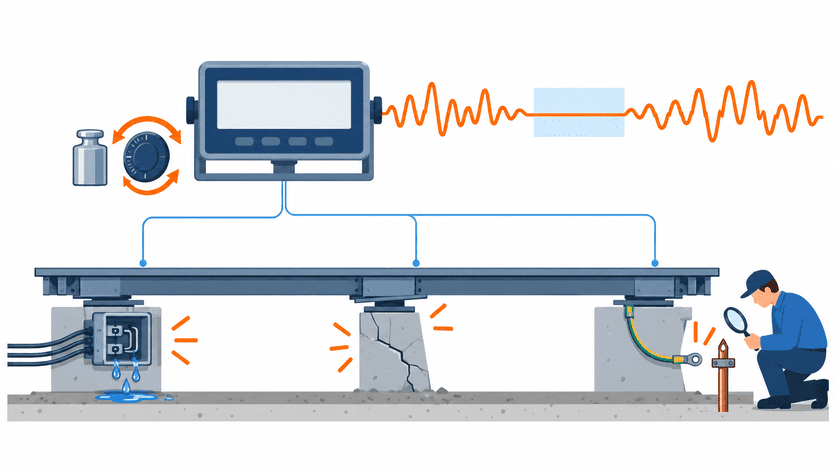
I separate calibration error from changing system behavior
A stable, repeatable offset and a reading that changes unpredictably are different problems. I may recommend authorized calibration when a sound installation produces consistent results that require correction. I do not recommend calibration as the first response to intermittent instability.
I use three examples when explaining the distinction:
- A wet junction box: I expect moisture-related leakage or connection problems to require enclosure and electrical assessment. A new calibration value cannot make the condition stable.
- A settling support: I expect changing load transfer to require mechanical and foundation evaluation. An adjustment made today may no longer represent tomorrow’s support conditions.
- An electrical disturbance: I expect supply, grounding, shielding, or interference checks to address the source. Filtering or calibration may only hide part of the behavior.
When drift returns within days, I treat that recurrence as evidence that calibration alone was not the solution. I do not assume it proves a single alternative cause.
I preserve the historical accuracy baseline
Repeated undocumented adjustments can erase the comparison that would have helped explain the fault.2 I therefore request:
- The original commissioning or verified calibration record.
- The readings immediately before each adjustment.
- The parameters changed and the person responsible.
- The reference loads and conditions used.
- The time between adjustment and recurrence.
I apply the same reasoning to corner error. A corner problem that returns after adjustment usually points me back toward support movement, check rods, restraints, or another changing condition—not automatically toward a defective load cell. I keep wiring faults in the investigation as well.
My rule is simple: I want the system stable before its calibration becomes meaningful. If transaction accuracy is in doubt, I recommend that the operator follow local requirements for restricting use, obtaining verification, and managing affected weight records.
What Eight Data Points Do I Need to Diagnose Weighbridge Problems Remotely?
I can do little with a message that says only, “The weighbridge is inaccurate.” Without a reference reading, operating conditions, or configuration history, every recommendation carries avoidable uncertainty. I use an eight-point reply checklist so the customer and supplier investigate the same evidence rather than exchange guesses.
I request eight data points for weighbridge problems: indicated versus reference weight; zero and loaded behavior; environmental timing; individual load cell outputs; insulation results; junction-box condition; supply and grounding status; and parameter-change history. Together, these usually help me classify the likely fault layer remotely, although they cannot replace necessary site testing.
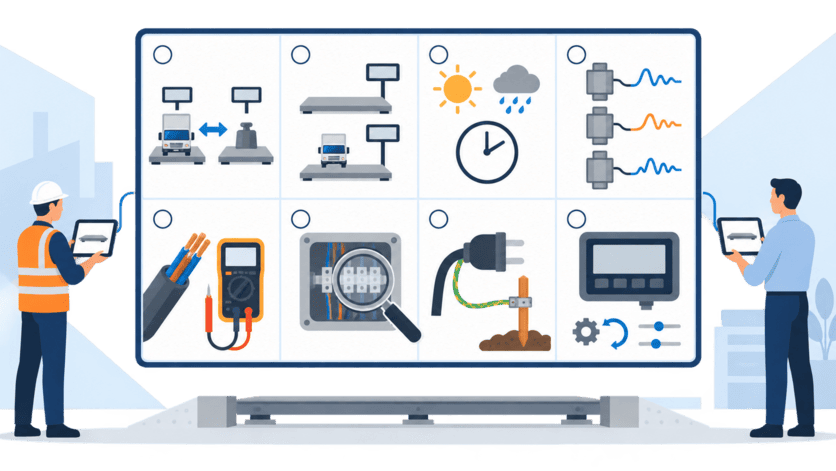
I use this checklist before recommending parts
| Data point | What I ask the customer or technician to provide | How I use it |
|---|---|---|
| 1. Indication versus reference | I request the exact displayed value, units, reference load, and the reference’s source or verification status. | I distinguish a documented discrepancy from a comparison with another unverified scale. |
| 2. Zero and loaded behavior | I request readings before loading, while the load remains stationary, after unloading, and during controlled position comparisons. | I separate zero-return, stability, repeatability, and position-dependent problems. |
| 3. Environmental timing | I request the relationship to rain, humidity, temperature, time of day, and nearby equipment operation. | I identify useful leads for moisture, thermal, mechanical, or electrical investigation. |
| 4. Individual load cell outputs | I request technician-recorded outputs, excitation conditions, load conditions, sensor models, and channel identities. | I look for channel-specific anomalies without assuming that every cell should carry the same load. |
| 5. Insulation resistance to ground | I request results from a qualified technician using the sensor manufacturer’s approved method and limits. | I assess possible insulation deterioration in the sensor or cable path. |
| 6. Junction-box interior condition | I request safely obtained photographs showing moisture, corrosion, glands, terminals, seals, and cable identification. | I connect visible condition with the affected channels and environmental timeline. |
| 7. Supply voltage and grounding status | I request recorded supply conditions during normal operation and during the fault, plus qualified inspection findings. | I evaluate whether power quality, bonding, grounding, or interference needs further attention. |
| 8. Parameter-change history | I request configuration backups and details of recent calibration, resets, indicator replacement, or setting changes. | I compare the fault’s onset with documented configuration changes. |
I interpret measurements in context
For analog strain-gauge load cells, I may request output normalized as [mV/V, meaning millivolts of signal per volt of excitation.](3">https://www.massload.com/what-is-mv-v-in-load-cells-an-introductory-guide/)3 I do not compare readings blindly: dead load, truck position, rated capacity, excitation, and mounting conditions affect interpretation.
A cell beneath a more heavily loaded part of the deck can legitimately produce a different output. I therefore ask the technician to follow the manufacturer’s controlled comparison method and verify expected behavior against the actual load cell datasheet. Digital systems require their own diagnostic tools and procedures.
I also avoid requesting an insulation test as an informal maintenance experiment. Some test voltages can damage connected indicators or electronics. I require qualified personnel to follow the manufacturer’s isolation instructions, permitted test voltage, and acceptance criteria.
With these eight data points, I can usually classify the likely root-cause layer remotely. Without them, everyone guesses. I still distinguish remote classification from a confirmed diagnosis and from authorization to return a trade scale to service.
Which Purchasing and Installation Decisions Reduce Future Weighbridge Faults?
I prefer discussing drainage, cable protection, and service access before a purchase order rather than after the first rainy-season complaint. These details can look minor beside deck size and capacity. In my after-sales work, they often determine how easily a team prevents, identifies, and repairs recurring faults.
I reduce future troubleshooting risk by specifying suitable enclosure sealing, protected cable routes, drainage responsibilities, grounding and surge-protection design, and documented factory testing. I also ask buyers to define installation and site-acceptance responsibilities. Factory calibration provides useful evidence, but it cannot establish the completed site’s performance on its own.
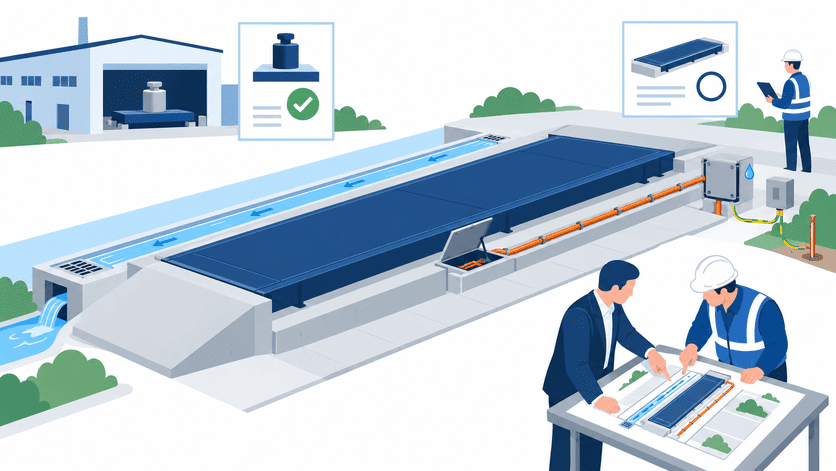
I connect each purchase requirement to a fault mechanism
| Procurement or installation decision | Fault mechanism I want to control | Evidence I request |
|---|---|---|
| Junction-box sealing and cable entries | Moisture can affect insulation and connections.4 | I request the exact enclosure specification, gland arrangement, installation instructions, and maintenance requirements. |
| Cable routing and protection | Crushing, abrasion, and rodents can damage the signal path. | I request route drawings, protective provisions, and accessible inspection points. |
| Pit drainage and service access | Accumulated water and inaccessible debris can prolong faults. | I request a locally qualified drainage assessment and a safe maintenance-access plan. |
| Grounding and surge protection | Electrical disturbances can affect readings or damage equipment. | I request a qualified design that follows equipment instructions and local electrical code. |
| Foundation and restraint arrangements | Settlement or binding can change load transfer.5 | I request supplier interface drawings and local professional approval of site-specific work. |
| Factory and site testing | Missing baseline evidence makes later disputes harder to resolve. | I request test records tied to the supplied configuration and an agreed site-acceptance plan. |
I do not accept “waterproof” as a complete specification. An IP rating applies to defined test conditions and the rated assembly.6 It does not promise unlimited immersion resistance or compensate for damaged seals and incorrectly installed glands.
HENER’s supplied business information states that selected core components and indicators are available with protection up to IP67. I ask buyers to verify the rating of each quoted component, rather than assume that the whole installed weighbridge has identical protection.
I separate factory-controlled quality from site-created conditions
According to HENER’s supplied manufacturing information, its quality process includes corner-error adjustment, multi-point calibration, overload testing, repeatability testing, and final inspection. I use these process facts to explain what buyers should request as documented evidence—not as a guarantee that transport and installation cannot affect performance.
Factory testing can help identify assembly, connection, adjustment, and repeatability issues under factory conditions. It cannot prevent future site settlement, damaged field cabling, blocked drainage, or unsuitable local electrical work.
I also tailor my procurement questions to recurring conditions described in regional fault reports. Dust and debris exposure at mining sites, high heat in Middle Eastern installations, and moisture in humid port environments prompt different questions. I do not treat those patterns as measured failure rates or assume that every site in a region behaves alike.
I ask buyers to verify any relevant quality-system certificates, conformity documents, and legal-metrology approvals against the actual model, configuration, intended use, and destination market.
Frequently Asked Questions
How do I know whether a weighbridge load cell needs replacement?
I consider replacement only after mechanical restrictions, cabling, supply conditions, and indicator settings have been investigated. I then look for repeatable sensor-specific evidence from manufacturer-approved tests. An abnormal channel does not automatically prove sensor failure, because its cable, connections, mounting, or load distribution may explain the result.
Why does my weighbridge become inaccurate after rain?
I first suspect moisture exposure, but I do not assume the junction box is the only cause. I request drainage observations, enclosure photographs, and qualified electrical checks. Rain-related timing is a useful clue; I still need evidence to distinguish wet connections, cable insulation problems, and changing mechanical conditions.
Can I use the same truck to check corner error?
I treat the same truck as a possible screening tool only under a controlled procedure defined by a qualified weighing professional. I need consistent loading, positioning, and zero-return records. Ordinary truck tickets alone cannot establish corner error or replace the approved verification required for legal-for-trade use.7
Should I change zero tracking to stop a drifting display?
I do not recommend changing zero tracking simply to suppress visible drift. An unsuitable setting can conceal evidence without correcting the cause. I first investigate mechanical, environmental, and electrical stability, then ask an authorized technician to verify the settings against the instrument documentation and applicable metrology requirements.
Conclusion
I approach weighbridge problems as an evidence problem before a spare-parts problem. My sequence stays consistent: site and mechanics, wiring and power, indicator configuration, and finally load cells. I preserve readings and settings before adjustment, and I use the eight-point fault report to guide the next decision. I leave site-specific engineering and legal verification to qualified local professionals. For a supplier-side review, I invite you to share your fault report or project requirements with HENER so we can discuss the evidence, responsibilities, and appropriate next steps.
References
- Using corrections to compensate systematic errors in measuring ...
- [PDF] Calibration and Calibration Verification - CMS
- What Is mV/V in Load Cells? An Introductory Guide
- Inexpensive electrical connector is moisture and corrosion-proof
- [PDF] Bridge Safety Standards for the Sandersville Railroad
- IP code - Wikipedia
- Consolidated code of practice: enforcement weighing of vehicles